How to Find and Recover Your Escaped Parrot, Step by Step
Most escaped parrots land within a mile of home, but the first 60 minutes are everything; here's the exact playbook that brings birds like Mango back safely.
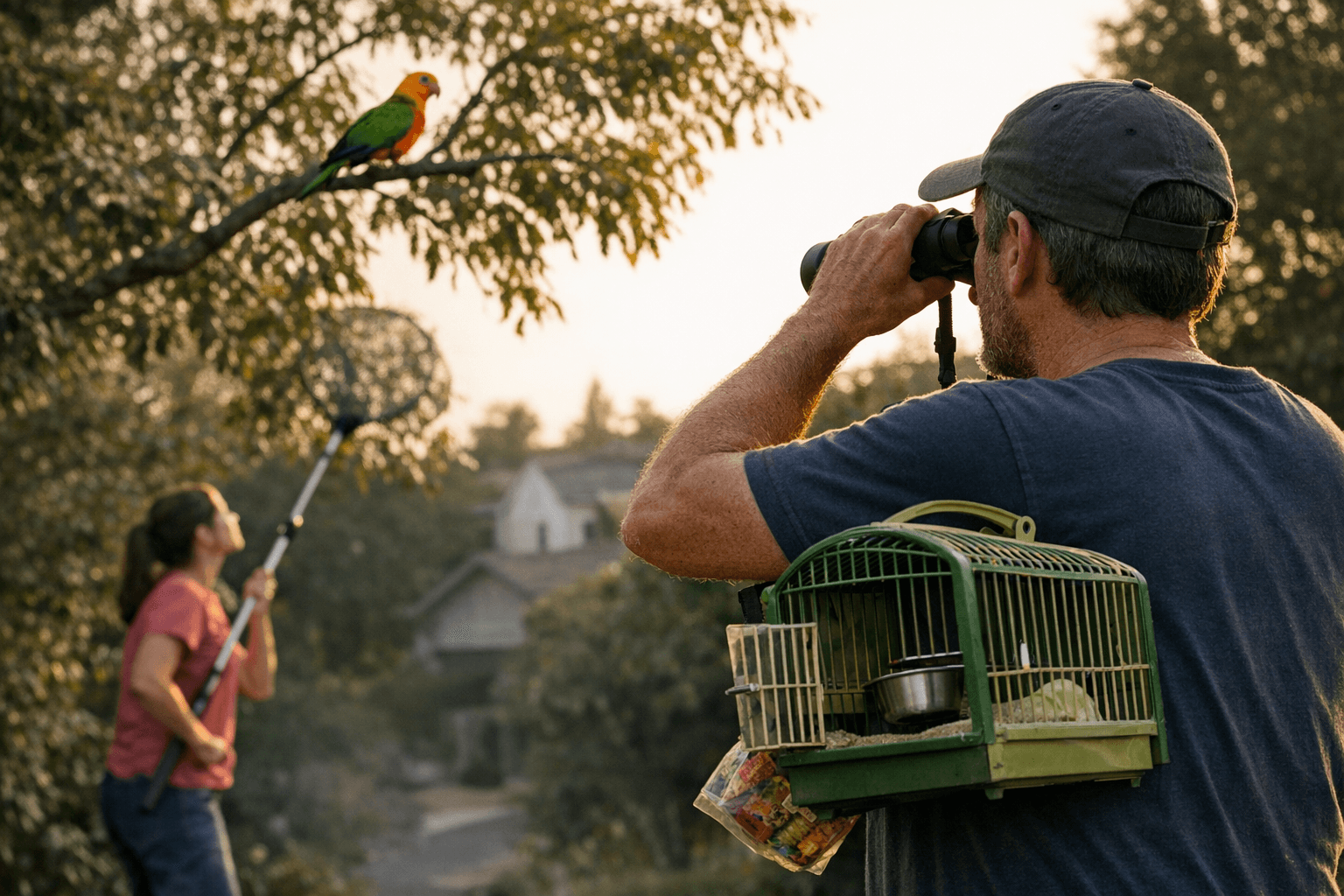
Picture this: Diane Torres steps onto her back porch to refill a water dish, and in the three seconds she glances down, her green-cheeked conure Mango slips past her shoulder and vanishes into the oak tree line behind the house. Her stomach drops. What she does in the next hour will determine whether Mango comes home tonight or begins a days-long ordeal. This guide is built around that sixty-minute window and everything that follows it.
The Reassuring Truth You Need to Hear First
Most parrots keep within a mile radius of home when they escape, unless they've been chased further away by other birds, through fright, or caught in strong winds. That is the single most important fact to hold onto when panic sets in. A parrot can fly around 30 miles per day, and some have been recovered 50 miles from their home, but the overwhelming majority of pet parrots, especially tame ones, don't want to be far from their flock. You are their flock. That instinct is your most powerful recovery tool.
The First 60 Minutes: Diane's Playbook
The moment Mango disappears, the worst thing Diane can do is run toward the tree line screaming his name. Loud, frantic movement signals danger and drives a disoriented bird further away. Instead, the first action is to freeze, watch, and note the exact direction of flight. Keep visual contact as long as possible.
Next, send one calm person to retrieve three things: the bird's cage (with familiar perches and bedding inside), a container of Mango's absolute favorite food (in his case, chopped mango and pine nuts), and a portable speaker loaded with audio recordings of Mango's own vocalizations. These three items form the core of every luring attempt.
Take the bird's cage outside when searching, and arm yourself with the parrot's favorite treats. Position the open cage at the base of the last tree where the bird was spotted. The familiar smell and sight of home is a powerful draw for a stressed bird seeking comfort.
Work the Dusk and Dawn Windows
Birds naturally seek shelter at dusk or dawn, and these times are prime for their return. If Mango hasn't come down by mid-afternoon, don't waste energy in the midday heat. Consolidate your lure stations, make sure the cage is visible and stocked, and prepare for the two critical windows: the hour before dark and the first grey light of morning. These are the moments when a frightened parrot is most likely to call out, fly down, and accept comfort. Plan to be in position with your speaker and food lure before either window opens.
For the dawn search especially, you need to be back out with your bird before dawn so you're already in place when the bird wakes up and begins vocalizing. A disoriented parrot calling at sunrise can be pinpointed quickly if a search team is already spread across the search zone listening.
Sound and Food: The Counterintuitive Lures That Work
Playing Mango's own recorded vocalizations from a phone or portable speaker does two things: it signals safety to him and it tells you exactly where he is when he calls back. Household sounds he knows, a running tap, a television program he hears daily, or even a phrase he's been taught, can trigger a vocal response from a hiding bird. Playing parrot sounds on a cell phone, either recorded by the owner or downloaded from the internet, is a recognized technique for drawing a bird back.
Food-based lure stations should be set up in open, visible spots rather than tucked under cover. Bright-colored perches alongside favorite foods make the station visible from above, which is how Mango sees the world right now. If you know a companion bird or a bird whose calls your parrot responds to, playing flock sounds, the calls of other conures or the specific species, can trigger a powerful homing response that a lone, frightened bird can't resist.
The Social Media Blitz: Do It Now, Not Tomorrow
While one person manages the lure stations, a second person should be posting within the first thirty minutes. The reporting structure matters:
- Post a clear, recent photo and a short description (species, color, any identifying marks, the neighborhood name) to local Facebook parrot groups, your neighborhood app, and the official 911 Parrot Alert network, which covers the US and Canada and connects with regional state groups.
- Enter a report in the 911 Parrot Alert database and also post on Nextdoor, the lost and found section of Craigslist, neighborhood Facebook pages, bird owner Facebook groups, and other lost and found social media sites.
- Register with Lost & Found Birds Worldwide on Facebook and place flyers at local veterinarian offices and pet stores.
- Contact nearby bird rescues and avian vets directly with a photo. Staff members encounter found birds regularly and a phone call is faster than a flyer.
Targeted posts to parrot-specific groups outperform generic lost-pet boards because parrot owners know what they're looking at. Someone who keeps Amazons will recognize a green-cheeked conure faster than a dog-rescue volunteer will.
SHAREABLE MINI-POSTER: Screenshot and Send to Neighbors
🦜 LOST PARROT IN THIS NEIGHBORHOOD > Name: MANGO | Green-cheeked conure | Bright green with red belly > Last seen: [Your street name], [Date], [Time] > Responds to his name and whistles back > DO NOT CHASE. Stay still, speak softly, call (Your number) > Photo: [Attach clearest photo] > Report sightings to: 911 Parrot Alert + (Your number)
Coordinate Volunteers and Canvass on Foot
Search on foot or bicycle in concentric circles from the point where the bird was last seen, keeping the direction of flight in mind. Your bird is most likely within one-half to two miles. Divide the search zone among volunteers so that multiple people can listen simultaneously. One person calling the bird's name while moving is far less effective than three people stationed quietly at intervals, each holding food and waiting.
Printed flyers should go up within the first two to three hours. Prioritize vet clinics, pet stores, feed stores, and community bulletin boards near parks or green spaces where a bird might land. Include a photo, the neighborhood name, and a single phone number.
Bring in the Professionals
If Mango is spotted but won't come down, this is the moment to call in an experienced bird trainer or local rescue. Experienced rescuers often have protocols and equipment including mist nets and perch lures designed to safely recover a bird without causing the bird to bolt. Attempting to net a bird without experience frequently results in injury or simply driving it further away.
Trail cameras positioned near lure stations can confirm overnight visits even when nobody is present. Drone footage, where local regulations allow, helps survey tree canopies and rooftops that foot searchers cannot easily see.
Check local shelters daily, as their stray hold period is only three to seven days or less. A found bird can pass through animal control quickly if nobody checks in time.
Build Your Emergency Kit Before You Need It
The owners who recover their parrots fastest are almost always the ones who were prepared before the escape happened. A basic emergency kit lives by the front door: a container of the bird's single most-loved food, a printed recent photo, a USB drive with audio recordings of the bird's voice, and a list of local rescue contacts and the 911 Parrot Alert number.
Microchipping, leg bands with legible ID, and wing-tagging all increase the odds that a found bird is matched back to its owner quickly. Keep your microchip registration current and photograph your bird monthly to ensure you have a sharp, recent image ready.
The birds that come home are the ones whose owners stayed calm, planted the right lures in the right places at the right hours, and got the word out immediately to the people most likely to recognize them. Mango's best chance has always been Diane standing quietly at the tree line at first light, a bowl of pine nuts in her hand, playing his own voice back to him through a phone speaker. That combination of patience, timing, and the right lure has brought home countless parrots that seemed gone for good.
This article was produced by Prism’s automated news system from verified source data, official records, and press releases, then run through automated quality and moderation checks before publishing. The system is built and supervised by the people who set the standards it runs under. Read our full AI policy.
Did this article answer your question?