Monk Parakeet Nests Threaten Long Island Utility Poles, Raise Fire Risks
A monk parakeet colony in Lindenhurst built stick nests so large they can top 10 feet across, putting Long Island utility poles at risk.
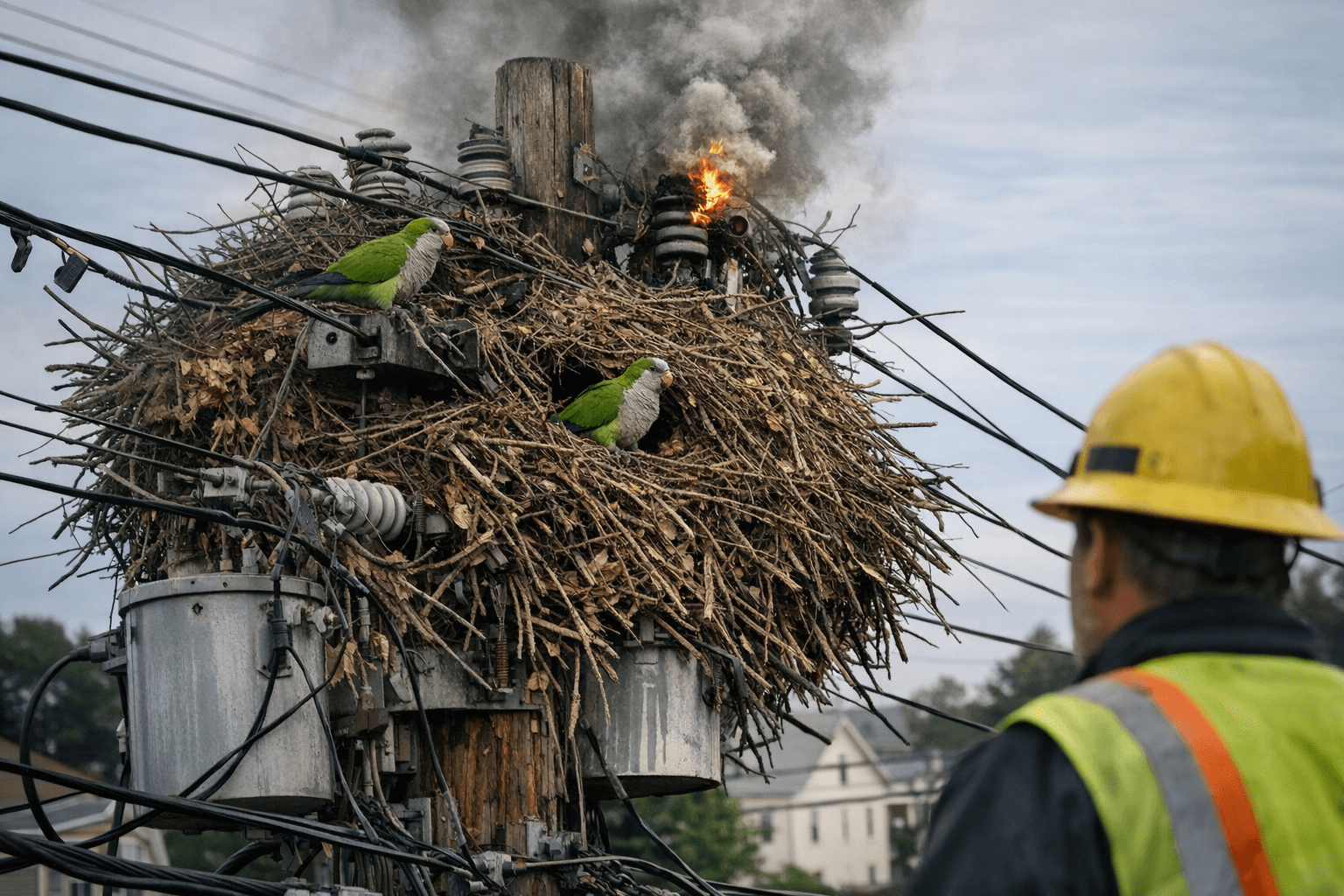
The monk parakeets along Montauk Highway in Lindenhurst have turned a roadside utility line into a public safety problem. Their communal stick nests can grow to about 10 feet in diameter and weigh hundreds of pounds, enough to crowd poles, wires and other equipment on Long Island and raise concerns about outages, fire risk and damage during routine work.
That scale is what makes monk parakeets so unusual. Cornell Lab of Ornithology says they are the only parrot species known to build stick nests and nest communally, with dozens living together year-round in large, multifamily structures. Audubon describes the species the same way: these birds do not just breed in the nests, they also use them as sleeping shelters through the year. For parrot owners used to seeing companion birds in cages, play stands or backyard aviaries, the monk parakeet’s engineering is a different kind of adaptation entirely.
PSEG Long Island says crews may need to remove the nests during restoration efforts, emergency repairs or routine maintenance to prevent outages, fires and equipment damage. The utility says it uses a four-stage relocation process and asks the public to report birds building on poles, wires or utility structures. When eggs or young birds are found during nest work, PSEG says they are brought to a sanctuary. The company says it must keep electric service safe and reliable around the clock while still trying to minimize disruption to wildlife.
The birds also carry a long and tangled New York story. Monk parakeets are native to South America, but their presence in the region is tied to a legend about escaped birds from a damaged shipping crate at John F. Kennedy Airport in the 1960s. Audubon says the details are murky, with accounts placing the escape in 1968, 1969 or the early 1970s. However they arrived, the birds spread, adapted and became part of the landscape, even as they remained controversial.
That tension has reached Albany more than once. New York lawmakers introduced monk parakeet protection bills in 2013, 2015 and 2021, while a 2015 New York State Senate memo estimated fewer than 1,000 wild monk parakeets in the state. New York’s invasive-species framework defines invasive species as non-native species that can cause economic, environmental or human-health harm, which explains why the birds are managed as both a wildlife story and an infrastructure threat. For Long Island, the consequence is clear: one highly adaptable parrot can become a local power problem when it chooses the wrong pole.
This article was produced by Prism’s automated news system from verified source data, official records, and press releases, then run through automated quality and moderation checks before publishing. The system is built and supervised by the people who set the standards it runs under. Read our full AI policy.
Did this article answer your question?