New Parrot Owners Guide: Nutrition, Cage Setup, Enrichment, and Vet Care
Most new parrot owners don't realize a seed-only diet causes liver damage, or that their bird needs 10-12 hours of sleep a night. Here's what actually matters.
Most people walk into parrot ownership focused on the bird's personality. The reality check hits fast: parrots have layered, non-negotiable physical and psychological needs that go well beyond a cage and a handful of seeds. Get the fundamentals right from day one, and you'll have a thriving companion. Get them wrong, and you'll spend years undoing the damage.
Know Your Species Before You Commit
Birds are prey species, which means they will attempt to hide all signs of disease until they can no longer do so. That instinct to mask vulnerability starts at the species level too. Unlike mammals that usually act sick when they feel bad, birds try very hard to hide their illness. In the wild, an ill or injured bird would attract the attention of predators, thereby endangering the whole flock. Understanding this is foundational, because it shapes everything from how you read your bird's behavior to when you call the vet.
Before you even bring a bird home, understand the scale of variation you're dealing with. The World Parrot Trust has identified specific, species-level differences that matter enormously for captive care. According to the Parrot Encyclopedia, physical requirements, diet, and exercise differ for each of the 220 or so species of parrots kept in captivity. Even within species groups, individuality matters: what one Orange-winged Amazon likes, another may not. Cockatoos, Amazons, conures, and macaws each present different husbandry demands. Do your species-specific research before you commit.
Nutrition: Pellets First, Fresh Foods Second, Seeds Last
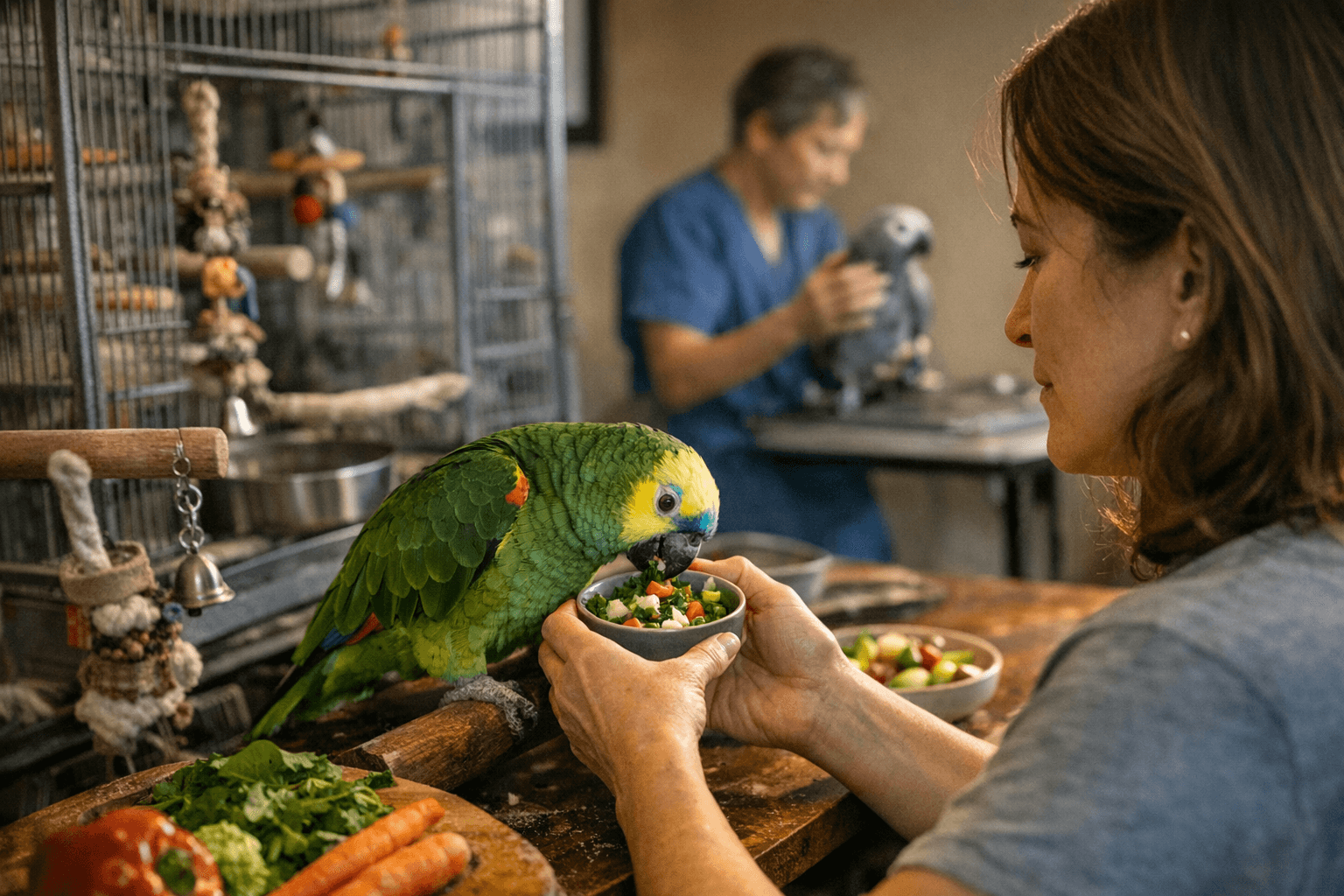
Diet is the single biggest lever on your bird's long-term health. A diet based only on seeds can lead to malnutrition, obesity, and liver problems. This is one of the most common mistakes new owners make, because seed mixes look natural and birds often prefer them enthusiastically. That preference is not a health signal.
A properly balanced parrot diet is pellet-forward, supplemented with safe fresh foods. The specific components to rotate in:
- Fresh vegetables like kale, carrots, and bell peppers
- Fruits like apples and blueberries, served moderately
- Grains and sprouts
- Quality pellets as the dietary foundation
- Seeds and nuts, treated as occasional treats only
Allowing parrots to get spoiled on seeds or a favorite food item prevents them from getting all the nutrition they need to stay healthy. While they don't eat dairy or meat products, they do enjoy a variety of fruits, vegetables, and pellets designed specifically for parrots. Without a proper diet, a captive parrot is prone to disease and nutrient deficiency. Start right and don't let convenience or the bird's lobbying convince you to cut corners on this.
Cage Size, Layout, and Safety
The cage is your bird's primary territory, and it needs to be as large as practically possible. The Parrot Encyclopedia is explicit on this point: provide the largest cage or aviary possible. The logic is behavioral. Parrots are highly intelligent and active animals. In the wild, their days are routinely spent travelling to and from feeding areas to forage and, during the breeding season, engage in courtship displays and mating. A smaller cage doesn't reduce those urges; it just removes any outlet for them.
Inside the cage, perch selection matters more than most new owners expect. Not all perches are created equal, and foot and joint health depends directly on the variety and texture your bird stands on. The most effective options are natural wood perches (like manzanita, dragonwood, or cholla) and rope perches for climbing and flexibility. Nail wear can be facilitated by having the bird walk on a variety of surfaces, or possibly by placing a coarse-surfaced perch, such as a cement perch, in the cage. Varying perch diameter across different spots in the cage ensures foot muscles don't fatigue from holding the same position all day.
On safety: toxic houseplants are a genuine hazard, and the fewer in the house, the better. Learn which common houseplants are known to be toxic to parrots before your bird ever has free-roam time. If possible, set up a dedicated play area outside the cage, a parrot gym or a stand where the bird can climb, play, and vocalize safely, away from household hazards. And the non-negotiable rule: a parrot should never be left out of its cage or enclosure unattended. Ever.
Environmental Enrichment and Exercise
A parrot in captivity will have the urge to forage, explore, and interact, but will not be able to do so naturally. So it is up to you to provide an outlet to expend that energy, through environmental enrichment or playing with toys. This isn't optional enrichment for an already-happy bird; it's the baseline requirement for psychological health.
The most effective approach is providing safe, complex toys for the parrot to work on and climb all over, combined with other visual or auditory stimulation. Rotate toys regularly so novelty is maintained. For a mentally healthy and stimulated parrot, handle your pet and let it out of its cage at least once daily. As birds are naturally curious about noises, you can leave a quietly playing radio or television on for them and see which music they respond to. Foraging toys that require the bird to work for its food are particularly effective because they replicate one of the most time-consuming wild behaviors.
Managing Noise: What Excessive Screaming Actually Means
Parrots are naturally vocal animals. Every owner needs to accept a baseline level of noise as normal and non-negotiable. What you watch for is the pattern change. Excessive screaming often signals boredom, stress, or a need for attention. Managing your bird's environment, offering enrichment toys, and maintaining a predictable routine can help reduce unwanted screaming.
The level of noise depends on the species of parrot and its upbringing. Parrots can often be quite loud, and sometimes even scream for attention or fun. Sometimes they make noise depending on the time of day. Many times the larger the parrot, the louder the noise they make, which is why they are unsuitable for most apartment settings. Know what you're getting into at the species level before you're surprised by volume.
Sleep: The 10-12 Hour Rule
Sleep is a critical part of parrot care that gets routinely underestimated. Parrots require 10-12 hours of uninterrupted, restful sleep each night. Using a sleep cage or covering the cage in a quiet, dark room can promote better emotional balance and health. A bird kept in a bright living room until midnight and then expected to be well-adjusted in the morning is a bird being set up to fail behaviorally. Chronic sleep deprivation contributes to screaming, aggression, and stress. Treat the sleep schedule like a hard commitment.
Grooming Basics
Birds, just like dogs and cats, need regular grooming to stay healthy and safe. While wild birds use their flight feathers to get around and keep their nails worn down by landing on rough branches and rocks, pet birds in cages don't have these experiences. Thus, pet birds often develop overgrown nails and may become injured while flying indoors.
The three grooming fundamentals for parrots are bathing, nail maintenance, and beak monitoring:
- Bathing: Avian veterinarian guidance often includes offering a shallow bathing dish or warm water spray two to three times weekly. Never add chemicals to your bird's bath water unless instructed to do so by an avian veterinarian. Never let the bird go to bed wet.
- Nail trimming: Given most pet birds' lack of activity compared to their wild counterparts, nails typically grow fast and require trimming every few months. When nails become too long, perching is uncomfortable and may lead to more serious foot problems. Long sharp nails are also uncomfortable when the bird perches on bare skin, and may become snagged in toys, clothing, or on a cage, resulting in serious leg or foot injuries. If you're new to this, have your avian vet demonstrate the correct technique before attempting it at home.
- Beak care: Beaks should never be trimmed at home and should be done by a professional vet. Beaks do not require routine trimming; if the bird's beak is overgrown, it requires vet care. Beak conditioning is supported with bird-safe and chewable toys, helping with beak shaping and preventing beak overgrowth.
When to See an Avian Vet
Establish a relationship with an avian veterinarian as soon as you welcome your new bird into your home. When you acquire a new bird, it is a good idea to get it checked over by an avian vet, who can advise on husbandry and diet, as well as checking for latent disease problems. Don't wait for a crisis to find out who your avian vet is.
The Parrot Encyclopedia lists the following as signs that may indicate your parrot is ill:
- The bird is lethargic or less active than usual
- It may not be hungry
- It may not be thirsty
- It may sit hunched over, feathers puffed out
- It may sit on the floor of the cage and not move
- It exhibits a drastic change in behaviour
Birds are prey species, which means they will attempt to hide all signs of disease until they can no longer do so. Therefore, any signs of illness should be investigated carefully. When a sick bird or parrot injury occurs, it is critical to act fast because birds can decompensate very quickly due to their high metabolism and small stature.
More obvious signs like a change in the colour or consistency of droppings, discharge from nostrils or eyes, vomiting, or wheezing should be immediate calls for alarm. Annual checkups are recommended so the veterinarian can get to know your bird and establish what's normal for them. If your veterinarian isn't open 24/7, you should certainly be aware of a local facility near you that can treat your bird on an emergency basis.
The through-line across all of this: parrots are not low-maintenance pets dressed up in colorful feathers. They are intelligent, social, and physiologically demanding animals. Nail the nutrition, give them space and enrichment, protect their sleep, and build the vet relationship before you need it. That's the foundation everything else is built on.
This article was produced by Prism’s automated news system from verified source data, official records, and press releases, then run through automated quality and moderation checks before publishing. The system is built and supervised by the people who set the standards it runs under. Read our full AI policy.
Did this article answer your question?