US authorities return 11 white-fronted parrots to Mexico after border seizure
U.S. Fish and Wildlife Service agents seized 11 white-fronted parrots hidden in a private vehicle at the Córdova–Las Américas bridge; PROFEPA took custody and five chicks need veterinary care.
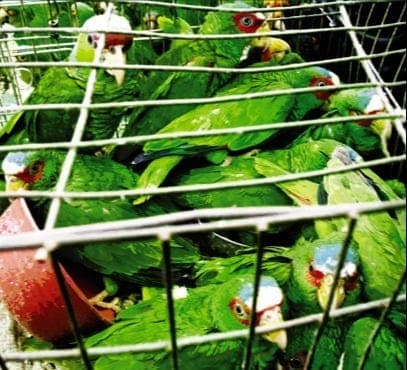
U.S. Fish and Wildlife Service agents intercepted 11 white-fronted parrots (Amazona albifrons) concealed in a private vehicle attempting to cross into the United States at the Córdova–Las Américas International Bridge, the crossing that links Ciudad Juárez, Chihuahua with El Paso, Texas. The shipment was returned to Mexico’s Federal Attorney for Environmental Protection, PROFEPA, after the seizure and transfer, and Mexican officials formally received the birds.
The detention tied to the seizure occurred on Feb. 10 when a U.S. citizen was detained at the inspection lane; the individual remains under investigation and was placed at the disposal of U.S. authorities. U.S. law enforcement identified the parrots during the border inspection and notified Mexican counterparts before transferring custody to PROFEPA for veterinary assessment and further legal disposition.
PROFEPA’s initial medical evaluation classified the 11 specimens as hatchlings roughly 2 to 6 weeks old and described them as highly dependent. Five of the parrots presented respiratory and digestive complications and were placed under veterinary care; PROFEPA said final disposition of the birds will be determined in line with Mexican wildlife protection regulations once they have recovered.
U.S. authorities initially presumed the parrots originated in Ciudad Juárez, and Mexican investigators noted that Ciudad Juárez is a common route for wildlife trafficking into the illegal market across the border. The birds had been hidden inside the private vehicle during the attempted crossing at the puente known variously as Puente Internacional Córdova, Cordova International Bridge, or Bridge of the Americas.

Under Mexican law the white-fronted parrot is listed under special protection in NOM-059-SEMARNAT-2010, and Article 60 Bis 2 of Mexico’s General Wildlife Law prohibits extractive use of any native psittacine species for subsistence or commercial purposes. Mexican authorities and U.S. Fish and Wildlife Service framed the transfer as part of ongoing binational cooperation to combat wildlife trafficking.
Advocacy groups monitoring illegal parrot trade have urged stepped-up enforcement at the border. Defenders recommends “increased enforcement efforts by U.S. Fish and Wildlife Service Law Enforcement agents to reduce the illegal trade, especially for the orange fronted parakeet (Aratinga canicularis), white fronted parrot (Amazona albifrons), yellow cheeked parrot (Amazona autumnalis), lilac crowned parrot (Amazona finschi) and red crowned parrot (Amazona viridigenalis), for which smuggling across the border appears to be increasing, thus is a continuing threat to the species’ survival.” Defenders also notes historical trapping records from 1979 to 2005 showing Aratinga canicularis and Amazona albifrons were legally trapped for 23 years and Amazona autumnalis for 19 years, and that those species rank among the top seized in Mexico.
Mexican authorities pointed to recent binational conservation work as precedent, citing the September 2025 reintroduction of two California condor chicks into the Sierra de San Pedro Mártir under the Binational Program for the Recovery and Conservation of the California Condor. For the white-fronted parrots returned after the Feb. 10 seizure, PROFEPA will name the facility caring for the chicks and determine rehabilitation or other legal disposition once the veterinary team clears the birds to move.
Know something we missed? Have a correction or additional information?
Submit a Tip
