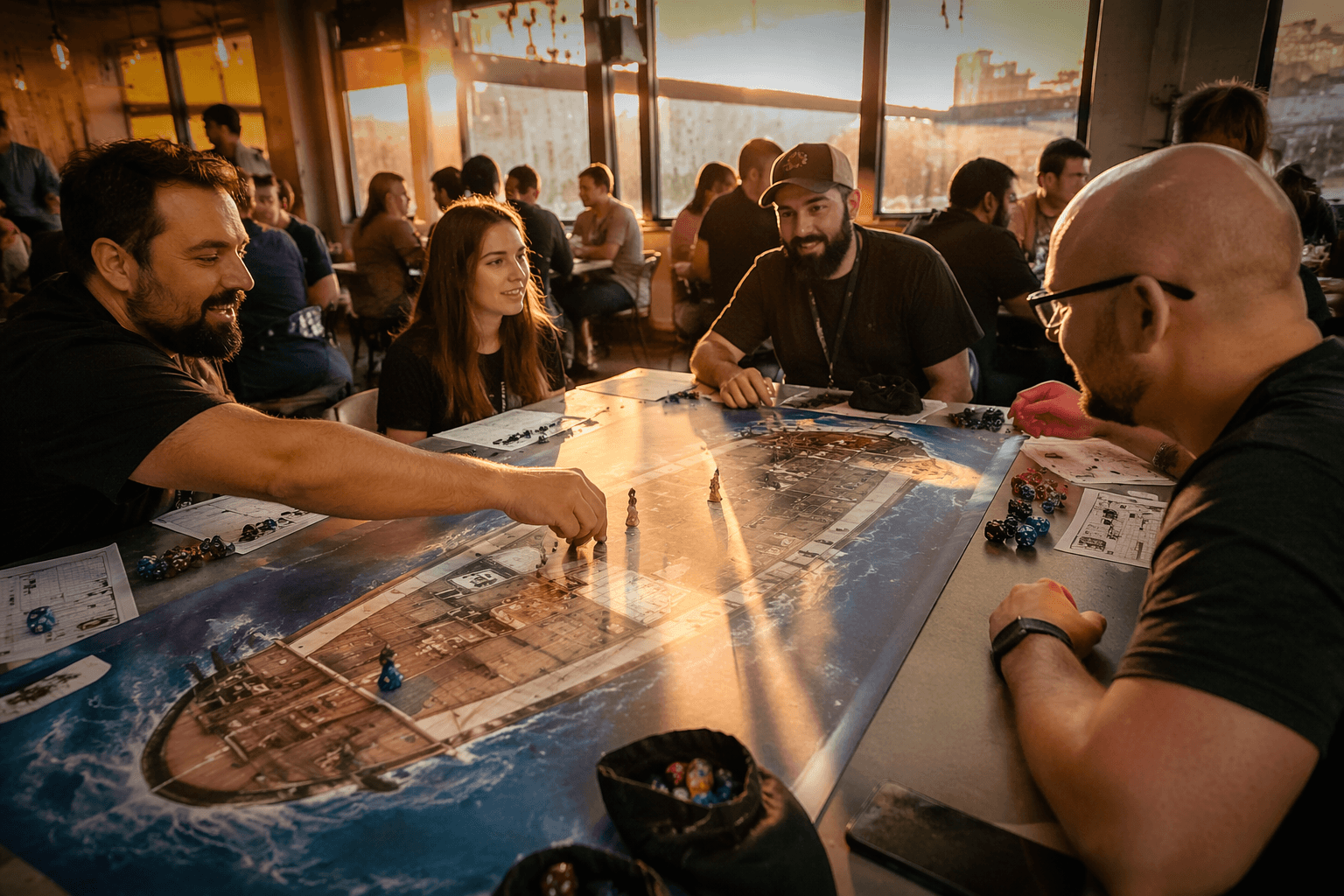
Pathfinder Society offers a portable, persistent campaign for players
Pathfinder Society solves the hardest part of learning Pathfinder: you can keep the same character, keep earning rewards, and move from table to table without losing your place.
Pathfinder Society gives you a place to start Pathfinder without betting your whole hobby life on one fixed group. The campaign is built so your character keeps advancing even if the GM changes, the table changes, or the convention hall is on the other side of the country. That portability is the whole trick: you bring one character, one set of earned rewards, and one ongoing story into a worldwide organized-play network.
A campaign that moves with you
Paizo describes Pathfinder Society as a worldwide fantasy roleplaying campaign using the Pathfinder Second Edition ruleset, and it treats organized play as a living campaign rather than a sealed-off club. In practice, that means the same character can travel with you to local gaming stores, conventions, and online games, instead of being trapped in a single home campaign with one GM and one calendar. Paizo says players can take their character to any Pathfinder or Starfinder Society game worldwide, which makes the structure unusually flexible for a hobby that often depends on stable groups.
That flexibility is what makes Society such a clean entry point. Home campaigns can be wonderful, but they usually require the right schedule, the right group, and a GM willing to carry a long story. Pathfinder Society lowers that barrier by giving you a shared framework that already knows how characters enter, earn rewards, and keep moving.
How a session fits into real life
The campaign is built around short formats that let you sample Pathfinder without signing up for a months-long commitment. Paizo breaks play into Scenarios, which run about 4 to 5 hours and carry the main plotline, Quests, which are 2 to 3 hour adventures, and Bounties, which are roughly one-hour side jobs. That range matters because it lets you choose the size of the bite you can actually finish, whether you have a long convention slot or just an evening to spare.
For newcomers, that structure removes one of the biggest points of friction in tabletop RPGs: the fear that you need to know everything before you begin. A one-hour Bounty can teach you how Society feels at the table. A Quest gives you a quicker taste of the setting and the rules. A full Scenario gives you the classic organized-play experience without asking you to commit to an open-ended home campaign first.
Getting your first character on the table
Paizo makes the onboarding path very direct. Current organized-play resources offer free 1st-level pregenerated characters, and Paizo’s materials also note pregens at 4th and 7th level. The campaign supports blank character sheets and a character-creation guide, so you can either learn the system through a ready-made character or build your own from the start.
For players who want to make a custom hero, Pathfinder Society generally allows content from the rulebooks while still reviewing options for balance and public-play suitability. That balance is part of what keeps Society usable across many tables: everyone is building inside the same shared rules environment, even when they are sitting with different GMs and different groups. The Pathfinder Remaster has also been folded into the campaign’s current rules ecosystem, which shows that this is an actively maintained program, not a legacy side mode.
- Grab a level 1 pregenerated character if you want to learn by playing.
- Read the character-creation guide if you want to build your own.
- Pick a Quest, Bounty, or Scenario that matches the time you have.
- Show up ready to log the results on your Chronicle Sheet.
A simple first-step path usually looks like this:
Why Society characters keep growing
The key difference between Society and a one-shot is the record-keeping. After each adventure, players receive a Chronicle Sheet that summarizes the session and tracks rewards. Paizo says these sheets usually record experience points, gold, and Reputation, so your character’s progress is preserved even when you move between tables.
That Reputation system gives Society its persistent feel. Current tiers are Ignored at 0 to 19, Liked at 20 to 59, Admired at 60 to 119, and Revered at 120 and up. Major infractions can earn Infamy instead of negative Reputation, which gives the campaign a formal way to track misconduct without pretending it is the same thing as ordinary progress. Some reward boons are tied to total faction Reputation, while others are earned through Achievement Points, so there are multiple paths to getting more out of a character over time.
That structure means your Society character is not just a convention pregen you hand back at the end of the night. It is a long-term campaign identity that carries experience, treasure, and earned standing from table to table.
The campaign behind the curtain
Pathfinder Society has its own history, and that history helps explain why the system feels so established. Paizo says its first organized-play foray premiered at Gen Con in 2008, and the first year was dubbed Season Zero because it functioned like an open playtest. Pathfinder Society First Edition then ran from 2008 to 2019, with hundreds of adventures built for that version of the campaign.
When Pathfinder Second Edition launched in August 2019, Paizo rebooted Pathfinder Society to match the new ruleset. That reset kept the campaign aligned with the current game instead of leaving newcomers to sort through a split legacy structure. For anyone arriving now, the important point is simple: Society is not a side archive of old stories. It is the living organized-play face of Pathfinder, with enough continuity to reward long-term play and enough renewal to stay readable for new players.
How the network supports play
The campaign’s regional structure is part of why it works across so many tables. Paizo assigns Regional Venture-Coordinators to geographic areas, and those volunteer leaders collect and report data from Venture-Captains while helping players find games. That network gives organized play a human backbone, which matters when you are trying to locate a table in a store, at a convention, or in an online game.
Put together, that system explains why Pathfinder Society feels easier to enter than a home campaign for many players. You do not have to assemble a permanent group first. You do not have to wait for a single GM’s schedule to open up. You can step into a structure that already knows how to handle portability, progress, and repeat play.
This article was produced by Prism’s automated news system from verified source data, official records, and press releases, then run through automated quality and moderation checks before publishing. The system is built and supervised by the people who set the standards it runs under. Read our full AI policy.
Did this article answer your question?