Fujifilm Launches Retro-Styled instax Mini Evo Cinema and Mini Link+ Printer
Fujifilm's instax Mini Evo Cinema pairs a 28mm f/2.0 lens with a '10 Eras Dial' and QR-linked video prints, launching at P22,599 in the Philippines.

A printed photograph that doubles as a portal to a video clip sounds like a gimmick until you're holding one. That's the core proposition Fujifilm Philippines placed its bet on when it unveiled the instax Mini Evo Cinema and Mini Link+ portable printer at a branded experiential event on April 2, positioning both products at the intersection of analog nostalgia and digitally enabled convenience.
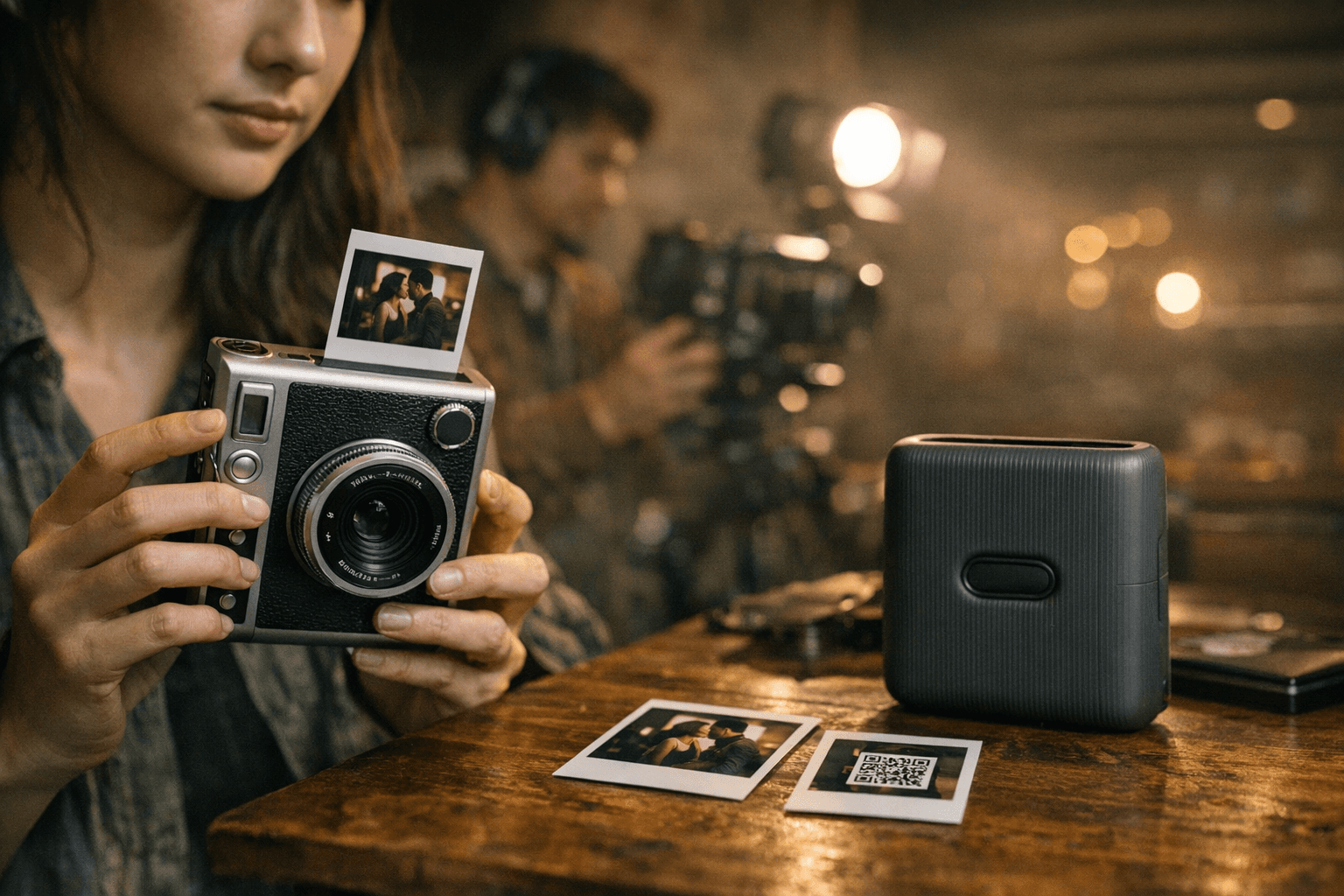
The Mini Evo Cinema is the more technically ambitious of the two. Styled after a 1980s handheld video camera, it carries a 1/5-inch CMOS sensor behind a 28mm f/2.0 lens, captures stills at 1920×2560 pixels, and records short-form clips up to 15 seconds at 1080×1440. What separates it from earlier instax hybrid cameras is the print-to-video bridge: shoot a clip, and the camera generates a printed still embedded with a QR code that links directly to the footage. The tangible photograph becomes the access point for the moving image.
Creative control runs through a mechanical "10 Eras Dial," which applies decade-inspired filters simulating photographic aesthetics from the 1930s through the 2020s, nine decades of visual history mapped to a single rotary control. A secondary dial handles quick adjustments to color, contrast, and film-like grain, offering more granular tuning than typical instant cameras have historically provided.
The Mini Link+ printer, at P8,999, handles smartphone-to-paper output with augmented reality print features and customizable layouts, covering the print-from-phone workflow that the Mini Evo Cinema does not. Both products are available now through authorized dealers in the Philippines, with the Mini Evo Cinema sitting at P22,599.
Fujifilm Philippines president Masahiro Uehara framed the launch in deliberately emotional terms. "Through the instax Mini Evo Cinema and Mini Link+, we want to reimagine how people connect with their memories, not just through images on a screen, but through photographs they can truly hold and share," he said at the event.
That framing reflects a broader industry calculation: physical prints retain cultural weight that digital files have not displaced, particularly among younger audiences who grew up sharing content online but increasingly seek tangible keepsakes. The QR-video bridge is a low-friction answer to that tension, pairing the shareability of motion content with the collectible permanence of a printed photograph. For event photographers, travel journalers, and social gifters, it opens a format that neither a standalone instant camera nor a smartphone alone could previously deliver.
The Mini Evo Cinema builds on the original instax Mini Evo's digital-to-print workflow, and its video capability marks the most substantial functional expansion the instax hybrid line has seen since that predecessor launched. As smartphone image quality continues to climb, Fujifilm's answer is not better pixels; it is a printed object with a story embedded in it.
This article was produced by Prism’s automated news system from verified source data, official records, and press releases, then run through automated quality and moderation checks before publishing. The system is built and supervised by the people who set the standards it runs under. Read our full AI policy.
Did this article answer your question?