Eric Williams says smarter strategy beats better pickleball gear
Williams’ new guide flips the pickleball script: before you buy another paddle or book a retreat, tighten your decisions, balance, and soft game.
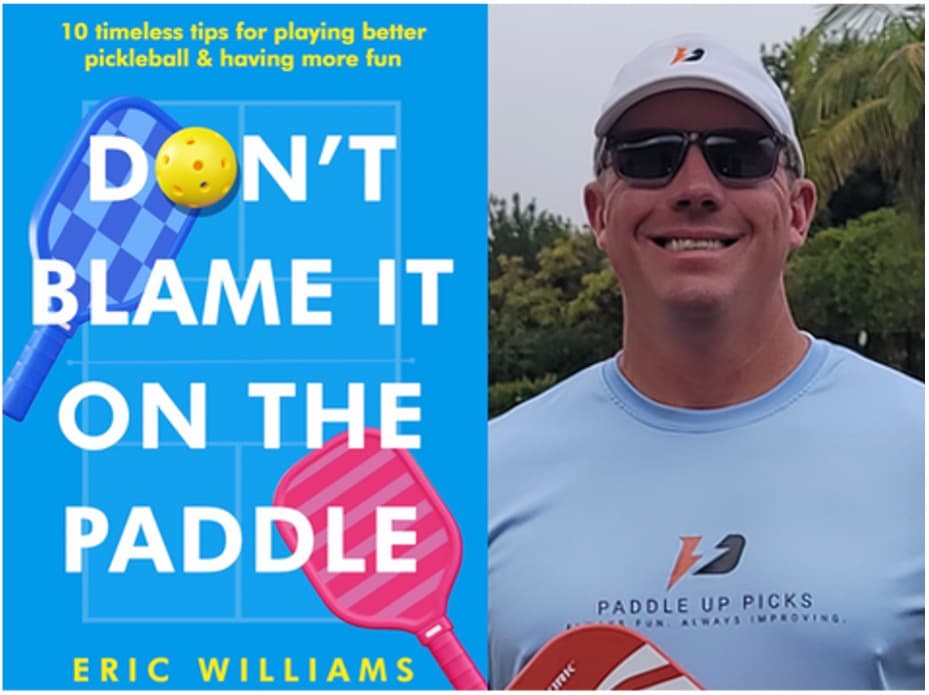
Eric Williams is making a simple argument that lands hard in pickleball circles: if your points are leaking, a shinier paddle will not save you. His new book, *Don’t Blame It on the Paddle: 10 Timeless Tips For Playing Better Pickleball & Having More Fun*, is built around the idea that better choices, cleaner fundamentals, and more consistent execution matter more than chasing gear.
The real buyer-vs-skill check
That message matters for anyone planning a pickleball trip, especially players drawn to retreat-style experiences that promise a quick jump in level. Williams, a PPR-certified coach and tournament medalist, is positioning his guide as a compact reset for players who keep blaming equipment when the real issue is decision-making. The book’s pitch is refreshingly direct: win more points without hitting harder, cut down mistakes, and stop mistaking gear upgrades for skill development.
The Amazon description makes that philosophy even clearer. The guide is presented as short, humorous, and beginner-friendly, but it is not only for first-timers. It is aimed at anyone who wants to play smarter, stay balanced, and build points with more discipline instead of more power.
What Williams says to practice before you spend more
The book’s ten-tip framework centers on a few repeatable habits that recreational players can actually use on a retreat court or at their home club. The message is not to ignore equipment entirely, but to stop treating equipment as the main answer to every problem.
- Move with control before you swing with force.
- Build points with smarter placement, not bigger cuts.
- Reduce unforced errors by making simpler choices under pressure.
- Lean into the soft game instead of trying to overpower every rally.
- Stay balanced so your shots do not fall apart when pace changes.
Those basics are the kind of work that pays off fast in a retreat setting, where players often get many reps but not always the time to rethink habits. Williams’s framing suggests that a player who can clean up balance and shot discipline will get more value from any clinic, open play block, or destination weekend than someone who arrives with a brand-new paddle and the same old errors.
The Amazon listing also highlights two memorable teaching lines, “Middle solves the riddle” and “Save the bird.” That kind of language matters because it gives players cues they can remember under pressure, especially when a match starts speeding up and technique gets sloppy. In a sport where players often talk about dinking, resetting, and controlling the middle, Williams is packaging those ideas in a way that is easy to repeat on court.
Why this fits the retreat crowd
For retreat operators, coaches, and players booking instruction-heavy getaways, the takeaway is not just that strategy matters. It is that the most useful retreat content is often the kind that changes habits, not the kind that simply showcases advanced gear or flashy drills. A player who understands when to soften the ball, when to hold balance, and when to stop forcing speed is usually more ready to benefit from paid instruction.
That is especially relevant in a market where pickleball keeps getting bigger and more organized. USA Pickleball says membership surpassed 100,000 in 2025, and the sport’s participation climbed to more than 24.3 million in April 2026. At the same time, court and location growth keeps expanding, with Pickleheads adding over 2,300 new places to play in 2025, bringing the total to 18,258 locations nationwide, after 4,000 new locations were added in 2024 to reach 15,910 courts nationwide.
In other words, more people are entering the sport, more places are opening up to play, and more players are looking for the next edge. Williams’s guide fits that moment because it pushes the conversation away from consumer shortcuts and back toward repeatable skill.
The credibility behind the message
Williams is not being presented as a theorist from the sidelines. The Oklahoman’s June 4 release describes him as a PPR-certified coach and tournament medalist, and Paddle Up Picks says he discovered pickleball during COVID before becoming a certified PPR coach. Paddle Up Picks also identifies him as the founder of a community and coaching business based in San Marcos, California.
That background helps explain why the book reads less like a product pitch and more like a coach’s practical correction. PPR, the Professional Pickleball Registry, serves as the official education and certification partner of USA Pickleball, which describes itself as the national governing body for pickleball in the United States and the official source for rules, tournaments, and educational resources. For a recreational player trying to decide whether to spend on new equipment or more instruction, that credentialing chain reinforces the book’s central message: fundamentals still come first.
The timing is notable too. Amazon lists the print edition as publishing on May 27, 2026, with 69 pages, while the Kindle edition is listed with a May 28, 2026 publication date and 89 pages. That short length matches the book’s promise of a compact, no-nonsense read rather than a long technical manual. It is designed to be absorbed quickly, then tested immediately on court.
Why the anti-gear lesson resonates now
Pickleball’s tournament structure is also becoming more formal, with USA Pickleball’s Golden Ticket events serving as official qualifying tournaments for the USA Pickleball National Championships. That matters because it shows how deeply skill, standards, and progression are now woven into the sport. As the competitive and recreational sides keep growing, the temptation to buy an edge will keep growing too.
Williams’s book cuts against that instinct. It says the sharper move is to build a cleaner game, trust the soft stuff, and make better decisions point by point. For players planning their next retreat, that is the most useful kind of upgrade because it travels with you, works on any court, and does not depend on what is in your bag.
The whole point of the book is that the next big leap may not come from a new paddle at all. It may come from learning to play the middle, save the bird, and stop blaming the gear for shots that should have been better in the first place.
This article was produced by Prism’s automated news system from verified source data, official records, and press releases, then run through automated quality and moderation checks before publishing. The system is built and supervised by the people who set the standards it runs under. Read our full AI policy.
Did this article answer your question?