Hong Kong Mall Hosts Record Pickleball Tournament With 1,000 Players
A shopping mall in Tsuen Wan just hosted 1,000-plus pickleball players inside its atrium, with permanent courts staying after the tournament: Hong Kong's clearest proof yet of sport's role in retail.
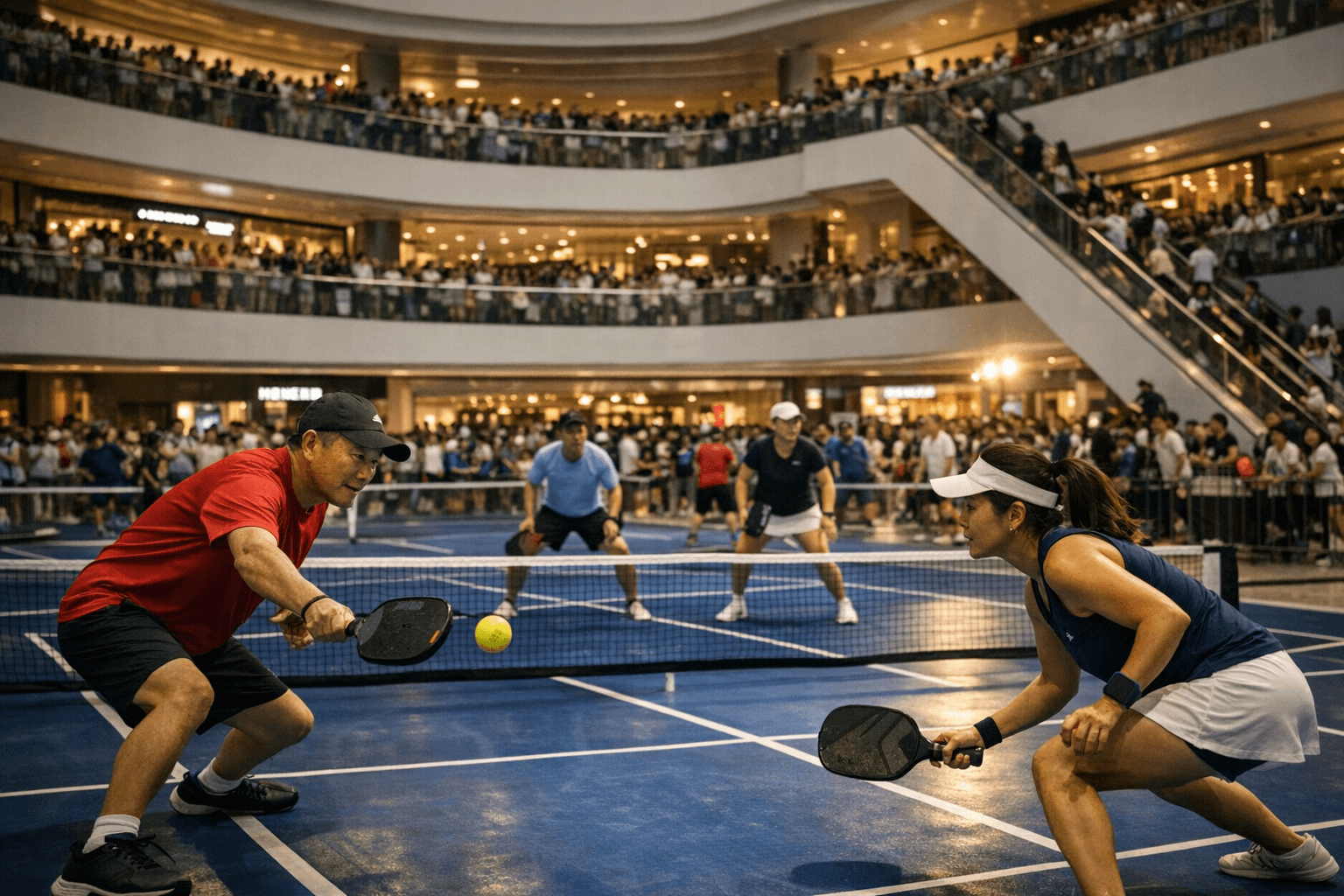
More than 1,000 registered players competing inside a shopping mall, and a chief referee whose credential has never appeared at an amateur Hong Kong tournament. The CCG Pickleball Challenge 2026, running through April 12 at D·PARK in Tsuen Wan, is simultaneously Hong Kong's largest mall-based pickleball event on record and a live proof-of-concept for what happens when a major property developer decides retail space and sport programming belong together.
Chinachem Group partnered with community organizer Bay Pickle to stage the ten-day event, which opened April 2 with a celebrity invitational featuring Linda Chung and Fatboy (Leung Yip) of ERROR. The field, 1,000-plus players aged 5 to 64, spans men's and women's singles and doubles plus mixed doubles across age brackets from Under-8 through open divisions. More than 1,200 matches are scheduled across D·PARK's Level 1 atrium courts during the 10am-to-10pm daily window, with a free-admission Pickleball Carnival running alongside the competitive brackets for anyone who wants to watch or pick up a paddle for the first time.
The officiating standard is worth flagging. Zhou Yunming, a National Level 1 Referee, is serving as chief referee, making the CCG Pickleball Challenge the only amateur tournament in Hong Kong operating at that level of oversight. That's not a marketing claim; it's a structural signal that Chinachem and Bay Pickle built this competition to a standard most recreational leagues in the city never reach. Jenny Wan, chair of the Hong Kong Pickleball Foundation, is among the event's key organizers alongside Bay Pickle co-founder Albert Fung.
Chinachem Group CEO Andy Cheung framed the intent plainly at the opening ceremony, saying the event "illustrates how everyday spaces can be reimagined to foster community connection and inspire active living." For a property developer, that's also a retention strategy. A mall with four pickleball courts and a competition calendar gives visitors a reason to return that a food court alone cannot.
The headline number is 1,000 players. The more consequential number is two: the additional permanent pickleball courts D·PARK will install in its atrium after the tournament ends, bringing the facility's total to four. Bay Pickle already operates professional-grade courts at the Tsuen Wan location and stocks a pro shop carrying more than 20 brands, including Joola, Odea, and Legendtek. Four courts inside a single climate-controlled venue, connected to Tsuen Wan MTR station, represents a genuinely different kind of pickleball infrastructure for Hong Kong, not a gym annexe or rooftop setup, but a permanent, weather-proof hub embedded in a commercial center where foot traffic is already built in.
For any player building a trip around Hong Kong pickleball, D·PARK after April 12 becomes the lowest-friction court access in the city. Bay Pickle handles bookings at thebaypickle.com. Peak demand on Hong Kong's indoor courts follows the city's leisure pattern: weekday evenings from roughly 6pm onward and full weekends fill fast, while mid-week mornings offer the clearest window for shorter-notice booking. During the tournament window itself, competitive matches dominate court time, making the carnival area the practical on-ramp for visitors who want to play without entering a bracket.
Mall courts present an equipment calculus that catches outdoor regulars off guard, and D·PARK's atrium surface is the kind of hard, smooth indoor floor that rewards specific choices. On balls: the standard 40-hole outdoor ball plays fast and bounces high on polished hard surfaces, compounding errors for players not yet dialed in to the environment. Indoor courts call for the softer, 26-hole indoor ball, which dampens pace and keeps rallies playable. In an atrium setting where ceiling reflections and retail ambient noise amplify the acoustic environment, a slower rally tempo is not just tactically sensible; it makes the game more enjoyable for players at every level. Bay Pickle's on-site pro shop eliminates the guesswork. Staff can confirm the house ball standard before you commit to a new sleeve, and with more than 20 brands on the shelf, paddle selection is legitimately broad.
On shoes: non-marking court soles are a firm requirement on any managed indoor surface, and running shoes are categorically wrong for pickleball regardless of venue. They lack lateral support and slide on polished flooring in a way that creates both injury risk and foul calls. For players packing specifically for indoor sessions at D·PARK, shoes built for gym court surfaces are the functional standard. The Asics Upcourt 4 and Mizuno Wave Lightning Z6 have established track records on smooth indoor floors, and the HEAD Motion Pro, with its Hybrasion+ compound, is specifically engineered for grip on that surface type. If your regular shoe is an outdoor court model, leave it at the hotel.
One lighting note for first-timers: mall atrium lighting differs from an outdoor evening game or a dedicated sports hall. Under commercial overhead fixtures, the ball is generally easy to track against the court surface but can disappear briefly against bright retail backdrops during overhead shots near the ceiling sightlines. A few warm-up rallies to calibrate before competitive play is the standard acclimatization, not a lengthy adjustment.
Albert Fung built the event around pickleball's cross-generational pull, with Under-8 brackets and 60-and-over divisions competing in the same atrium on the same days. That range, ages 5 to 64 in a single registered field of over 1,000 players, is not common in any sport at this scale in Hong Kong.
The commercial logic of the model Chinachem and Bay Pickle demonstrated is replicable: developer investment, community organizer partnership, permanent facility addition, and tiered programming for competitive and casual players alike. Four permanent courts in an atrium cost less than most major retail fit-outs and generate a recurring revenue stream from bookings and memberships while extending visitor dwell time. The free-admission carnival is the smart design choice within that framework. Every spectator who borrows a loaner paddle from the pro shop and plays their first point over a tournament net is a potential court-booking regular six months from now. The 1,200 matches and 1,000 players define the event. The four courts remaining in the atrium after April 12 define the strategy.
This article was produced by Prism’s automated news system from verified source data, official records, and press releases, then run through automated quality and moderation checks before publishing. The system is built and supervised by the people who set the standards it runs under. Read our full AI policy.
Did this article answer your question?