McKinney camp blends pickleball, swimming and arts for families
McKinney's Courts camp turns pickleball into a full-family summer plan, pairing court time with swimming and arts so mixed-interest households can stay together.

A summer camp built for families, not just players
At The Courts of McKinney, pickleball is being sold less like a stand-alone lesson and more like the center of a full-day family routine. The summer camp mix includes tennis, pickleball, swimming, arts and crafts, and more, a combination that makes the program especially useful for households trying to satisfy both court time and kid-friendly variety.
That is the practical appeal here: not every parent, grandparent, or child wants a day built entirely around dinking and drilling. By folding pickleball into a broader camp structure, McKinney is offering a format that feels closer to a family compromise than a pure sport clinic, and that may be exactly what makes a retreat-style trip or a summer booking more realistic.
How the camp is structured
The 2026 version is laid out as a 10-week, five-days-per-week program, which gives families a long runway instead of a one-off session. The registration call to action points families to the Impact Activities app, a sign that the camp is being set up for mobile-friendly scheduling and easy management.
A 10-week schedule also changes the way the experience feels. Rather than asking a family to commit to a single sport for a weekend, the camp creates a repeatable summer rhythm where pickleball can be one anchor activity among several. For newer junior players, that lowers the intimidation factor; for more experienced players, it still delivers court time without demanding that every hour of the day revolve around a paddle.
Why this format fits mixed-interest households
For pickleball families, the interesting part is not just the court access, but the bundle. Swimming gives kids a break from the heat and a change of pace. Arts and crafts add a quieter lane for children who are not wired for nonstop competition. Tennis rounds out the racquet-sport menu, which matters for families where siblings or cousins are at different stages of interest and ability.

That mix is also what makes the program relevant to retreat-minded readers. A dedicated pickleball camp can be ideal for a single-sport household, but many trips have to serve more than one agenda. When one child wants the court, another wants the pool, and an adult wants structure without friction, a hybrid camp model is easier to sell.
A facility built for a broader recreation day
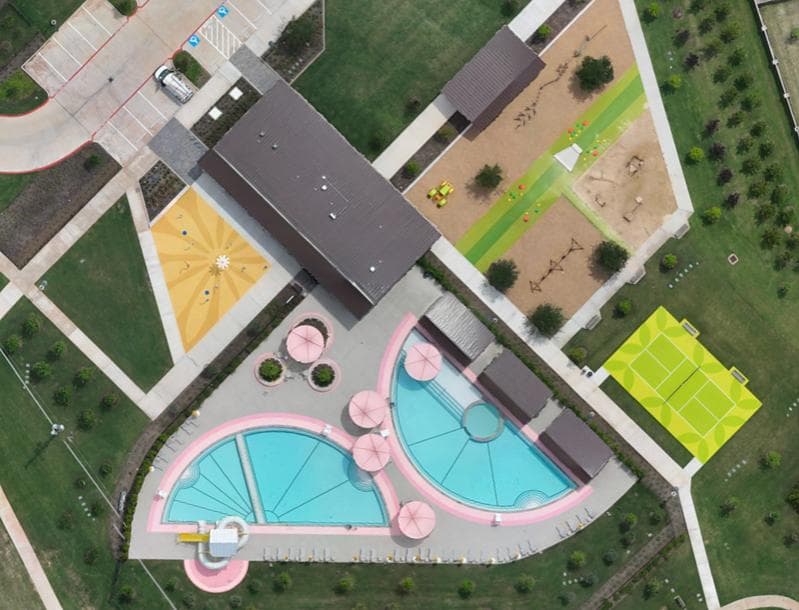
The Courts of McKinney appears well equipped for this kind of programming. The City of McKinney says the facility includes 22 lighted outdoor tennis courts, 4 lighted outdoor pickleball courts, 5 indoor tennis-pickleball hybrid courts, and 4 indoor pickleball courts. It also has a 3,500-square-foot clubhouse, year-round leagues and tournaments, lessons, court reservations, ball machines, retail shop service, and holiday and summer camps.
That setup matters because it turns the site into more than a place to play a quick match. It functions like a recreational campus, and the fact that it sits within Gabe Nesbitt Community Park reinforces that larger feel. Families are not arriving at an isolated court complex; they are stepping into a broader park environment that supports a day built around movement, downtime, and regrouping.
Why swimming shows up in the mix
The swimming piece makes even more sense when you look at the city’s broader camp ecosystem. The City of McKinney lists Apex Centre as a camp location at 3003 Alma Rd., and says it offers health and fitness classes, swim lessons, summer camps and more. Its camp page lists summer camp pricing at $200-$275 for members and $280-$375 for non-members, depending on duration and activity type, with before-care available from 7 to 8 a.m. for $20.
That is useful context for families trying to manage summer logistics. It shows McKinney already has a model for structured, schedule-friendly youth programming, and it gives parents a sense of how the city packages care, activity, and pricing. In that environment, a camp that blends pickleball with swimming and arts fits neatly into the local recreation culture.

The demand behind the model
McKinney’s family audience is big and still growing. The U.S. Census Bureau lists the city’s 2020 population at 195,308 and its July 1, 2024 estimate at 227,526. It also shows that 26.2 percent of residents are under 18, a reminder that youth recreation is not a side business here, but a core part of the city’s demand picture.
Pickleball’s national growth helps explain why this kind of camp now makes sense. USA Pickleball’s 2025 Annual Growth Report says Pickleheads added more than 2,300 new locations in 2025, bringing the nationwide total to 18,258 places to play. The Sports and Fitness Industry Association also reports that U.S. pickleball participation climbed from about 4.2 million players in 2020 to over 24 million in 2025. That surge creates more first-timers, more casual players, and more families looking for a gentler way into the sport.
A familiar camp, not a one-off experiment
This does not read like a brand-new concept suddenly appearing out of nowhere. A 2025 McKinney Chamber listing described the same camp as an 11-week Monday-through-Friday program starting May 27, and included a camper quote of “100!” when asked how much they liked summer camp. The 2026 version keeps the same basic idea alive, even as the schedule is presented as a 10-week, five-days-per-week program.
That continuity matters for families weighing whether this is a real option or just a seasonal promotion. The Courts of McKinney is clearly leaning into a format that lets pickleball share the stage with swimming, tennis, and arts, which is exactly the kind of setup that can make a retreat-style week feel workable for households with different interests. For families trying to build a summer around one shared destination, that balance may be the difference between a niche sports camp and a trip everyone can actually use.
This article was produced by Prism’s automated news system from verified source data, official records, and press releases, then run through automated quality and moderation checks before publishing. The system is built and supervised by the people who set the standards it runs under. Read our full AI policy.
Did this article answer your question?