Errol Brown Reflects on Engineering Jamaican Music's Golden Era
The man who recorded *Uprising* and helped shape the Treasure Isle dub canon finally opens up about learning his craft from Duke Reid himself.
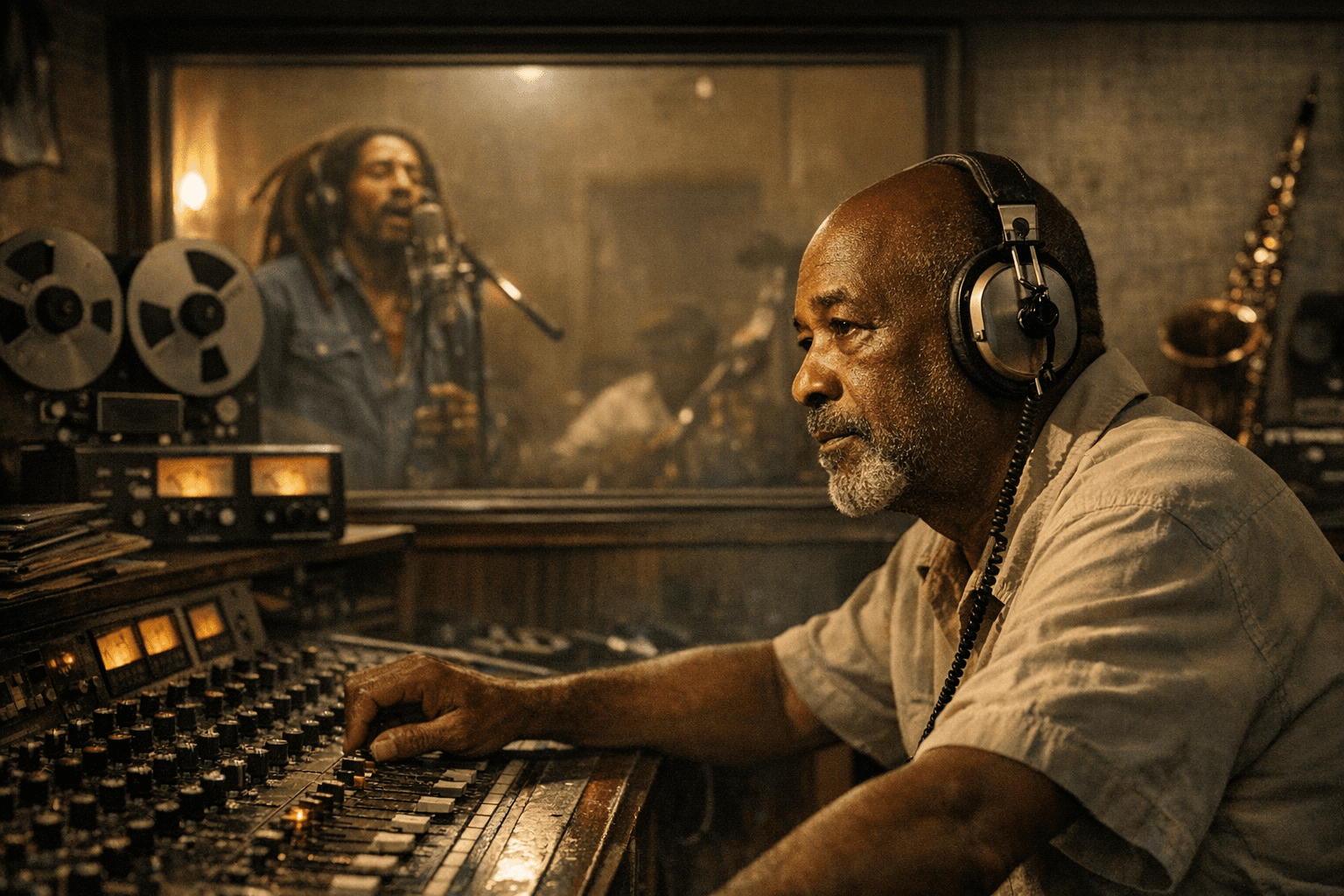
There is a quiet, specific kind of authority that comes from having sat at the right consoles at the right moments. Once you attune to it, the Errol Brown sound is unmistakable: full, rounded, glossy and clear, an audible hallmark traceable across albums like Bob Marley's *Uprising*, Marcia Griffiths' *Naturally*, and Culture's *Harder Than The Rest*. Yet the man behind the sound at Treasure Isle and Tuff Gong studios has long remained a quiet, humble industry insider's treasure. Reggaeville's recent two-part interview series pulls him into the light, and what he reveals spans the full arc of Jamaican music's most consequential decades.
Born Into the Music
Born in 1950 in Kingston to non-musical parents, Errol was taken under the wing of his formidable uncle, the producer and soundman Arthur "Duke" Reid. He began engineering at Reid's Treasure Isle studio on Bond Street, first learning his trade in the late 1960s from Byron Smith, then returning in the early 1970s to take the chief role. It wasn't a formal apprenticeship so much as a family immersion. Duke Reid would invite the young Errol to "come around and listen what's happening on Sundays" at Treasure Isle on Bond Street, 33 Bond Street.
The education was exacting. Recording in those days meant one track: everybody on one track. You couldn't pull down or push up, drop out, or layer more voices. You had better be good, because if Duke Reid didn't feel happy with what came out, there was a lot of language. That unforgiving, live-to-tape discipline shaped the precision that would define Brown's entire career at the console.
The Treasure Isle Years
From the 1950s, when his sound system ruled Kingston's dancehalls, through to his untimely passing early in 1975, Arthur "Duke" Reid remained a giant of the Jamaican music industry, producing some of the most important and influential recordings ever to see issue on the island. When Reid's health declined, the studio's future became uncertain. When Reid, struggling with cancer, sold the business to Sonia Pottinger, Treasure Isle became the base for her High Note Records imprint, and she and Brown co-produced a fantastic run of music on the label by Culture, Marcia Griffiths, Bob Andy, and many more.
Brown also became the custodian of the Treasure Isle tape vault, a role he took with striking integrity. Recounting the moment Pottinger asked him to dig through the archive for dub and various-artists albums, he told Reggaeville: "Hold on, Mrs Pottinger, tomorrow I bring some tapes for you." She looked at him with wide eyes. So he took up all the tapes he had kept at his house and brought back every single one of them. He didn't keep even one, because, as he put it, "I am a straight person."
That integrity produced some of the most celebrated dub releases in the canon. In Errol Brown, Pottinger had in her employ one of Jamaica's foremost sound engineers, whose talents at the mixing desk ensured the high quality of any reinterpretations of Reid's work, as evidenced by a trio of dub albums he oversaw in the mid-1970s. Pottinger also had Brown remix many of Reid's most significant sides, updating the sound to fit the new dancehall style. The artists he recorded during the Treasure Isle era read like a syllabus of the golden age: Alton Ellis, The Paragons, The Sensations, Marcia Griffiths, Judy Mowatt, Peter Tosh, U-Roy, Gregory Isaacs, Culture, and many more.
The Bridge to Bob Marley
It was Marcia Griffiths who recommended Errol to Bob Marley, who was recruiting a team for his newly built Tuff Gong studio. Brown had been Griffiths' personal engineer, and she bragged about him to Marley. The connection was also less accidental than it might seem: Bob had already been listening when Peter Tosh rented Treasure Isle to record *Legalize It* with The Wailers, and Marley was there through the recording, quietly taking note.
Errol's technical abilities impressed Bob, who gave him the assistant engineer's position on 1979's *Survival* album, a seat on the plane to balance that year's Zimbabwe Independence concert, and the main chair at the console for 1980's crowning culmination, *Uprising*. The promotion to lead engineer on *Uprising* came directly from the band. As Brown recalled, guitarist Junior Marvin delivered the news after the *Survival* tour: "Mr Brown, me and Bob had a meeting after the end of this tour and we've come to a conclusion. We want you to engineer our next album." Brown's response was disbelief: "What?" He was young, and the request caught him off guard. Marvin told him: "We did one with Alex Sadkin but we want to do one with you now."
The resulting album became one of reggae's defining works. Brown toured *Uprising* with the Wailers to huge crowds in Europe, and at the crucial stages of breaking America. He was also present in the studio for moments that reshaped what reggae sounded like to the world. He has spoken candidly about the making of "Redemption Song," recounting that the band spent one whole day trying to record "Redemption Song" musically with the full band before Chris Blackwell intervened and redirected the session toward the sparse acoustic version the world now knows.
A Sound That Carries Forward
After Bob's death, Brown shaped the sound of the Marley children in the Melody Makers, and engineered Stephen and Ziggy's Grammy-winning solo projects. He left Treasure Isle in 1979 and joined Bob Marley and The Wailers at Tuff Gong Studios, where he recorded and mixed albums with Bob Marley and The Wailers, Rita Marley, Burning Spear, and Third World.
The decades since have kept him continuously in motion. In 2001 and 2002 he was Shaggy's house engineer, and in 2003 he engineered Ziggy Marley's first ever solo tour. Since leaving Tuff Gong, he has teamed up with his producer son Shane, bringing the signature sound to notable releases from Etana and Busy Signal. He has also been sought by touring bands Rebelution and, most recently, Steel Pulse to add his audio magic on the road.
A teacher respected deeply by the many engineers he has taught to elevate their ears, Brown's influence on the craft extends well beyond his own discography. The Reggaeville interview is a rare chance to hear the man who pressed record on some of reggae's most sacred sessions explain, in his own words, what it felt like to be there. For anyone serious about understanding how Jamaican music actually sounded the way it did, this conversation belongs on your required listening list alongside the records themselves.
Know something we missed? Have a correction or additional information?
Submit a Tip