Home Producers Can Craft Authentic Roots and Dub Reggae on a Budget
Roots and dub reggae's warm, cavernous sound is fully achievable from a bedroom setup with the right gear, signal chain, and mixing approach.

The bassline hits first. It always does in roots reggae. Before the skank, before the one-drop, before the reverb-drenched snare fades into the distance, it's that low, rolling bass that tells you exactly where you are. The good news for home producers is that the gear required to build that world has never been more accessible or affordable. Authentic roots and dub reggae is not about having a console the size of a dining room table — it's about understanding the philosophy behind the sound and making deliberate choices at every stage of your signal chain.
Start with the right tools
You don't need a vintage SSL or a room full of outboard gear to get there. A capable DAW running on a modest computer, a decent audio interface with at least two inputs, a MIDI controller or keyboard, and one solid bass guitar or bass plugin will cover the essential ground. For drums, reggae production leans heavily on programmed patterns or sample-based kits rather than live tracking, which actually favors the home setup. Look for drum samples with weight in the kick and a snappy, dry crack on the snare. The famous "one-drop" pattern, where the kick falls on beat three rather than one, is non-negotiable for that roots feel. Program it deliberately, not as an afterthought.
For guitar, a clean or slightly overdriven tone played on the upbeat — the "and" of each beat — gives you the classic skank. A single-coil or humbucker guitar going direct into your interface with a subtle room reverb will serve you well. Many foundational reggae recordings were cut with relatively simple setups, and the tightness of the performance matters far more than the gear chain behind it.
Building a signal chain that works
The signal chain in reggae production is where the philosophy becomes practical. Bass should come through clean, with compression that glues rather than squashes. A slow attack on your compressor lets the transient breathe before it clamps down, which preserves the note attack while controlling the sustain. In roots reggae, the bass and kick drum occupy almost the same sonic space, so you need to carve carefully. A high-pass filter on the kick around 50-60Hz clears just enough room for the bass fundamentals to sit underneath without the two fighting each other.
Guitar and organ tracks need to live in the midrange, leaving the low-end completely open for bass and kick. This isn't subtle — in classic Jamaican studio recordings, the separation between the low end and everything else is stark and intentional. Use high-pass filters liberally on anything that doesn't need to live below 200Hz. The result should be a mix that feels physically weighted at the bottom, airy in the mids, and spacious up top.
Rhythm is the message
Reggae rhythm is a conversation between restraint and emphasis. The one-drop pattern puts the kick and snare together on beat three, leaving beats one and two wide open. That space is not emptiness — it's tension, and it's what makes the groove feel like it's pulling slightly behind the beat. When you program your patterns, resist the temptation to fill every bar. Ghost notes on the snare can add feel, but less is almost always more.
The "steppers" pattern, used in harder roots and nyahbinghi-influenced tracks, layers a kick on every quarter note. It creates a relentless, ceremonial drive that suits heavier spiritual material. Knowing when to use the one-drop versus the steppers is a fundamental creative decision that shapes the entire mood of a track. Play around with both before you commit to an arrangement.
Low-end mixing: where the work really happens
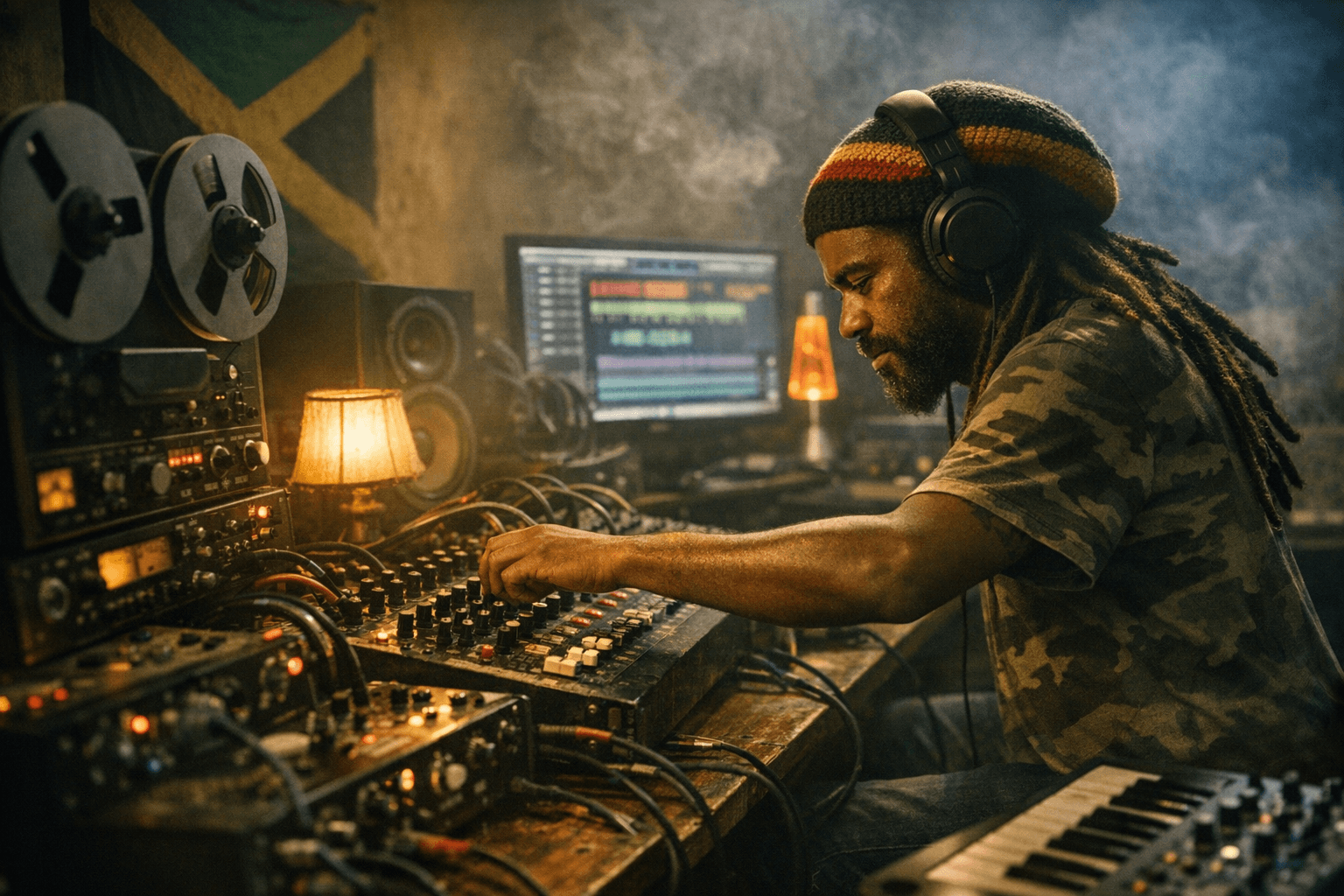
Getting the low end right in dub and roots reggae is the craft that separates a muddy home mix from something that sounds like it came off a real system. The sub-bass frequencies between 40-80Hz are where roots reggae lives, and every decision you make in the mix either protects that range or compromises it. Side-chain compression between the kick and the bass is one of the most effective tools available — it ducks the bass very slightly every time the kick hits, which keeps the two elements distinct on large soundsystems without sacrificing the weight of either.
Checking your mix on multiple playback systems is essential. What sounds balanced on studio monitors may be completely different on a small speaker or, critically, on a proper soundsystem. If you have access to any large speaker setup, even a quality home hi-fi, test your low-end there. The Jamaican and British producers who defined this sound were mixing for real soundsystem culture, and that context should inform every decision you make below 100Hz.
Dub effects: delay, reverb, and the art of the drop
Dub is where mixing becomes performance. The hallmark tools are tape delay and spring reverb, both of which are widely available as high-quality plugins. A tape delay on the snare, set to dotted-eighth or quarter-note timing synchronized to your tempo, creates the cascading echo effect central to classic dub. Automate the delay send so it pulses in and out rather than sitting statically in the mix. Pull elements completely out of the arrangement and throw them back in drenched in reverb — that sudden return of a vocal or bass hit through a cathedral of reverb is one of the most powerful moves in dub production.
Spring reverb on guitar and organ adds warmth and that slightly unstable, organic wobble associated with older plate and spring hardware. Modern plugins emulate this convincingly. Don't be afraid to use your effects aggressively; subtlety is not the dub tradition.
Finding your reference points
Study the source material closely. King Tubby, Lee "Scratch" Perry, Scientist, and Mad Professor defined the sonic language of dub. Listen to how Tubby's mixes feel skeletal and percussive, how Perry's work is denser and more psychedelic, how Scientist's bass sits with such controlled density. On the roots side, producers working with artists like Burning Spear, Culture, and the Mighty Diamonds understood how to balance spiritual weight with rhythmic precision. These recordings are your real textbook, and returning to them while you mix will recalibrate your ear every time.
The home studio is not a compromise. It's a different set of constraints, and constraints have always driven reggae production toward creativity. Work the low end, automate the delays, give the one-drop the space it needs, and the music will do the rest.
This article was produced by Prism’s automated news system from verified source data, official records, and press releases, then run through automated quality and moderation checks before publishing. The system is built and supervised by the people who set the standards it runs under. Read our full AI policy.
Did this article answer your question?