Retro-Zero turns Cardputer Zero into a portable Libretro emulation hub
Retro-Zero gives the Cardputer Zero a real Libretro front end, with on-demand cores, ROM uploads, and a surprisingly broad system list.

Retro-Zero is the rare embedded emulation project that feels built for actual use, not just for showing off a tiny board. On the Cardputer Zero, it pairs a Libretro-based frontend with LVGL and hardware-accelerated graphics, so the interface is meant to stay responsive on a small screen instead of fighting it.
That matters because the project is not treating the Cardputer Zero like a stripped-down Linux box with a launcher bolted on. Retro-Zero is aimed at ARM64 Linux and tries to make the whole setup feel self-contained and handheld-friendly, the way a good retro handheld should. The pitch is simple: boot it, browse it, and play without spending an evening stitching together your own frontend stack.
The system support is broad enough to make that pitch believable. Retro-Zero’s project description calls out NES, SNES, Game Boy, Game Boy Advance, Nintendo 64, Mega Drive, Master System, Game Gear, Dreamcast, PlayStation, PSP, Neo Geo, FBNeo, MAME 2010, PC Engine, MSX, Atari 2600, Atari 7800, Atari Lynx, and WonderSwan. That is a serious spread for a compact device, covering everything from 8-bit staples to 3D-era handheld and console emulation.
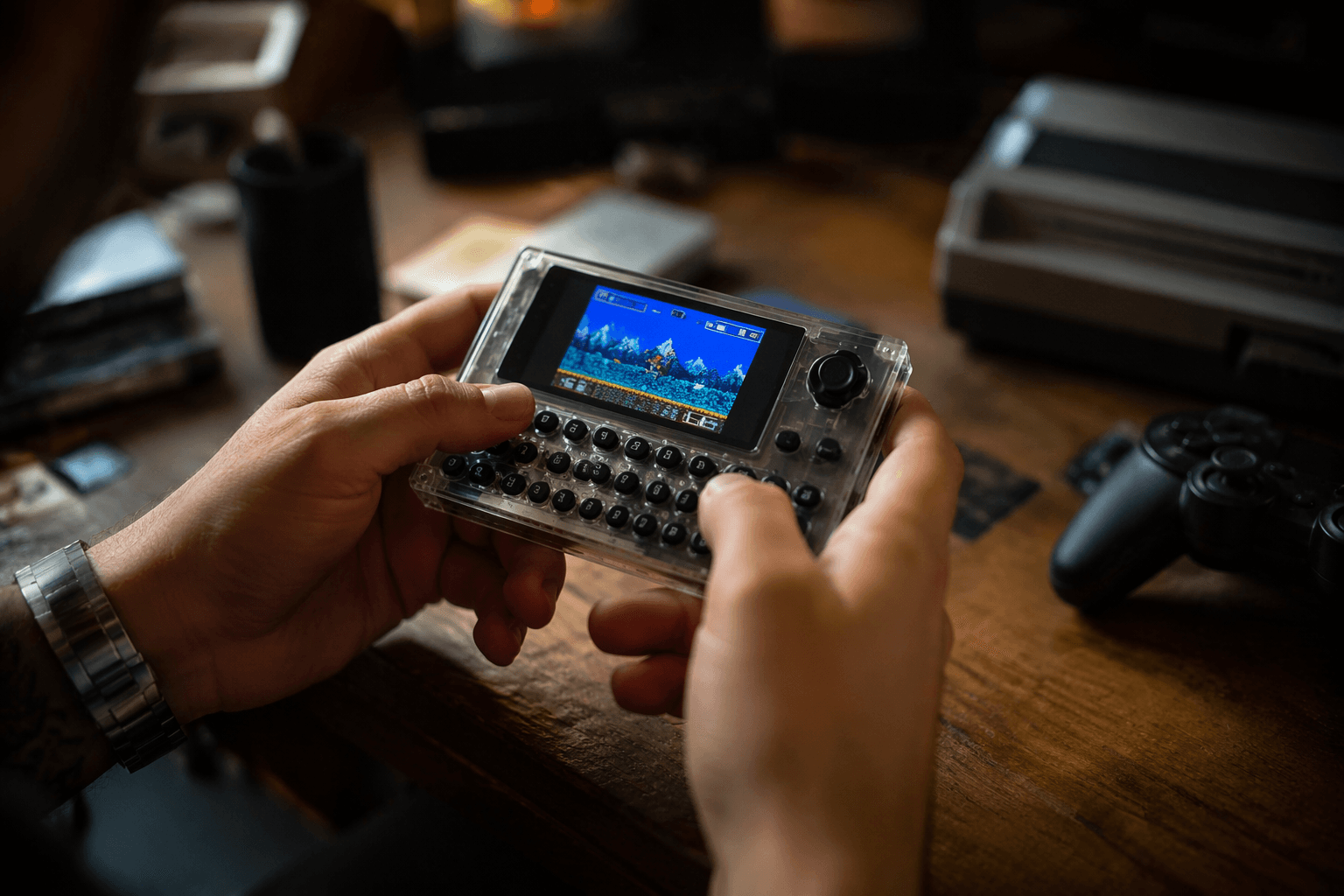
The better part is how little friction the frontend tries to add. Retro-Zero includes on-demand core downloading, structured ROM folders, dedicated save-file subdirectories, and direct ROM uploading to the device. In practice, that means you do not need to pre-stage every core before you can start testing a system. It behaves less like a development board experiment and more like a polished emulation appliance, which is exactly why it stands out.
Retro-Zero showed up on June 4, 2026, and the timing makes sense: the embedded-emulation scene has plenty of clever proof-of-concepts, but far fewer projects that try to solve the whole handheld experience. On the Cardputer Zero, that combination of LVGL polish, hardware-accelerated graphics, and low-friction content management turns a neat novelty into something hobbyists can actually build around. For anyone who cares about compact Linux handhelds and Libretro setups, this is the kind of project that changes the question from whether it works to how often you would want to carry it.
This article was produced by Prism’s automated news system from verified source data, official records, and press releases, then run through automated quality and moderation checks before publishing. The system is built and supervised by the people who set the standards it runs under. Read our full AI policy.
Know something we missed? Have a correction or additional information?
Submit a Tip