Best Practices for Publishing and Maintaining Rust Crates on crates.io
Verify rustc, cargo, and git, run cargo publish dry-run, and treat every publish as permanent, use yanking and semantic versioning to manage the crate lifecycle.

Publish once, publish carefully: crates.io treats releases as archive entries, so the practical workflow is verify your toolchain, prepare a spotless manifest and docs, tag the release in git, run a dry run, then publish, and if something goes wrong use yanking rather than deletion.
1. Verify your toolchain before you start
Verify installations locally to avoid needless publish failures: run rustc version, cargo version, and git version. Ajit Kumar’s checklist emphasizes these three commands as the first gate of readiness; mismatched toolchains or missing git credentials are a common source of publish-time errors. If cargo or git are missing or mismatched you’ll see clear Rust error messages that usually tell you both what the error is and how it might be fixed.
2. Create the crate and initial project layout
Use cargo to scaffold a clean project: cargo new lib hello-world-lib for libraries or cargo new hello-world-bin for binaries, then cd into the project directory. Edit Cargo.toml for package metadata and add a README.md at the repository root so the remote repository page recognizes it; a README.md “at the root of the project should be just fine.” Small, well-structured projects are easier to maintain and inspect before publishing.
3. Fill out Cargo.toml with the right metadata
Populate the manifest with explicit fields, name, version, edition, rust-version, and description are the common examples authors supply. For example: [package] name = "roman_numerals_fn" version = "1.0.0" edition = "2021" rust-version = "1.60.0" description = """ A function to convert integers to their roman numeral representation as strings. Values from 1 to 3999 are possible, otherwise it returns an OutOfRangeError. Zero has no representation in roman numerals. """ Note that the excerpts don’t list a full canonical set of required manifest keys; use the examples above and confirm with the official docs before publishing.
4. Pick and verify your crate name early
Crate names on crates.io are first-come, first-served, search before you publish. While you can use any name locally, if the name is already taken cargo publish will warn and then error; a common example in docs uses name = "guessing_game". If the desired name collides, change the name in Cargo.toml and pick a different tag/name scheme.
5. Tag releases in git and push tags for clear history
Create annotated tags for releases so downstream users can match crates to commits: git tag -a v0.1.0 -m "Release version 0.1.0". Verify tags with git tag -l and git show v0.1.0, and push with git push origin v0.1.0 or git push origin tags. Tags mark specific versions in your git history and make it easier to trace regressions or patch releases.
- cargo test all-features to run unit tests.
- cargo clippy all-features -D warnings to fail on lints.
- cargo fmt all to normalize style.
- cargo doc all-features no-deps open to inspect generated docs locally.
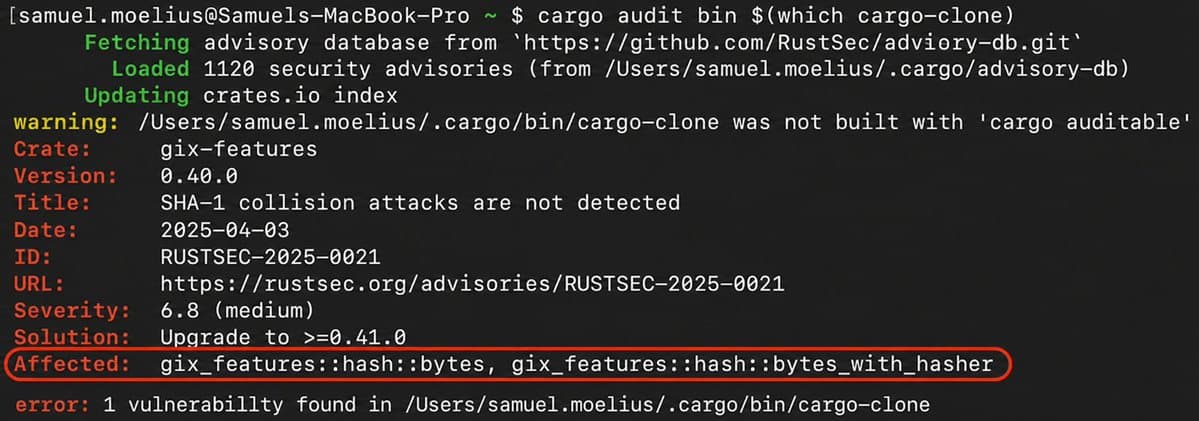
- cargo audit to scan known vulnerabilities.
6. Run quality checks: tests, linting, formatting, docs, and audit
Before publishing, run a deterministic set of checks:
Medium and DEV Community guidance stresses unit tests and spotless docs; publishing without tests is frowned upon unless you clearly mark the crate as experimental in the README.
7. Use the dry-run to catch packaging issues
Run cargo publish dry-run to surface packaging warnings and errors before uploading; a dry-run produces messages such as "warning: aborting upload due to dry run". Treat the dry-run output as a checklist, packaging, verification, and compilation steps will be simulated and must succeed before the real publish.
8. Publish flow: login, dry-run, then publish
The consolidated flow is simple but exact:
1. Create a crates.io account.
2. Login locally via cargo login with your API key.
3. Ensure required manifest keys are present.
4. Run cargo publish dry-run.
5. Run cargo publish.
Typical successful output looks like:
Packaging hello-world-lib v0.1.0
Verifying hello-world-lib v0.1.0
Compiling hello-world-lib v0.1.0
Finished dev [unoptimized + debuginfo] target(s) in 1.23s
Uploading hello-world-lib v0.1.0
If you aren’t logged in, cargo publish will emit an error and usually suggest how to remedy the issue.
9. Expect permanence, plan versioning and use semver
Crates.io is intended as a permanent archive: “Be careful, because a publish is permanent. The version can never be overwritten, and the code cannot be deleted except in certain circumstances.” When you’ve made changes, update the version in Cargo.toml and “Use the Semantic Versioning rules to decide what an appropriate next version number is.” You can publish unlimited versions; choose MAJOR.MINOR.PATCH appropriately and prefer new versions to overwriting.
10. Use yanking to protect downstream users without deleting history
If a published version is problematic, don’t expect deletion, use yanking. The supported commands are cargo yank vers 0.1.0 and cargo yank vers 0.1.0 undo. Yanking does not delete the version; it prevents new projects from adding it as a dependency and discourages its use while preserving the permanent archive goal.
11. Validate and monitor docs.rs builds after publish
After a publish, docs.rs will automatically build your documentation. If the docs.rs build fails, consult troubleshooting guidance in the docs.rs or Rust documentation, sources indicate failures happen but don’t include exact steps in the excerpts. As a practice, “review the locally generated documentation and make the appropriate corrections” until the docs are spotless before you publish.
12. Design for reusability: think small and use feature gates
Favor small, focused crates, “Think small ... Small, simple crates of functionality are likely to be more valuable.” For larger libraries, provide feature gates so downstream users only pull the functionality they need. Thoughtful feature flags reduce compile-time bloat and make your crate easier to adopt across different consumers.
13. Maintenance: patches, new versions, and community engagement
You can publish unlimited new versions over time and should use semantic versioning to communicate compatibility. Publishing helps the ecosystem, “If it's helpful to you, it's likely to benefit others one day” , and maintainers should expect issues, pull requests, and feedback from the community. Use git tags and changelogs to document what changed between versions so downstream integrators can upgrade confidently.
- cargo test all-features
- cargo clippy all-features -D warnings
- cargo fmt all
- cargo doc all-features no-deps open
- cargo publish dry-run
- git tag -a v0.1.0 -m "Release v0.1.0"
- git push origin v0.1.0
- cargo login
- cargo publish
- cargo yank vers 0.1.0
- cargo yank vers 0.1.0 undo
- cargo audit
14. Quick-reference commands and troubleshooting cheatsheet
Keep this verbatim quick reference near your terminal:
If cargo publish fails because the name is taken, rename in Cargo.toml; if other publish errors occur, Rust’s error messages often explain what to fix.
15. Finish strong: what success looks like
After a successful publish you’ll see confirmation output and the docs.rs build kick off, and you can quote the docs’ sign-off: “Congratulations! You’ve now shared your code with the Rust community, and anyone can easily add your crate as a dependency of their project.” Treat publishing as a durable act: test, document, pick names carefully, tag your history, and prefer yanking over deletion to protect users while preserving the archive.
Conclusion Publishing to crates.io is straightforward but carries long-term consequences, prepare your toolchain, polish tests and docs, adopt semver, and use yanking and feature gates to manage risk. Do the upfront work and crates.io will serve both your users and the ecosystem for years to come.
This article was produced by Prism’s automated news system from verified source data, official records, and press releases, then run through automated quality and moderation checks before publishing. The system is built and supervised by the people who set the standards it runs under. Read our full AI policy.
Did this article answer your question?