Rust project RCommander revives Norton Commander style file management
RCommander brings Norton Commander’s two-pane flow to Rust, with GTK4 aimed at Windows, Linux, and macOS from one codebase.
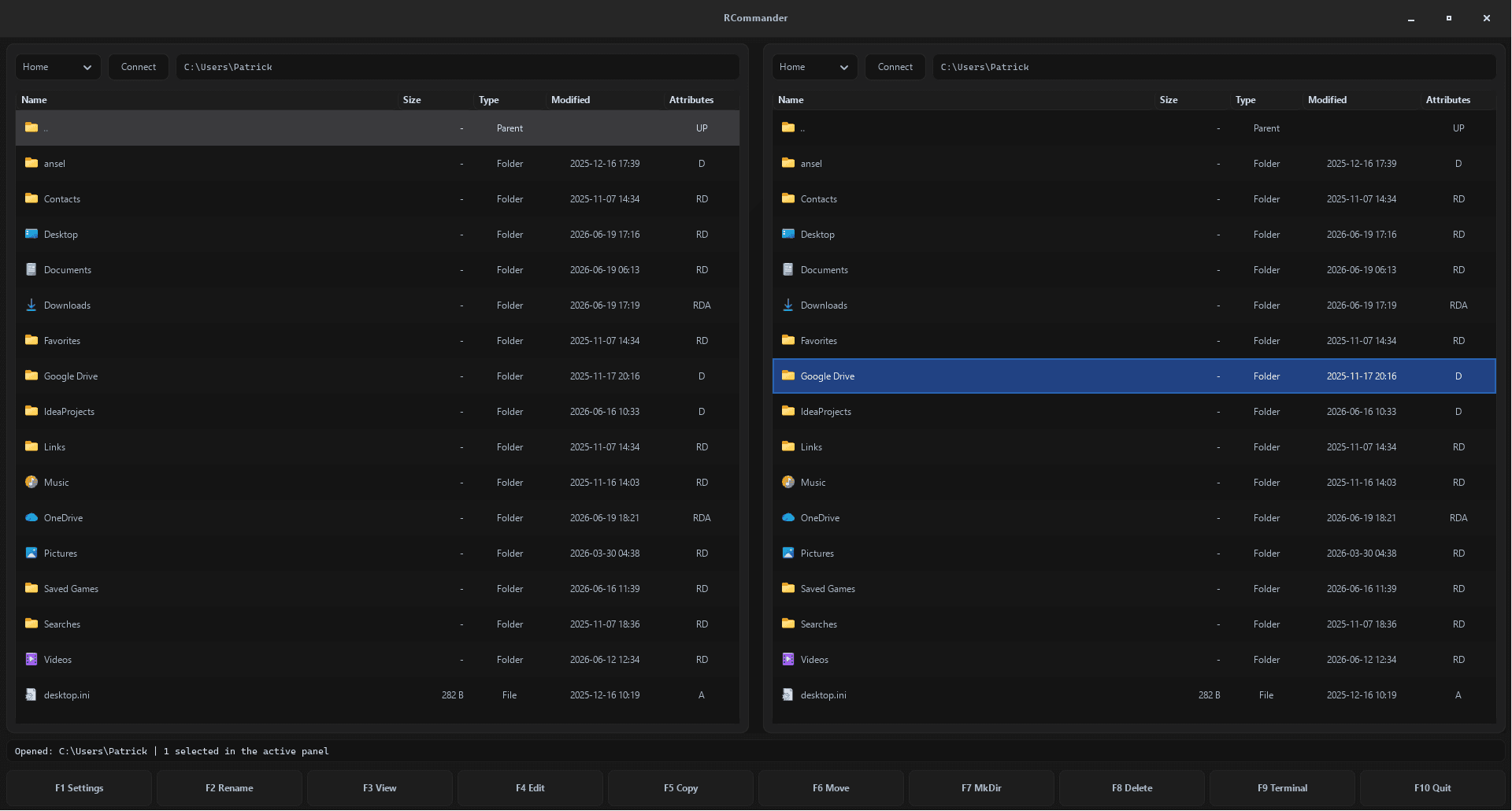
RCommander is doing something that feels instantly legible to anyone who has ever liked a fast file manager: it puts two panes side by side and makes file operations the point, not an afterthought. Built in Rust and styled as a GTK4 rewrite of a Norton Commander-style manager, it is now presented as running on Windows, Linux, and macOS, which gives the project a much bigger ambition than the usual Linux-only or CLI-only Rust utility.
A familiar workflow, rebuilt in Rust
The appeal here is not nostalgia for nostalgia’s sake. RCommander is chasing a workflow that still makes sense when you want to move, copy, sort, and inspect files without bouncing through endless dialogs or tabs. The repository description frames it as a two-pane file manager, and the architecture notes make the intent even clearer: this is a clean GTK4 rebuild, with an older Slint prototype kept only as a source of domain behavior such as panel state, directory entries, sorting, roots, file operations, watcher behavior, and open-with-system actions.
That distinction matters. It tells you the project is not just skimming the surface of the commander layout, but trying to preserve the parts that make the model efficient in the first place. If you like keyboard-driven file handling, side-by-side directory views, and the ability to keep your hands on the keys while you work, RCommander is aiming directly at that muscle memory.
Why the commander layout still has teeth
Norton Commander is the obvious reference point because it essentially defined the orthodox file manager for a generation of users. Original author John Socha released it in 1986, and the final release, 5.51, arrived on July 1, 1998. Its dual-pane interface became a template that later tools copied, which is why the format still feels familiar even now.
RCommander is not trying to reinvent that model. It is trying to modernize it with Rust and GTK4, which gives the project a practical edge: the layout is already proven, so the question becomes whether the implementation can make it feel modern, safer to maintain, and genuinely cross-platform. For users who still prefer rapid file operations over abstract UI flourishes, that is a meaningful product decision rather than a retro gesture.
What GTK4 buys the project
GTK is a free and open-source cross-platform widget toolkit for graphical interfaces, and its documentation explicitly covers Windows, macOS, Wayland, and X11. That is a big part of why RCommander can plausibly target all three major desktop operating systems without changing its core interaction model.
The GTK4 choice also signals a real desktop-app mindset. Rust has long been associated with back-end services, systems code, and command-line tools, but GTK4 pushes RCommander into the space of everyday desktop software where polish, native integration, and platform conventions matter. The GTK4 Rust bindings are maintained in gtk-rs, which gives the project a well-established ecosystem path instead of a one-off UI experiment.
That matters for file management in particular, because file tools live close to the operating system. They need to handle permissions, directory metadata, file watchers, and platform-specific open actions without becoming brittle. Rust’s safety model and GTK’s cross-platform reach are a sensible pairing for that job.
How much of a real app is it today?
The shortest honest read is that RCommander looks promising, but still modest in scope. The repository itself suggests a small codebase, and that is exactly where a lot of interesting Rust desktop work starts: with one focused tool that proves the stack can handle native-feeling GUI software without sacrificing maintainability.
That modesty is part of its value. The project is already specific about what it wants to be, and the architecture notes show a deliberate separation between the old prototype and the current GTK4 rebuild. It is not a sprawling general-purpose suite; it is a file manager with a defined shape, and that makes it easier to judge on its core promise: does the dual-pane workflow feel fast, stable, and useful on multiple desktops?
For now, it reads like a serious early-stage utility rather than a fully established replacement for the veteran file managers people already rely on. That does not make it weak. It makes it focused.
Install friction and day-one usability
The likely friction point is the usual one for a young cross-platform desktop app: you get a clear concept before you get a frictionless installation story. Because RCommander is presented as a GitHub-hosted Rust project built on GTK4, the path of least resistance is likely to favor people who are comfortable with source builds and desktop dependencies.
GTK helps here and complicates things at the same time. It is explicitly designed for cross-platform desktop work, but it still brings platform-specific runtime and packaging concerns with it, especially when you are spanning Windows, Linux, and macOS. In practice, that means the app’s workflow may be easier to understand than its packaging story is to trust, at least until it matures further.
The upside is that if you are already a Rust developer, or a power user who likes trying new GUI tools before they become mainstream, this is exactly the sort of project worth keeping on your radar. It combines a clear use case, a familiar interface pattern, and a modern implementation stack. That is a better starting point than novelty for novelty’s sake.
Where it fits in the Rust desktop picture
RCommander also sits inside a broader sign of life for Rust GUI work. Rust’s 2024 State of Rust survey results were published on February 13, 2025, and the broader ecosystem continues to show that developers are still investing in desktop-facing tools, not just servers and libraries. There is also a contemporaneous ecosystem of other cross-platform Norton Commander-inspired projects, which means RCommander is entering a space where the interaction model is still actively being revisited.
That makes the project interesting as a signal, not just a utility. Rust is not only being used to write fast backend code or safer low-level components. It is also being used to build everyday desktop tools that have to feel good under the fingertips, and file managers are one of the clearest tests of that ambition.
RCommander’s best trick is that it makes the promise obvious immediately: familiar two-pane file management, but rebuilt for modern desktops in Rust and GTK4. If you want a new Rust desktop app to watch, this is the kind that earns attention by making an old workflow useful across Windows, Linux, and macOS without asking you to relearn how file management should work.
This article was produced by Prism’s automated news system from verified source data, official records, and press releases, then run through automated quality and moderation checks before publishing. The system is built and supervised by the people who set the standards it runs under. Read our full AI policy.
Know something we missed? Have a correction or additional information?
Submit a Tip