Rust project updates 41 goals, many continue into 2026 cycle
Rust’s roadmap now spans 41 goals, with 13 flagship efforts carrying into 2026. The near-term payoff is likely faster builds, sharper Cargo workflows, better docs, and steadier Linux support.

Rust’s latest goals update shows a project trying to move several layers of the stack at once, not just polish one release. The 2025H2 goal period ended with 41 goals on the board, including 13 flagged as flagship goals, and many of them are continuing into the 2026 cycle. For Rust users, that points to a familiar but important pattern: the changes likely to be felt first are in the compiler, Cargo, documentation, and platform support, where small infrastructure wins can change day-to-day work quickly.
The clearest compiler-side payoff is speed and ergonomics. Work on a parallel front end, relink-don’t-rebuild efforts, and a production-ready Cranelift backend all point toward shorter edit-compile-test loops and more flexible code generation paths. The same update also keeps the spotlight on in-place initialization, the next-generation trait solver, Polonius support on nightly, MIR move elimination, and ergonomic ref-counting, which together suggest that Rust’s type system and borrow checking are still being tuned with real programs in mind. Even the more experimental items, such as pin ergonomics, field projections, reborrow traits, and dormant traits, are part of the same push to make advanced patterns easier to express without fighting the compiler.

Cargo is where users may notice the most immediate workflow changes. The goal list includes build-std, new Cargo plumbing commands, build-dir layout work, cargo-script stabilization, and public/private dependency stabilization. That combination suggests more control over how builds are assembled, clearer internal commands for tooling, and less friction for packages that need custom build behavior. Cargo-semver-checks integration blockers also remain on the agenda, which matters for teams trying to keep API changes honest as dependencies evolve.
Documentation work is moving too, and it is not just cosmetic. A rustdoc team charter, more precise Rust reference documentation, and rustdoc doc_cfg stabilization all point to a tighter story for users trying to understand what is stable, what is conditional, and what each feature actually means. That is the sort of maintenance that saves time when a codebase spans multiple crates, targets, and feature flags.
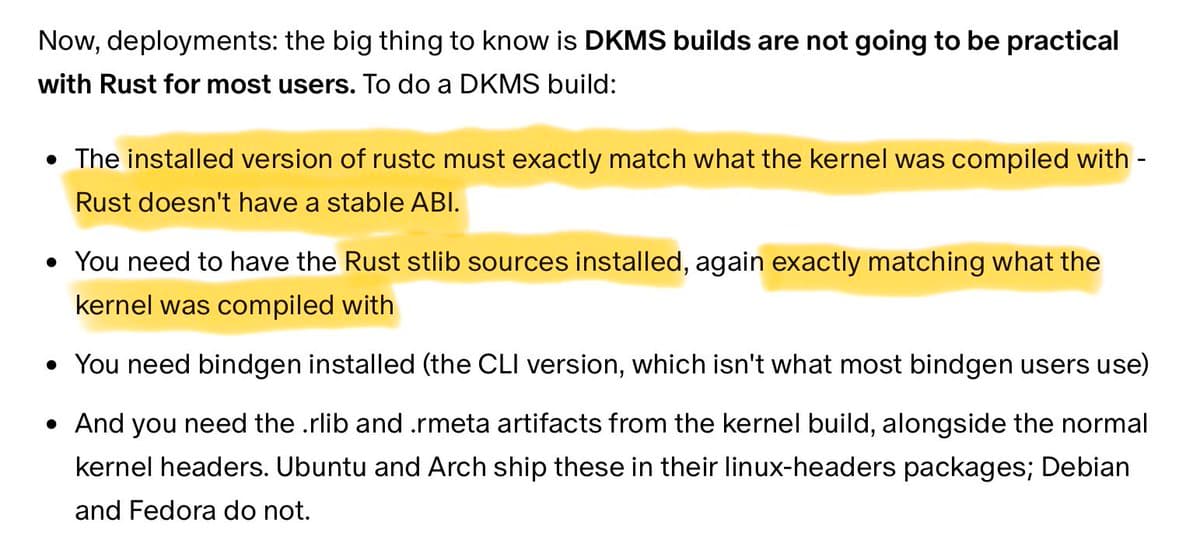
Platform support remains a major thread, especially around Rust for Linux. The goals update says that effort is getting closer to stable, while SVE and SME support on AArch64, MemorySanitizer and ThreadSanitizer support, Open API namespace support, and GCC backend testing all widen the set of environments Rust can serve. Taken together, the message is clear: the next Rust cycle is not about one headline feature, but about making the compiler faster, Cargo cleaner, docs sharper, and Linux integration more dependable where systems code is already under pressure.
This article was produced by Prism’s automated news system from verified source data, official records, and press releases, then run through automated quality and moderation checks before publishing. The system is built and supervised by the people who set the standards it runs under. Read our full AI policy.
Did this article answer your question?