Uncle Pappy drives coast to coast to spotlight America’s water crisis
Uncle Pappy’s coast-to-coast van trip turns an 8,000-mile road story into a lesson in water access, from closed Great Salt Lake ramps to Florida resilience.

Uncle Pappy’s van is doing more than collecting miles. Blair Carlyle, the law student and conservation-minded creator behind the persona, is driving from Los Angeles to the Everglades on a route built to turn rivers, reservoirs and shorelines into a moving conversation about water access, water policy and the fragility of the places people recreate in.
What the Great American Water Road Trip is really about
Carlyle, a 30-year-old native Floridian and Stetson law student, revealed his identity publicly in January 2026 after building Uncle Pappy anonymously. He is using summer break to push what United By Nature calls the Great American Water Road Trip, an 8,000-mile run from Los Angeles to the Everglades that is expected to last about 62 days and reach more than 30 communities. The trip launched at Santa Monica Pier on June 10, and the campaign has been cast as both a media project and a listening tour.
That framing matters for travelers because this is not a sightseeing loop built around scenery alone. The trip is designed to move through communities where water is part of daily life, whether that means drought in the West, storms in Florida, or the practical question of whether a boat ramp is open at all. United By Nature says the road show is meant to prove that clean, accessible water is a mainstream concern, not a niche issue reserved for policy circles.
A traveling petition, not just a road trip
The van itself has become part of the message. Backers say travelers can sign the van and send postcards along the route, and those messages are supposed to be hand-delivered to leaders in Washington, D.C. at the end of the trip. That gives the journey a civic edge that is unusual even in the Southwest adventure scene, where road trips often become informal campaigns for the landscapes they cross.
For route-planning purposes, that also changes the way the journey reads on the ground. Stops are not just pit stops or photo ops. They are points where people can connect the experience of moving through the West with the water systems that make those places usable in the first place, from campground faucets to marina slips to the simple expectation that shoreline access will exist when you arrive.
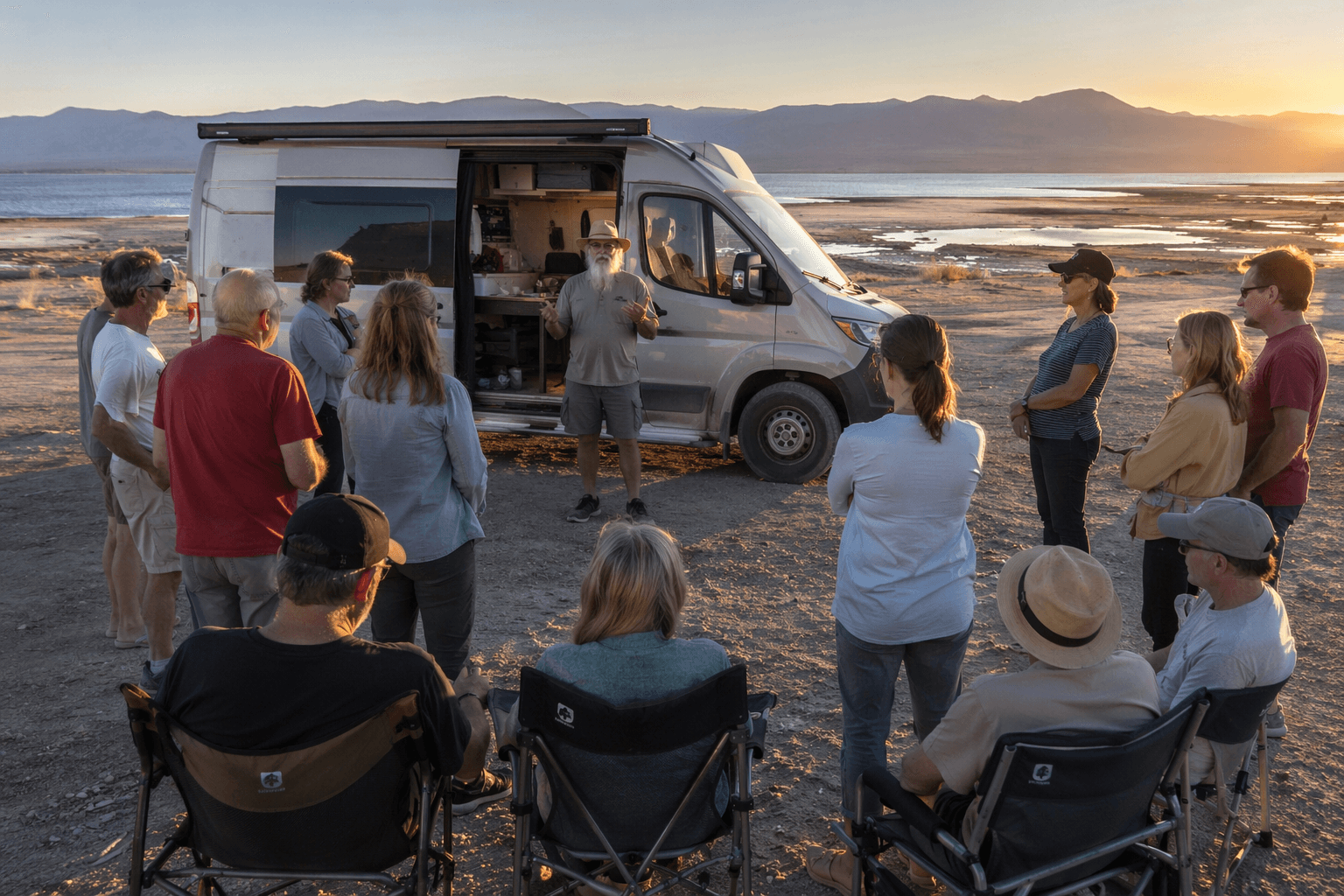
Utah is the sharpest preview of the trip’s stakes
The Utah leg shows why this story lands so hard for desert travelers. Carlyle has already made stops in Utah, including a stopover around Park City and a photo of him overlooking Antelope Island, a place that has become a symbol of how low water affects recreation in real time. Utah State Parks says Antelope Island’s main boat ramp is closed because Great Salt Lake levels are extremely low, and the Antelope Island Marina is unusable for launching boats.
The access problem is not abstract. Utah State Parks says getting from the parking lots to the lake shoreline is now more than a third of a mile. That means the easy assumption that a boat day starts at the water’s edge no longer holds. For road-trippers, it is a reminder that recreation infrastructure can vanish when a lake falls, and that the scenic stop on your itinerary may also be a place where water scarcity is impossible to ignore.
Utah’s drought office added more urgency on May 14, 2026, saying drought conditions were worsening and stressing wildlife, recreation and water supply. The Great Salt Lake itself remains below healthy levels, even as officials say conditions have stabilized and actions to ensure a healthy lake remain necessary, urgent and possible. That mix of warning and guarded hope is exactly the kind of signal travelers should watch for when planning desert water outings.
How the West changes the way you travel beside water
The practical lesson from the Utah stop is that water routes across the Southwest demand more attention than a standard road atlas gives them. A lake on a map does not guarantee a launch ramp. A shoreline does not guarantee easy access. A reservoir does not guarantee normal boating, camping or wildlife viewing conditions, especially when drought is already affecting reservoir storage and increasing fire danger.
That is where Uncle Pappy’s route becomes useful as a guide. It points travelers toward a better habit: check water conditions before you go, not after you arrive. If a stop like Antelope Island can leave you walking a long distance from parking to shore, then every desert water corridor deserves the same kind of respect. The scenery may still be there, but the access, and the rules around it, may have changed.

Florida brings the trip full circle
The road ends in a very different water world. Florida’s coast and wetlands are shaped less by drought exposure than by sea level rise, flooding and increasingly severe storms, the pressures laid out in the Florida Department of Environmental Protection’s 2026-2027 resilience plan. That contrast is one of the trip’s most useful ideas for travelers: the water crisis looks different depending on where you stand, but it is still a water crisis.
The federal response underscores that point. On March 25, 2026, the U.S. Environmental Protection Agency said it awarded Florida $1,687,013,000 in supplemental funds to improve water infrastructure resiliency after Hurricanes Helene and Milton. That is not a backcountry inconvenience story. It is a reminder that the same system that shapes road-trip scenery also shapes public infrastructure, flood recovery and the safety of communities at the end of the line.
What Southwest travelers can take from the route
- Treat shorelines, ramps and marinas as conditions-based, not permanent.
- Read drought and water updates before heading for a lake, river or reservoir.
- Expect access changes when water levels are low, especially in places like Great Salt Lake.
- Understand that recreation, wildlife habitat and local water supply are tied together.
- Look for ways to support stewardship while you travel, not after you get home.
Seen from the perspective of a Southwest adventure vacation, Carlyle’s journey offers a route-level checklist for responsible recreation:
That is the quiet genius of the Great American Water Road Trip. It turns a van, a signature campaign and a long drive from Santa Monica Pier to the Everglades into a rolling lesson in how water shapes every mile. The road still promises adventure, but in the West, the best travelers are the ones who notice how much of that adventure depends on what the water is doing beneath them.
This article was produced by Prism’s automated news system from verified source data, official records, and press releases, then run through automated quality and moderation checks before publishing. The system is built and supervised by the people who set the standards it runs under. Read our full AI policy.
Did this article answer your question?