Cyanotype of Grace Binney Winkley Wilson reveals early Hamptons tennis
A 1891-93 cyanotype of Grace Binney Winkley Wilson shows Hamptons tennis as social theater, where racket, grass court, and pose mattered as much as play.
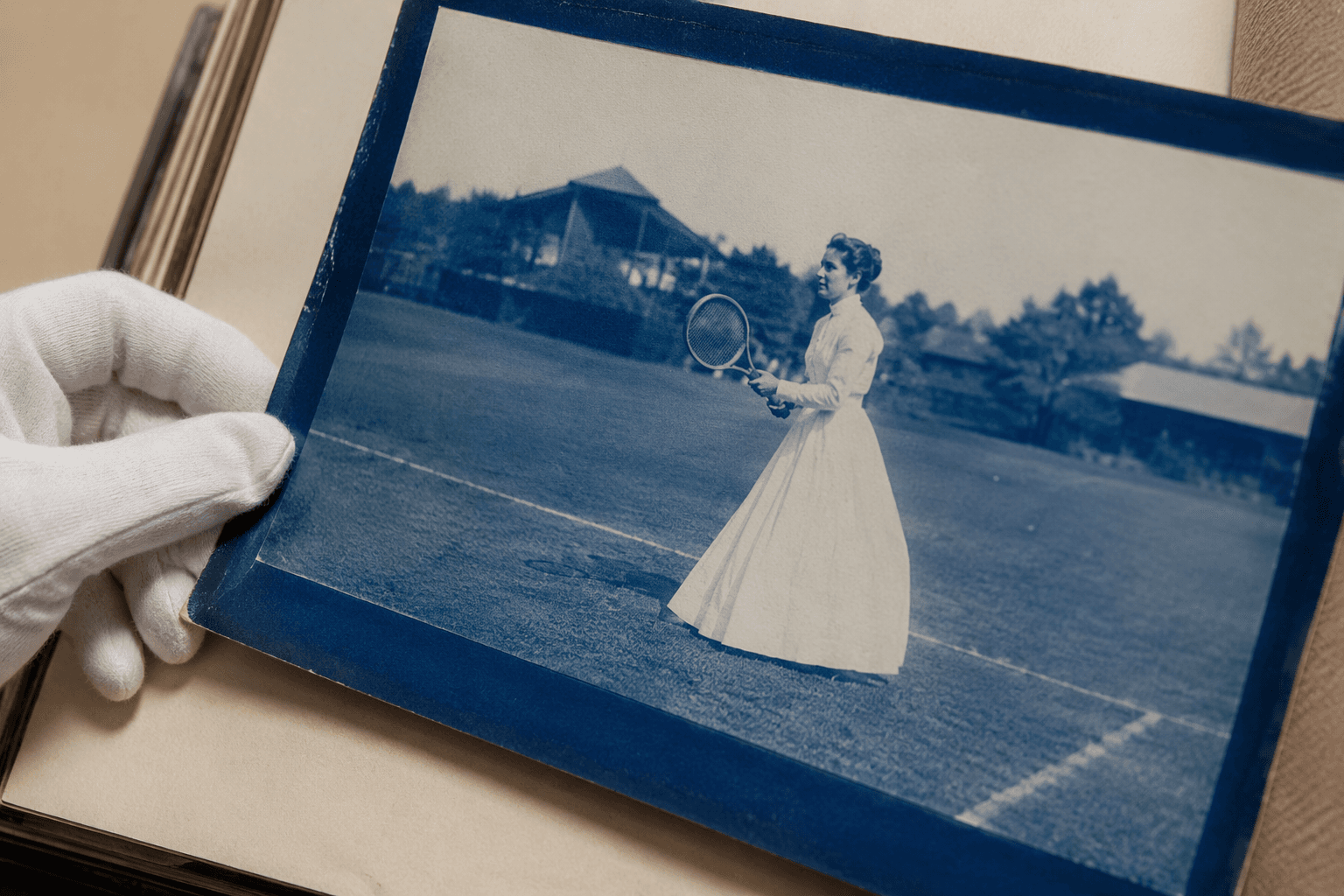
Grace Binney Winkley Wilson stands with her racket on a grass court, the net set directly behind her, and the image leaves little doubt that early Hamptons tennis was as much about being seen as being in motion. Dated circa 1891-1893 and made when Wilson was born in 1862 and was still well before her death in 1952, the cyanotype captures the East End at a moment when lawn tennis, dress, and setting worked together as a single social performance. That combination still echoes through the Hamptons game today, where the court has long carried meaning beyond the baseline.
A photograph that reads like a scene
The power of the image lies in how much it tells without a match in progress. Wilson is not frozen mid-swing; she is posed, racket in hand, on a carefully kept surface with the net prominently in frame. That choice turns the court into more than a place to play, because it shows how tennis already functioned as a visual ritual in East Hampton, New York.
The details matter. Long skirts, the style of the racket, the upright posture, and the grass court all point to a version of the game that was still tied to etiquette, leisure, and status. A court in the Hamptons in the 1890s was not just an athletic surface; it was a social marker worth photographing and keeping.
Why cyanotype made this possible
Cyanotype, invented by John Herschel in 1842, was a practical fit for scenes like this because it was simple, inexpensive, and iron-based. The Historic New Orleans Collection notes that no darkroom is required, and Kew describes the process as easier, cheaper, and more durable than earlier silver-based methods. That combination helped move photography beyond formal studio portraiture and into everyday life.
Those technical advantages matter for tennis history because they explain why a recreational moment on Long Island could survive so clearly in the archive. Cyanotype was safer and easier to use than earlier silver-based processes, so it worked well for the kind of informal but carefully composed image that documents a social world. In this case, the result is not just a likeness of Wilson, but evidence of how the game presented itself.
What the archive preserves about East Hampton tennis
The image lives in the East Hampton Library’s Digital Long Island Collection, part of a special collection and archive dedicated to the history and people of Long Island. The library says the collection contains more than 100,000 items, which gives you a sense of how much of the region’s social life has been preserved in one place. For tennis, that means the story is not limited to clubs and championships; it includes the small visual records that show who was on court and how they were framed.
Preservation Long Island adds another layer to that archive by noting that more than 500 documents from its manuscript collection were made accessible through the East Hampton Library’s Digital Long Island Collection. That access matters because a single cyanotype can do the work of a much larger record: it shows the setting, the posture, the clothing, and the way tennis fit into the visual culture of the East End. For readers trying to understand how Hamptons tennis began, that is not a side note, it is the evidence.
From estate lawn to modern club life
The early Hamptons version of tennis fit neatly into the estate culture of the era, where lawn, house, and recreation all reinforced one another. A grass court was enough of a leisure object to be photographed and preserved, and the image of Wilson shows how quickly the game became part of the local language of gentility. The net behind her is as important as the racket in her hand, because it places the sport in a setting designed to be read as much as played.
What has changed is the structure around the game. East Hampton Tennis Club describes itself as a private cooperative tennis club established in 1969, a far more formal organization than an outdoor court on a private lawn. What still feels familiar is the way tennis in the Hamptons remains tied to place, presentation, and membership, with the court acting as part of the social landscape rather than only a strip of playing surface.
That is why the cyanotype still lands with unusual force. Grace Binney Winkley Wilson is standing still, but the image shows a game already built from movement, dress, and display, and the Hamptons have never fully separated those things from tennis.
This article was produced by Prism’s automated news system from verified source data, official records, and press releases, then run through automated quality and moderation checks before publishing. The system is built and supervised by the people who set the standards it runs under. Read our full AI policy.
Did this article answer your question?