Southampton Invitation revived Hamptons tennis history from grass-court glory
The Meadow Club’s invitation event put Southampton inside America’s early grass-court circuit. Its wartime detours show how Hamptons tennis kept its prestige alive.

The Hamptons once held a meaningful stop in America’s grass-court culture, and the Southampton Invitation is the clearest proof. Long before the region was reduced to summer glamour and court-side socializing, the Meadow Club of Southampton Invitation gave local tennis a place on the early lawn-tennis map, with elite fields, grass courts, and a history that stretched across generations.
A grass-court event with real weight
Formally the Meadow Club of Southampton Invitation, the tournament began in 1887 and first staged play in 1888. It lasted for 85 editions through 1973, which is a remarkable run for any regional event and a reminder that Southampton was not on the margins of tennis history. It sat inside the old American invitation-event tradition, where summer tennis was built around prestige, club culture, and the kind of grass-court conditions that shaped the sport before the Open era changed everything.
That history matters because it gives the Hamptons a deeper athletic identity than the one most people remember. The Meadow Club was not just a backdrop for warm-weather sport. It was part of the circuit, a place where serious tennis was played and watched, and where a local event could carry enough standing to survive for decades.
The names that gave it stature
The Southampton Invitation drew some of the biggest figures from different eras of the game, which is exactly why it stands out in the record. Bill Tilden, Bobby Riggs, Rod Laver, Fred Stolle, and Tony Roche all appear among the names associated with the event, linking the Meadow Club to both the pre-Open amateur world and the more international grass-court game that followed.
That mix of players tells the story better than any abstract explanation could. Tilden represents the old guard of American tennis. Riggs connects the event to a later era of showmanship and rivalries. Laver, Stolle, and Roche place Southampton in the company of world-class grass-court talent that knew how to move, serve, and finish on the surface that once defined elite summer tennis. For Hamptons readers, that lineage is the real currency: it shows that this was never just a local social fixture, but a tournament with enough pull to attract serious names across changing generations.
Wartime tennis did not stop, it adapted
One of the most revealing chapters comes from wartime tennis in 1942, when the event did not disappear so much as reshape itself. TIME’s August 10, 1942 note records Ted Schroeder beating Sidney Wood 3-6, 6-1, 6-4, 1-6, 6-1 in the Southampton Invitation Tennis Singles Tournament, which that year was described as a round robin at The Meadow Club in Southampton, Long Island.
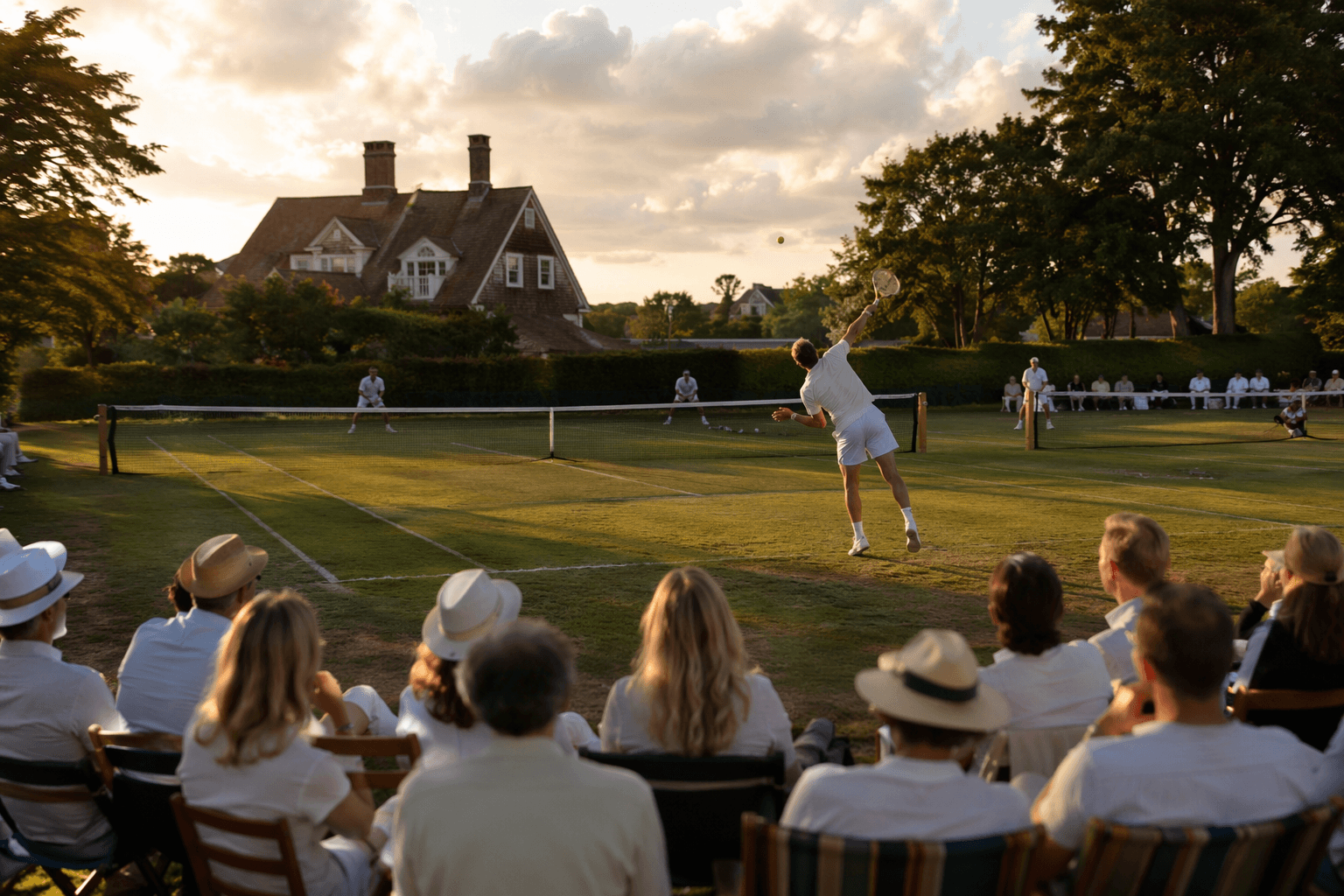
That detail says a lot about how the event survived an unsettled era. The format changed, but the competition remained visible, and the tournament kept its prestige even as the world was at war. Instead of shutting down entirely, Southampton kept tennis alive through flexibility, preserving the club atmosphere and the spectator draw that made the event matter in the first place. For anyone tracing the history of local sport, that wartime adjustment is a useful reminder that big traditions often survive by changing shape rather than by standing still.
Women were part of the story too
The Southampton Invitation is often remembered as a men’s grass-court tournament, but that is only part of the picture. Mixed doubles appeared in most years, which anchored women’s participation inside the broader event rather than treating it as a side note. There was also a brief women’s invitation singles competition under the Southampton Invitational Round Robin and Meadow Club Invitational Round Robin titles in the late 1920s through the early 1940s.
That matters because it shows the Meadow Club event was not frozen in one narrow format. It reflected the way club tennis actually worked in the Hamptons, where social, competitive, and mixed-gender play often overlapped. Women’s singles may have been brief in this setting, but its presence, along with mixed doubles, adds another layer to the tournament’s place in local tennis history.
Why Meadow Club grass still matters to the Hamptons
Grass courts shape the feel of a place, and the Meadow Club’s surface helped define Southampton’s tennis identity for decades. Grass reward skills that are easy to overlook from the sidelines: clean serving, quick footwork, sharp anticipation, and the ability to adapt point by point as the turf changes through a tournament. When an event lasts from the late 19th century into the 1970s, it leaves behind more than a champions list. It leaves a local memory of how tennis should look and sound in summer.
For the Hamptons, that memory still matters because it explains why tennis fits here so naturally. The Southampton Invitation tied the area to the broader history of American lawn tennis rather than to a purely recreational image of coastal summer life. It gave the region a place in a national sporting tradition, and it did so through a club event that was serious enough to attract top names, flexible enough to survive wartime, and broad enough to include mixed competition and women’s play.
The Southampton Invitation revived the right kind of Hamptons tennis history: not a glossy afterthought, but a grass-court story with structure, continuity, and consequence. That is why the Meadow Club belongs in any serious account of tennis in the Hamptons, and why its forgotten tournament still helps explain the area’s enduring tennis identity.
This article was produced by Prism’s automated news system from verified source data, official records, and press releases, then run through automated quality and moderation checks before publishing. The system is built and supervised by the people who set the standards it runs under. Read our full AI policy.
Did this article answer your question?