The Sims 4 vitiligo CC roundup expands skin details for every life stage
Vitiligo CC now gives CAS more than a look, it gives families continuity, from infant face details to bold full-body overlays that read cleanly in gameplay.
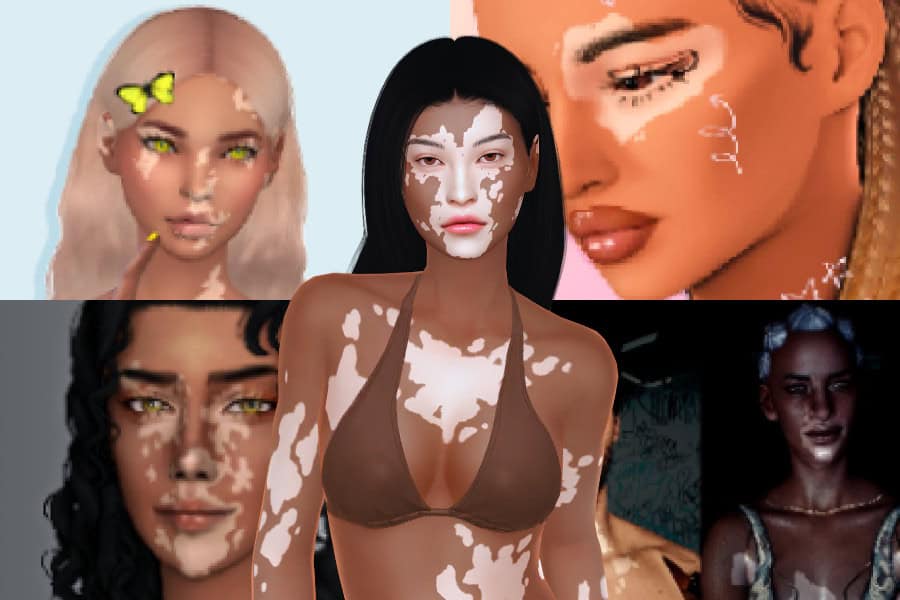
Vitiligo is one of those skin details that changes how a household feels the moment you load into CAS. A Sim stops reading like a perfect, default model and starts looking like someone with a family tree, a texture, a history, and a place in the save. That is exactly why this roundup works so well for realism-focused players: it treats vitiligo as something that can shape toddlers, children, teens, adults, and elders, not just one adult-only style choice.
Why this roundup matters for realistic saves
The strongest Sims 4 realism pieces do more than look accurate in a close-up. They help the whole household feel related, because skin details can echo across generations in a way that makes screenshots, genetics gameplay, and legacy saves feel more grounded. The CC gathered here builds on the same logic as the base game’s own representation work, where EA introduced vitiligo as a free Create-a-Sim skin detail update and framed it alongside birthmarks, stretch marks, scars, and freckles as part of a broader effort to expand representation.
That official update also mattered because it was not treated as a single preset with one look. EA said it wanted to start with a range of patterns showing different levels of coverage and symmetry, which is the same practical idea that makes CC useful here. The best vitiligo content does not force every Sim into the same visual story. It gives you enough variation to match a Sim’s face, body, age, and the kind of household narrative you are trying to build.
The pieces that work best when you want subtle realism
For everyday gameplay, the subtle options usually do the most work. Soft facial details, small patch placements, and skin details with only a little coverage are the ones that disappear into a Sim’s face in the best possible way. They are especially useful if you want a Sim to read as naturally lived-in without becoming the focal point of every screenshot.
One of the clearest examples in the roundup offers 45 spot variations, which is exactly the kind of control realism players want. Those swatches let you decide whether the patches look scattered, clustered, light, or more concentrated, and that kind of flexibility matters when you are building a Sim who needs to feel believable in a crowded household portrait. If you want the detail to support the Sim rather than dominate them, this is the kind of set that delivers.
These lighter pieces also tend to read well across different skin tones and art styles because they work with the face instead of flattening it. In gameplay, that usually means you get the effect you wanted without sacrificing the Sim’s features, makeup, or overall style. That balance is what makes subtle CC so effective in legacy saves, where you may want vitiligo to be visible but not overpower the whole household.
When a bolder overlay makes sense
Sometimes realism calls for the opposite approach. A more pronounced full-body overlay is the right choice when you want vitiligo to be unmistakable from the first screenshot, especially in close family scenes or portrait-style shots. One standout option in the roundup covers the chest, arms, stomach, face, and legs, which gives the pattern enough reach to look intentional rather than accidental.
That kind of coverage is useful when you are telling a story about a Sim whose look should be part of their identity, not just a small detail. It also tends to pair better with simpler outfits and cleaner makeup, because the skin detail is already doing a lot of visual work. For players who want their saves to feel more representative, this kind of overlay can turn an ordinary CAS session into a much more specific character-building moment.
There is also room in the roundup for more dramatic or even supernatural-leaning recolors, which broadens the use case beyond pure realism. Those sets are useful if you like your Sims to sit somewhere between grounded and stylized, or if you want a skin detail that still feels expressive in a more fantastical save. The point is not that every household needs the biggest option. It is that the roundup gives you a spectrum.
Life-stage continuity is what makes it feel real
The most valuable part of the vitiligo conversation in The Sims 4 is that it is not limited to one age group. Official vitiligo content already stretches from infants through elders and includes both face and body options, which makes it much easier to track a Sim across life stages without the feature feeling like a one-off cosmetic. That is a huge deal for players who care about family resemblance and genetics storytelling.
The roundup follows that logic by including infant-compatible updates, which means younger Sims can participate in the same visual language as their parents and grandparents. That continuity matters more than it might seem at first glance. When a detail appears on an infant and still makes sense on a teen, adult, or elder, the save starts to feel designed around real household growth instead of isolated outfit changes.
How these files are organized in CAS
A big part of making vitiligo CC work is simply knowing where the creator put it. Public listings place these details in different CAS categories depending on the pack, including skin details, face birthmarks, and tattoo categories. Some sets are built as separate face and body pieces, while others come with multiple swatches or opacity levels so you can mix and match the effect.
That is why creator notes matter so much here. A vitiligo overlay may look perfect in preview and still seem to “disappear” if you are checking the wrong CAS category. If you have ever downloaded skin detail content and spent too long hunting for it, this kind of label-checking saves a lot of frustration before you even hit play.
The larger EA backdrop keeps pushing realism forward
This CC moment did not appear in a vacuum. EA followed the 2024 vitiligo update with another free skin-details release on August 19, 2025, adding wrinkles, age spots, dark spots, rosacea, freckles with more coverage, and new stretch mark options. That update also made a point of giving more attention to elder Sims, which reinforces the same idea behind this roundup: skin details are part of how players tell the truth about age, inheritance, and identity in CAS.
Taken together, those official updates created the vocabulary that CC creators are now building on. The game showed players that skin details could be varied, representative, and meaningful, and the community answered with packs that reach from infant faces to elder bodies. That is why this roundup lands so well now: it does not just add more options, it makes the smallest details in a household do the storytelling work they were always meant to do.
This article was produced by Prism’s automated news system from verified source data, official records, and press releases, then run through automated quality and moderation checks before publishing. The system is built and supervised by the people who set the standards it runs under. Read our full AI policy.
Did this article answer your question?