Placer County approves rules for movable tiny homes
Placer County now recognizes movable tiny homes, but the real test is whether your parcel is zoned right and the unit is permitted as a primary home or ADU.
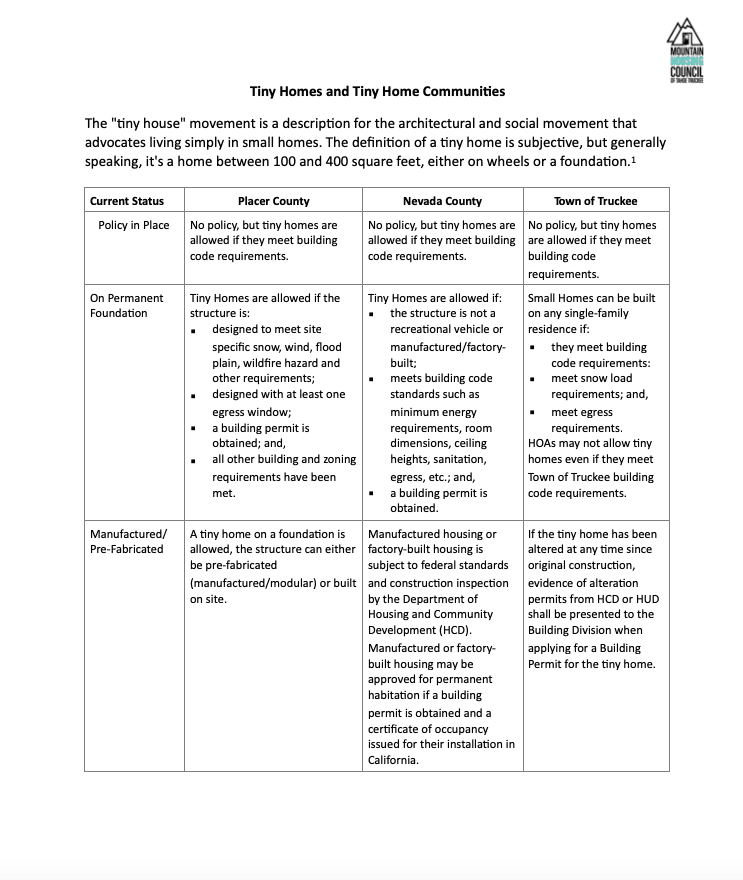
Placer County has drawn a real line around movable tiny houses: they are no longer a shrug-and-hope proposition, but a housing type tied to Article 17.56, Section 17.56.400 and the county’s permit process. If you are trying to place a THOW on a real parcel, the make-or-break questions are whether it will be treated as a primary home or a detached ADU, and whether the lot qualifies before you spend money on delivery.
What Placer County has actually approved
Placer County says its Housing Related Code Amendments were approved in summer 2022 and amended again in February 2026, and that is the backbone of its tiny-home policy. The county’s tiny-home page points directly to Article 17.56, Section 17.56.400, titled “Moveable Tiny Houses,” which sets general regulations to guide the location, design, and placement of moveable tiny houses.
That language matters because it shows the county is not treating tiny homes as a novelty or an afterthought. Once a unit is defined by code, the conversation shifts from “Can I fit it on the lot?” to “Does this parcel, this zoning, and this permit path allow it?” That is the difference between a buildable plan and an expensive shell that never clears the county’s review.
The first fork: primary dwelling or ADU
The county’s Moveable Tiny Home Permit Checklist says a moveable tiny home may be installed on a property as either a primary single-family dwelling or a detached accessory dwelling unit, as long as it complies with zoning ordinance standards and gets a building permit. That is the cleanest decision tree in the whole policy: your THOW is not just a movable object, it has to enter the county system as one of those two housing types.
Placer County’s FAQ adds another crucial layer. At this point in time, every parcel zoned residential in the county is allowed up to three dwellings: one primary dwelling, one ADU, and one JADU. In a separate FAQ, the county says a tiny home qualifies as a State-exempt ADU. Put together, those rules mean a tiny home is not floating outside the system. It is being folded into the county’s accessory-housing framework, where the zoning and permit labels matter as much as the floor plan.
For a buyer, that means the brochure language is secondary. If you are shopping a tiny house on wheels, the county wants to know whether it is landing as the main house or as an accessory unit behind an existing one. That is the classification call that should happen before money goes toward transport, site prep, or a build contract.
Where the county appears permissive
The county’s checklist says qualifying properties must be zoned to allow single-family residences, specifically including RS, RA, RF, RES, and A zones. That is the practical green-light area the county has already identified, and it gives you a real starting point when you are scanning a parcel listing or talking to a seller.
There is still a distinction between being “residential” in the broad sense and being eligible under the county’s tiny-home checklist. Placer County’s FAQ says residential parcels can hold up to three dwellings, but the checklist still points you to the single-family-residential zoning categories where moveable tiny homes are meant to fit. If your parcel is not in that lane, stop there and confirm with planning staff before you assume the answer will bend your way.
That is especially important in unincorporated Placer County, where county zoning, not a city code, is doing the heavy lifting. The county’s tiny-home guidance is the document that tells you whether the parcel is in the game at all.
What to ask before you spend money
The safest move is to call the Placer County Community Development Resource Agency or Planning Services Division before you buy the unit, schedule delivery, or pay for a site plan. The county’s own materials make clear that the unit must clear zoning standards and receive a building permit, and that no building or structure regulated by the California Building Code may be erected, constructed, moved, or converted without a separate permit.
Use that call to pin down the exact path:
1. Confirm the parcel’s zoning and whether it falls in RS, RA, RF, RES, or A.
2. Confirm whether the tiny home will be processed as a primary dwelling or a detached ADU.
3. Confirm that the building permit path is open before you commit to transport or installation.
That is the point where a tiny-home dream either becomes a permitted housing plan or stalls out in paperwork.
The county already had an accessory-housing playbook
Placer County’s tiny-home rules did not appear in a vacuum. On May 12, 2021, the county published free accessory home building plans, saying the resource was meant to save homeowners thousands of dollars and help increase the county’s stock of affordable housing. The county also said those pre-approved ADU plans had been reviewed by its Building Team for conformance with current building codes.
That history helps explain why tiny homes show up inside the county’s accessory-housing rules rather than as a one-off exception. The county’s ADU update materials say state law changes after its 2020 ADU ordinance rendered that ordinance null and void, which is why a new zoning text amendment was needed to restore consistency. The tiny-home language sits inside that broader reset, not outside it.
Why tiny-house watchers noticed
Tiny-home advocates were tracking Placer County early. The Tiny Home Industry Association’s legislation page lists the county’s movable tiny-home policy with an effective date of July 14, 2022, and its article on the topic says Placer County approved movable tiny house zoning for three uses.
That does not replace the county’s own code and permit materials, but it does show the policy was noticed beyond local government. Placer became a reference point because it moved from general interest to a written zoning structure, then amended that structure again in February 2026.
For anyone trying to land a movable tiny house on a real parcel this year, that is the lesson baked into the county’s rules. Placer County has opened a lane for movable tiny homes, but the lane still runs through zoning, classification, and permit review, not through guesswork.
This article was produced by Prism’s automated news system from verified source data, official records, and press releases, then run through automated quality and moderation checks before publishing. The system is built and supervised by the people who set the standards it runs under. Read our full AI policy.
Did this article answer your question?