INTERPOL Identifies 4 Cold Case Victims, 43 Unidentified Women Remain
Rita Roberts was identified 30 years after her murder when family recognized her black rose tattoo. INTERPOL's Identify Me campaign has now named 4 victims; 43 remain unknown.
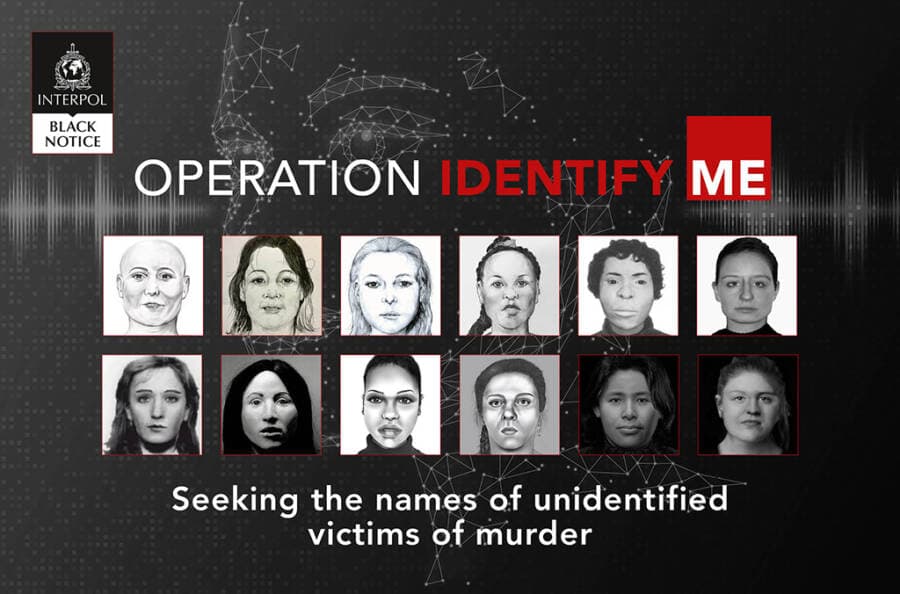
Four women killed in cold cases have been identified since 2023 through INTERPOL's Identify Me campaign, but 43 others whose remains were found across Europe are still without names. The second phase of the operation now targets 46 unidentified cases spanning Belgium, France, Germany, Italy, the Netherlands, and Spain, many of them dating back to the 1980s.
The campaign's most documented identification is Rita Roberts, a British woman murdered in Belgium. Her family had last heard from her through a postcard in May 1992; her body was found the following month. She went unidentified for roughly three decades until BBC coverage of last year's first appeal included an image that showed her distinctive black rose tattoo. Her sister Donna recognized it. When the family was told the body was indeed Rita, Donna broke into tears, but says she takes comfort knowing Rita is "at peace." The family is now appealing for any information, however small, that could help investigators move the case forward.
That single identification illustrates what makes Operation Identify Me structurally different from past INTERPOL practice. The campaign's launch marked the first time INTERPOL had ever publicly released what are known as "black notices," documents seeking information about unidentified bodies that had historically only circulated within INTERPOL's internal police network. Making those notices public, and pairing them with media outreach, turned a passive database entry into an actionable appeal.
The forensic toolkit running beneath that public outreach includes DNA profiling, facial reconstruction, and isotopic analysis, techniques that can indicate a victim's geographic origin, dietary history, and cause of death. INTERPOL has published facial reconstructions for the cases on its Identify Me web page. One case in the second phase involves a teenage girl found murdered in western France more than 40 years ago; the only physical clues available are a pair of red shoes, two beaded necklaces, and a British 10p coin. A separate reconstruction exists for the woman in what investigators call the Wassenaar case, though no further details on that victim have been released.
Dr. Susan Hitchin, coordinator of INTERPOL's DNA unit, framed the stakes plainly: "These women have suffered a double injustice. They've become victims twice: they've been killed through an act of violence and they've been denied their name in death." She has also pointed to structural factors driving the caseload, noting that open borders, increased global migration, and human trafficking have all contributed to more people going missing outside their home countries.

INTERPOL has enlisted celebrity ambassadors from each of the six participating nations to broaden the campaign's reach. Belgium's contingent includes actress Veerle Baetens and singer Axelle Red. France is represented by Olympic champion Marie-José Pérec and actress Sarah Biasini. Germany's ambassadors are boxer Regina Halmich and broadcaster Katrin Müller-Hohenstein. Figure skater Carolina Kostner and judoka Alice Bellandi are representing Italy. The Netherlands has actress Carice van Houten and athlete Stien den Hollander, while Spain's representatives are actress Luisa Martin and filmmaker Mabel Lozano.
One numerical inconsistency worth flagging: INTERPOL's press release describes 46 cold cases in the second phase, but a separate summary states that 43 unidentified women remain following the four identifications made since 2023. Simple subtraction from 46 would yield 42, not 43. INTERPOL has not publicly reconciled that one-case gap, and the names of three of the four identified women, aside from Rita Roberts, have not been released in available materials.
The full case list, including facial reconstructions, is available on INTERPOL's Identify Me web page for anyone who may recognize a face, a detail, or a memory that investigators have not yet found.
This article was produced by Prism’s automated news system from verified source data, official records, and press releases, then run through automated quality and moderation checks before publishing. The system is built and supervised by the people who set the standards it runs under. Read our full AI policy.
Did this article answer your question?