San Diego Tuna Anglers Get Key Summer Rigs From Long Range Report
Bring two tuna outfits, not six: San Diego’s summer playbook now centers on a 25/30-pound setup and a 40/50-pound yo-yo rig.
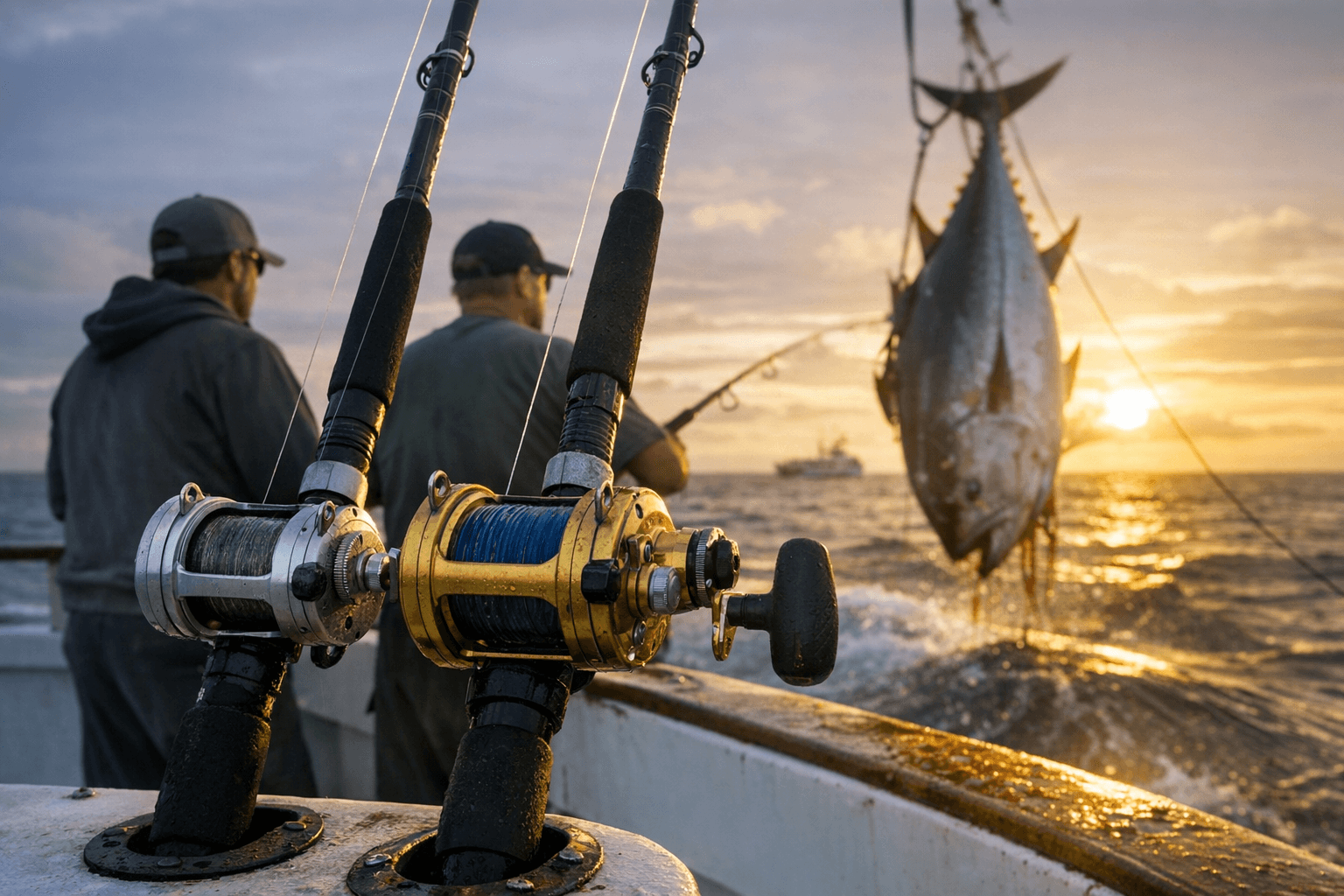
If you bring only two tuna rigs, make them these
San Diego’s smartest summer tuna setup is not a crowded rack of rods. It is two outfits that cover the most likely bite windows: a 25/30-pound rig for school-size fish and a 40/50-pound rig for bigger-grade tuna that can punish weak drag and sloppy decisions.
That is the practical message in episode 16 of BDOutdoors’ Long Range Report, where Steve Carson sits down with Rocco Sanchez of the American Angler to keep the conversation focused on what actually gets used on San Diego trips. The point is simple: if your gear overlaps too much, you waste space and money; if you leave a gap, you are stuck undergunned the moment the size class changes.
The two-rig framework that works
The best way to think about the San Diego summer tuna loadout is as a size-class split, not a tackle collection. One rig is built to cover school-size tuna when the bite is active and the fish are not overpowering the boat or the line. The other is there for the heavier fish that can show up without warning and force you into stronger line, more drag, and a more deliberate presentation.
A recent local report backed that up with a very specific recommendation: bring a 40/50-pound setup for a yo-yo jig and a 25/30-pound setup for the lighter end of the spread. That pairing is useful because it covers two different jobs instead of two versions of the same one. When the deck calls for speed and power, the heavier setup earns its keep. When the fish are smaller, more numerous, or less demanding, the lighter rig is the one you want already rigged and ready.
- 25/30-pound setup: your lighter, more versatile option for school-size tuna and situations where finesse matters more than brute force.
- 40/50-pound setup: your heavy hitter for yo-yo jigging and larger-grade tuna that can push the system hard.
When each setup wins
The 25/30-pound outfit is the rig that keeps you fishing when the fleet is working through smaller fish or when the bite rewards a cleaner, less intrusive presentation. It is the one that makes sense when you want enough control without carrying unnecessary bulk. On San Diego trips where the fish are present but not all oversized, this is the rig that keeps your line class in the conversation without overcommitting.
The 40/50-pound setup comes out when the tuna are bigger, the retrieve is more aggressive, or the technique demands more backbone. The March 18 Pacific Voyager report made that clear by pairing the heavier setup with a yo-yo jig, which is exactly the kind of presentation that rewards confidence in drag and tackle. If the fish get meaner, deeper, or harder to move, this is the outfit that protects the rest of your trip from turning into a tackle failure.
The expensive mistake is bringing two outfits that are too close together, such as a pair of rigs that both live in the same middle ground. That leaves you with no true light option for finicky school fish and no real heavy option when a bigger grade shows. The other mistake is the opposite: carrying a light rod and a beef stick with such a huge gap between them that one of them sits unused all day.
Why this guide matters now
This is not just tackle talk. BDOutdoors says the Long Range Report series will keep rolling through the summer and fall with current conditions, tackle recommendations, crew interviews, and future predictions. That makes the episode part gear advice and part real-time bulletin for a community that lives on changing bite windows and moving fish size classes.
Steve Carson matters in that mix because he is not presented as a casual voice. BDOutdoors describes him as a longtime PENN advocate and employee, which gives the gear discussion a very specific point of view. Rocco Sanchez adds the on-the-water credibility. He works as both captain and deckhand on the American Angler, so the advice is coming from someone who sees how tackle choices hold up when a boat is actually on tuna.
The boat behind the advice
American Angler is part of the Point Loma Sportfishing fleet at 1403 Scott Street in San Diego, and the landing lists Brian Kiyohara, Ray Lopez, and Lori Withee as owners, with Kiyohara and Lopez also named as captains. The boat page highlights state-of-the-art navigation, complementary WiFi, satellite TV, Sirius XM, two chefs per trip, 12 staterooms, and an RSW system for sashimi-grade fish.
The vessel itself is a 90-foot San Diego long-range boat, built in 1986, with a recreational-fishing gear designation, 24.87 meters of length, and 1280 horsepower in the IATTC vessel fact sheet. That matters because the rig advice is coming from a platform built for serious multi-day tuna work, not a casual day-trip setup.
The bigger fishery picture
The reason two rigs can be enough is that the Pacific bluefin tuna fishery has changed, but it is still demanding. NOAA Fisheries says Pacific bluefin tuna have rebounded enough to exceed international rebuilding targets ahead of schedule. Monterey Bay Aquarium adds the scale of the recovery story: the species was depleted to about 2 percent of historical abundance, and countries committed to rebuilding it to 20 percent of historic levels by 2034.
That recovery does not make the fishery simple. It makes it more active, more closely watched, and more sensitive to preparation. San Diego’s own spring reports show why. On March 18, 2026, Pacific Voyager returned with 72 bluefin tuna, 55 yellowtail, 110 lingcod, 14 red rockfish, and 1 halibut, and the same update told anglers to bring both a 40/50-pound yo-yo jig setup and a 25/30-pound setup. SportfishingReport.com’s 2026 bluefin leaderboard reinforces the point, listing Polaris Supreme with 575 bluefin tuna and Pacific Voyager with 248. The season is already moving enough that the right pair of rigs can decide whether you stay in the game or spend the day improvising.
The screenshot version
If you want the shortest possible dockside plan, it is this:
- Bring a 25/30-pound rig for school-size tuna and lighter presentations.
- Bring a 40/50-pound rig for yo-yo jigging and bigger-grade fish.
- Do not waste space on two rigs that do the same job.
- Do not leave a gap between light and heavy tackle.
- Match your setup to the size class you expect, because San Diego tuna can shift from one day to the next.
That is the value of the Long Range Report angle from Steve Carson and Rocco Sanchez. It does not try to turn tuna tackle into a museum of options. It gives San Diego anglers the two rigs that cover the most important summer decisions, and that is exactly the kind of advice that keeps a trip organized before the boat ever leaves Point Loma.
This article was produced by Prism’s automated news system from verified source data, official records, and press releases, then run through automated quality and moderation checks before publishing. The system is built and supervised by the people who set the standards it runs under. Read our full AI policy.
Know something we missed? Have a correction or additional information?
Submit a Tip