AI Memory Shortage Drives Sony to Consider PS6 Delay, Nintendo Price Rise
Sony is reportedly weighing a PlayStation 6 launch push to 2028 or 2029 as AI data centers gobble memory chips, while Nintendo mulls a Switch 2 price rise later this year.
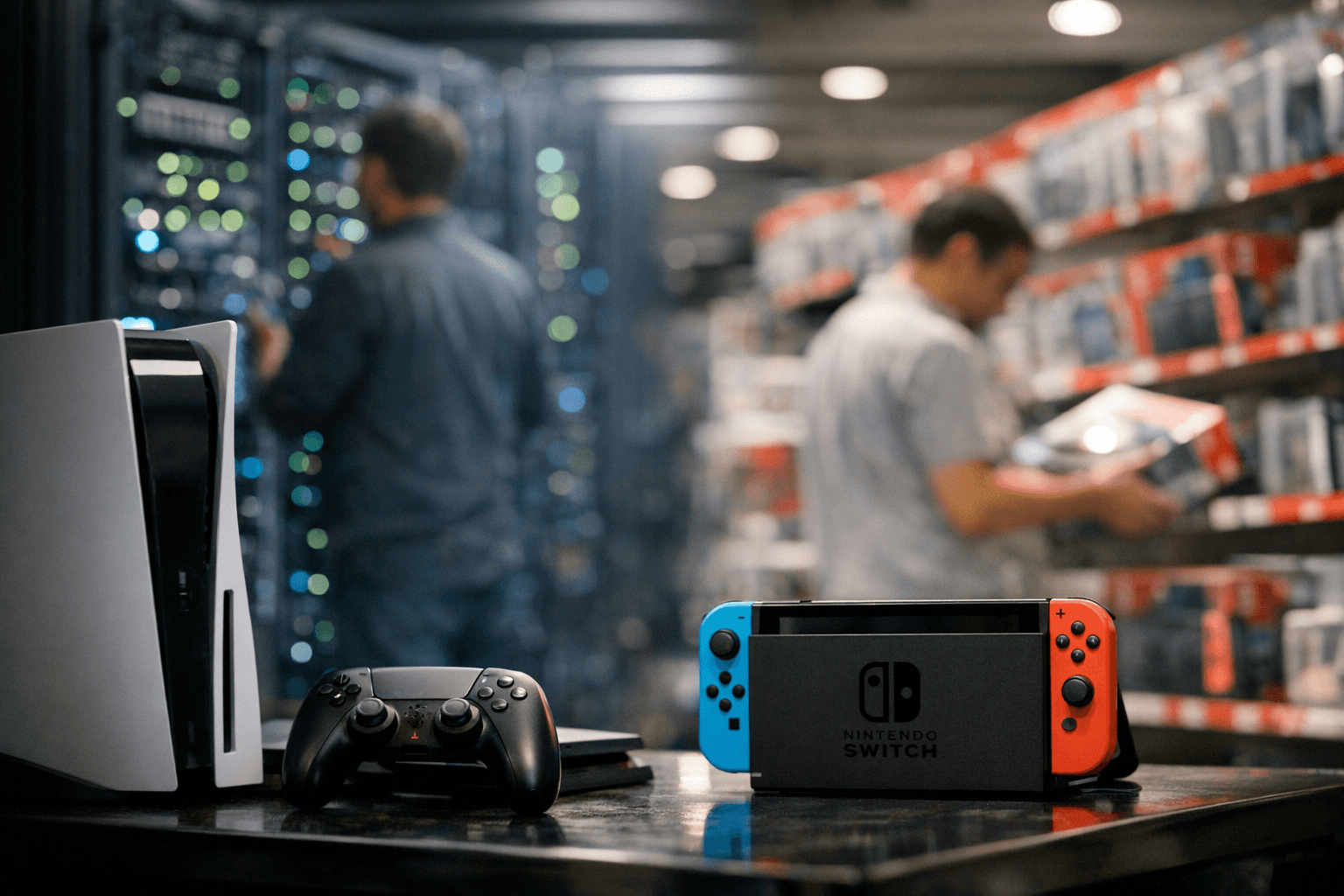
Bloomberg-sourced reporting says Sony "is reportedly thinking about delaying the PlayStation 6 to 2028 or possibly 2029," with multiple outlets repeating that claim via "people 'familiar with the company's thinking'." The move is tied directly to a global memory-chip crunch driven by AI data center expansion and hyperscaler demand for high-bandwidth memory.
GamesIndustry.biz, iPhoneInCanada, Kotaku and the Times of India all trace the core reporting to Bloomberg and note the anonymous sourcing. GamesIndustry carried a pull-quote reading "This is the most significant disconnect between demand and supply in my 25 years in the industry," and explicitly reported that "Neither Nintendo nor Sony representatives responded to Bloomberg's request for comment." The Times of India item, timestamped Feb 16, 2026, 18:31 IST, framed a delayed PS6 as making the PS5 generation "potentially the longest in PlayStation history, stretching well beyond the typical 7-year cycle."
Supply-chain specifics are stark: Times of India and other outlets name Samsung, SK Hynix and Micron as "the world's three major memory makers" that have shifted capacity toward high-bandwidth memory used in Nvidia's AI chips, leaving less standard DRAM for phones, laptops and game consoles. TOI quotes that "Companies like Alphabet and Amazon are pouring hundreds of billions into AI infrastructure this year alone," while GamesIndustry and iPhoneInCanada cite examples including Alphabet, OpenAI and Google as buyers snapping up memory. GamesIndustry noted that "some have dubbed the crisis 'RAMmageddon,'" and TOI relayed that "Analysts at Bernstein warn prices are going 'parabolic'."
Industry impacts extend beyond Sony. GamesIndustry reports Nintendo "is reportedly considering a price rise later this year" for the Switch 2 after last year's Switch 2 release "inadvertently drove up demand" for storage cards. Kotaku adds that Valve has already delayed pre-orders for its Steam machine, linking that delay to the memory shortage. Kotaku also recalled that PS6 was "rumored to be arriving in late 2027" before the Bloomberg-driven shift to 2028 or 2029, and relayed that "alleged specs for the PS6 began leaking last summer" alongside speculative pricing ranges of "$400-to-$600" versus "$700-to-$1,000." Kotaku further reported that Sony "is also believed to be currently working on a handheld that would be able to play PS5 and some cross-gen PS6 games," presented as industry belief rather than corporate confirmation.
Corporate and market voices underscore duration concerns. GamesIndustry quoted Lenovo CEO Yang Yuanqing saying "This structural imbalance between supply and demand is not simply a short-term fluctuation" during an earnings call last week, and TOI cautioned that new chip fabrication plants take years to build. That timeline underpins predictions that shortages and higher VRAM costs will affect consumer electronics through 2025 and beyond, per iPhoneInCanada and other excerpts.
Public reaction surfaced on Eurogamer's Facebook post 15h ago, which showed "All reactions: 11" and "12 comments 1 share" with users such as Paul Ancill posting "People will complain about the console delays and make an AI meme about it in protest" and Takeru Sakurai warning "RAM Shortages will just cause a shortage of PS5 units. The industry is in trouble if neither Sony nor Microsoft can release the next console by 2028." Given the anonymous Bloomberg sourcing and the lack of on-the-record corporate confirmations published in these excerpts, uncertainty remains high even as memory makers, hyperscalers and analysts signal a structural, multi-year market shift.
This article was produced by Prism’s automated news system from verified source data, official records, and press releases, then run through automated quality and moderation checks before publishing. The system is built and supervised by the people who set the standards it runs under. Read our full AI policy.
Did this article answer your question?