Pokémon GO Players Unknowingly Trained AI Now Guiding Delivery Robots
Every PokéStop scan you ever did just became a robot's GPS. Niantic's 30 billion player-captured images now guide Coco Robotics' sidewalk delivery bots with centimeter accuracy.
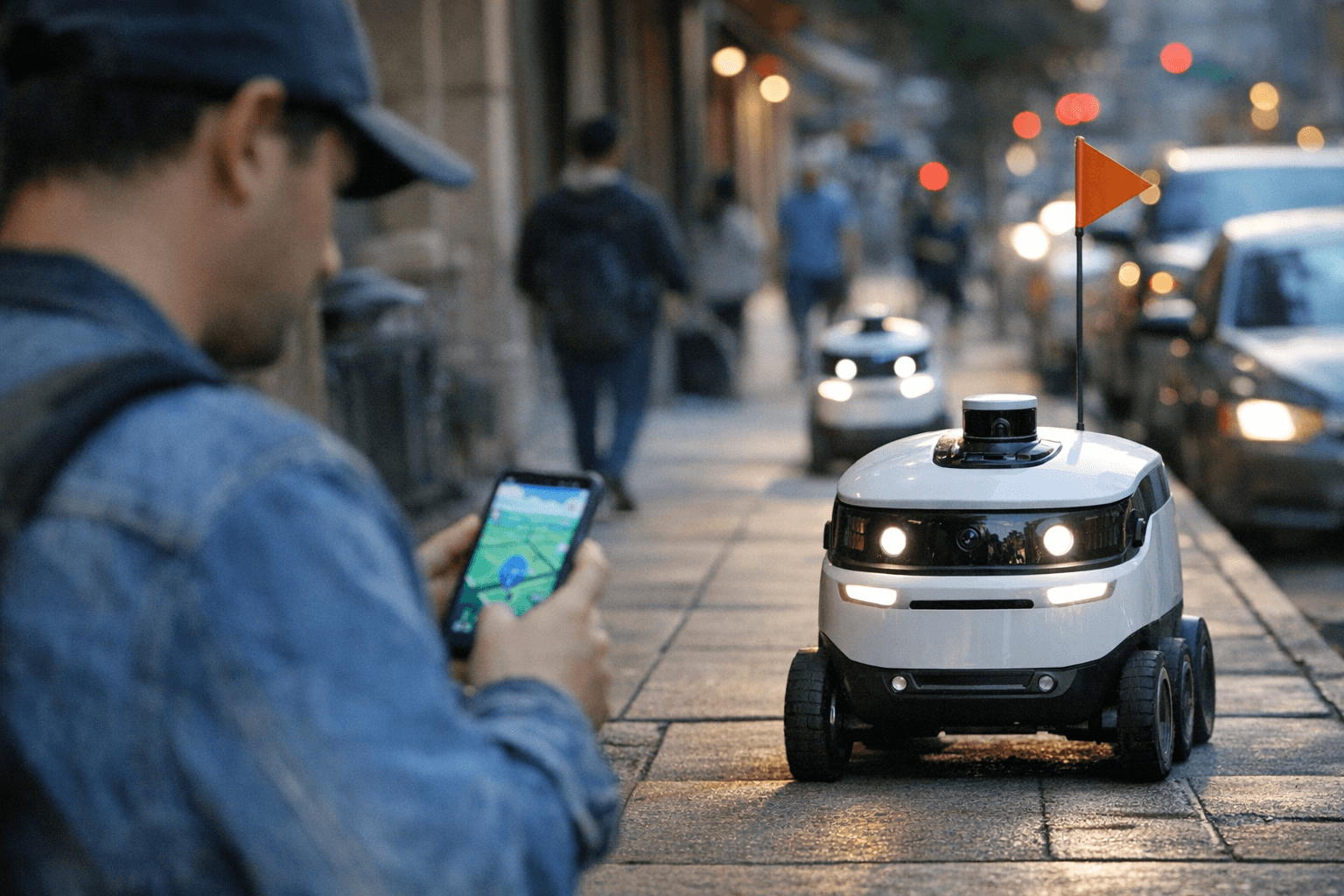
Every time a Pokémon GO player pointed their phone at a PokéStop to complete a Field Research task and pocket some in-game rewards, they were also doing something they had no idea about: mapping the physical world with enough precision to guide a delivery robot through a crowded city block.
Niantic Spatial has disclosed that more than 30 billion images and scans collected from players of Pokémon GO and Ingress have trained its Visual Positioning System, or VPS, a navigation tool capable of pinpointing location down to a few centimeters by analyzing surrounding buildings and landmarks. That system is now the backbone of a new partnership with Coco Robotics, whose short-distance delivery robots for food and groceries will use VPS to navigate urban sidewalks where standard GPS routinely fails.
The GPS problem Coco's robots face is specific and stubborn. In dense urban environments, tall buildings packed close together interfere with satellite signals, causing location data to drift in ways that are manageable for a pedestrian but potentially dangerous for an autonomous robot navigating a sidewalk at street level. Coco's solution, enabled by Niantic's VPS, relies on four cameras mounted around each robot that read the physical environment and cross-reference it against Niantic's trained model to determine position and heading with centimeter-level accuracy.
The dataset powering that model came almost entirely from players who had no idea it would ever leave the game. While chasing spawns from Chicago to Oslo to Enoshima, players scanned real-world PokeStops, Gyms, and landmarks as part of normal gameplay. Each scan logged not just a photograph but a dense bundle of metadata: exact GPS coordinates, camera angle, time of day, weather conditions, and player movement. Multiply that by 30 billion and you have what Niantic describes as coverage of more than a million distinct locations worldwide. "We had a million-plus locations around the world where we can locate you precisely," McClendon said in an interview with MIT Technology Review. "We know where you're standing within several centimeters of accuracy and, most importantly, where you're looking."
The images are particularly concentrated around the "hot spots" that Niantic's games deliberately funneled players toward, such as Pokémon battle arenas and Gyms, which means the dataset is densest exactly where delivery robots need it most: busy urban commercial corridors.
Niantic Spatial CEO John Hanke drew the conceptual through-line plainly. "It turns out that getting Pikachu to realistically run around and getting Coco's robot to safely and accurately move through the world is actually the same problem," he said. The AR challenge of anchoring a virtual creature to a precise real-world surface and the robotics challenge of steering a physical machine down a busy sidewalk both reduce to the same question: where, exactly, am I, and what is around me?
Konrad Wenzel at ESRI, which develops digital mapping and geospatial analysis software, put the scale advantage in context. "Visual positioning is not a very new technology," he said. "But it's obvious that the more cameras we have out there, the better it becomes."
The reaction across the Pokémon GO community has leaned toward amusement rather than outrage, though the ethical undercurrent is real. Many players already knew their in-game scans fed Niantic's broader mapping efforts, but the leap from AR game data to commercial robotics infrastructure was not something most anticipated when they were grinding Field Research tasks for a chance at a rare Galarian Zapdos. Whether Niantic explicitly disclosed that possibility at the time of collection remains an open question the company has not yet addressed publicly.
This article was produced by Prism’s automated news system from verified source data, official records, and press releases, then run through automated quality and moderation checks before publishing. The system is built and supervised by the people who set the standards it runs under. Read our full AI policy.
Did this article answer your question?