PS5 Costs More Than Past PlayStations Did at the Same Age
The PS5 disc edition now costs $649.99, $150 more than at launch in 2020, making it the first PlayStation in history to get pricier as it ages.

At five years old, the PS5 should be cheaper. That's how console generations work: manufacturing scales up, component costs fall, and the inevitable successor looms on the horizon. The PS4 cost $299 at this stage in its life. The PS3, despite its famously bruising $499-$599 launch price in 2006, had dropped below $300 by year five. The PS5, effective April 2, 2026, costs $649.99 for the disc edition. That's $150 more than it did on launch day in November 2020, and the highest price any PlayStation home console has reached at an equivalent point in its lifecycle. Sony has confirmed this is the first console generation to sustain price increases rather than reductions as it ages.
The Full Price History, By the Numbers
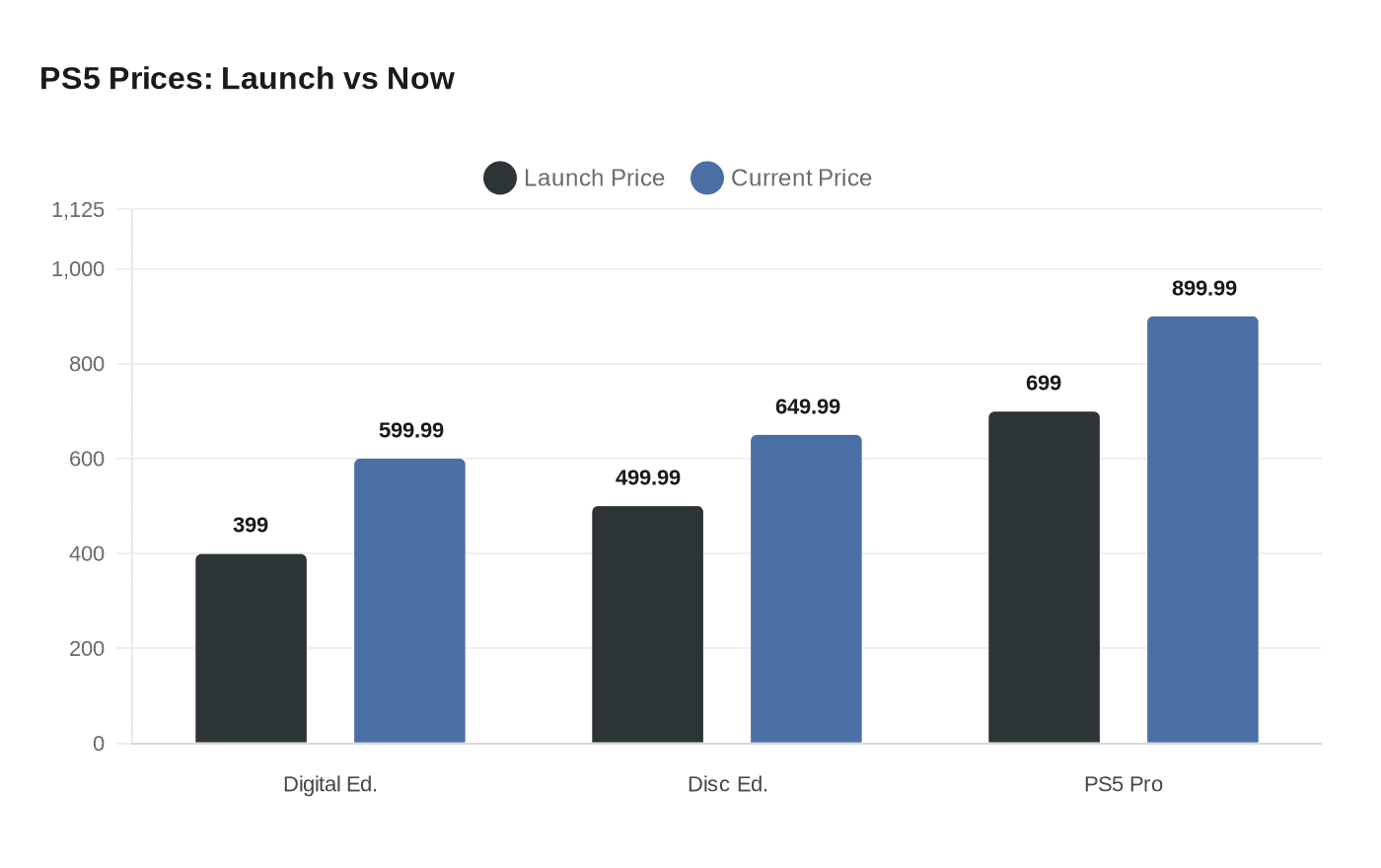
Sony has now raised PS5 prices across multiple rounds. In the United States, the standard PS5 disc edition costs $649.99, the Digital Edition $599.99, and the PS5 Pro $899.99, following earlier adjustments in 2025. The first US hike came in August 2025, raising each model by $50 over its original launch price. The second and larger increase, announced on March 27 and effective from April 2, 2026, applies globally across multiple regions at once.
The cumulative math is stark. The digital edition launched at $399 in November 2020 and now sits at $599.99, a $200 increase across the console's lifespan. The disc edition went from $499.99 to $649.99, a $150 jump. The PS5 Pro launched in September 2024 at $699 and now costs $899.99, a $200 increase in roughly 18 months. The PlayStation Portal remote player, which released in 2023 at $199.99, is also subject to the new round of increases.
Breaking the Console Gaming Golden Rule
PlayStation pricing history has followed a reliable pattern for thirty years: buy early and pay a premium, wait a few years and catch a deal. The original PlayStation launched at $299, the PS2 held that price point and sold over 155 million units, the PS3 stumbled out of the gate at $499-$599 but recovered with the Slim at $299, and the PS4 corrected course at $399 at launch. In each prior generation, the direction of travel was unmistakably downward. The PS4, for example, was available for $299 by 2016 via the PS4 Slim.
Industry observers have noted this appears to be the first console generation in modern history where sustained price increases have replaced the traditional markdown curve. A Kotaku analysis confirmed that the PS5 is now more expensive than any previous PlayStation at the same point in its lifecycle. The $499 sweet spot that anchored new-gen hardware pricing since the PS4 is fading, and Sony is effectively testing whether players will accept $650-$900 as the new standard for flagship consoles.
Why Sony Keeps Raising Prices
Sony's VP of Global Marketing, Isabelle Tomatis, cited "continued pressures in the global economic landscape" as the basis for the April 2026 increases, describing the move as a necessary step following careful evaluation. Component costs are the key structural driver. The PS5's custom 825GB PCIe 4.0 SSD and 16GB of GDDR6 RAM have remained expensive to source, with flash memory pricing staying volatile rather than following the predictable cost-decline curves of prior eras. Unlike the PS3 and PS4 generations, where manufacturing efficiencies reliably translated into price cuts for consumers, the current global supply environment has delivered no such relief.
Sony has described the increases as reflecting ongoing global economic pressure and rising component costs, particularly in memory and semiconductors. The back-to-back nature of the hikes, less than a year apart, signals that these aren't isolated responses to one-time disruptions. They reflect a structurally different cost environment.
The PS5 Pro: Worst Value on the Board
The standard PS5's price trajectory is troubling enough. The Pro's is in a different category. At $899.99, it is the most expensive PlayStation console ever sold at any point in a generation, and it arrived at that price just 18 months after its launch. Buyers who picked it up at the September 2024 release price of $699 effectively received a $200 discount compared to today's cost, inverting the traditional logic that early adopters pay the most for hardware. Unless you own a high-end 4K display capable of making full use of the Pro's enhanced rendering and frame-rate capabilities, spending $899.99 for incremental performance gains over a $649.99 disc console is a difficult case to make.
Who Should Buy Now, and Who Should Wait
The April 2 price change is already active, so the window to buy at 2025 prices has closed. Given that Sony raised prices twice in under a year, waiting has cost buyers money rather than saving it. Here is how to approach the decision going forward:
- Buy now if your PS5 backlog is real. The library is mature, physical game prices are dropping, and there is no credible signal that Sony will reverse course before the PS6 arrives. Locking in the disc edition at $649.99 is the cleaner move compared to waiting for a cut that history suggests won't come.
- Target Black Friday 2026 for bundles. Sony and major retailers have consistently packaged PS5 hardware with game credits or bundled titles during the November sales window. The base price won't drop, but a bundle can realistically reduce effective cost by $50-$80 in game value. This is the most reliable savings opportunity in the near term.
- Think carefully before choosing the digital edition. At $599.99, the digital model is only $50 less than the disc version. That gap has narrowed with each price round, and a single new physical game purchased below its digital equivalent price can offset the difference. For anyone who mixes physical and digital purchases, the disc edition now represents far better long-term value.
- Skip the Portal unless you're already deep in the ecosystem. With the Portal also receiving a price bump from its $199.99 launch price, buying it as a standalone purchase without a PS5 already in the house produces zero return on investment.
What Could Actually Change the Math
There is no confirmed PS6 release date. Industry speculation has pointed to a 2027 window at the earliest, but Sony has said nothing official. If that timeline holds, buyers waiting for a next-gen reset are looking at a minimum of two more years, during which the PS5's current pricing will remain in place and could theoretically climb further. If players absorb the current price increases without mass market resistance, the rest of the hardware industry will be watching closely to see whether this becomes a durable new pricing model.
The unwritten rule of console gaming held for three decades: patience rewarded buyers with lower prices. The PS5's trajectory has retired that rule, at least for this generation. The most expensive PlayStation at the five-year mark isn't a curiosity or an aberration. It's the new pricing reality, and every future buying decision around PlayStation hardware should be made with that context front and center.
This article was produced by Prism’s automated news system from verified source data, official records, and press releases, then run through automated quality and moderation checks before publishing. The system is built and supervised by the people who set the standards it runs under. Read our full AI policy.
Did this article answer your question?