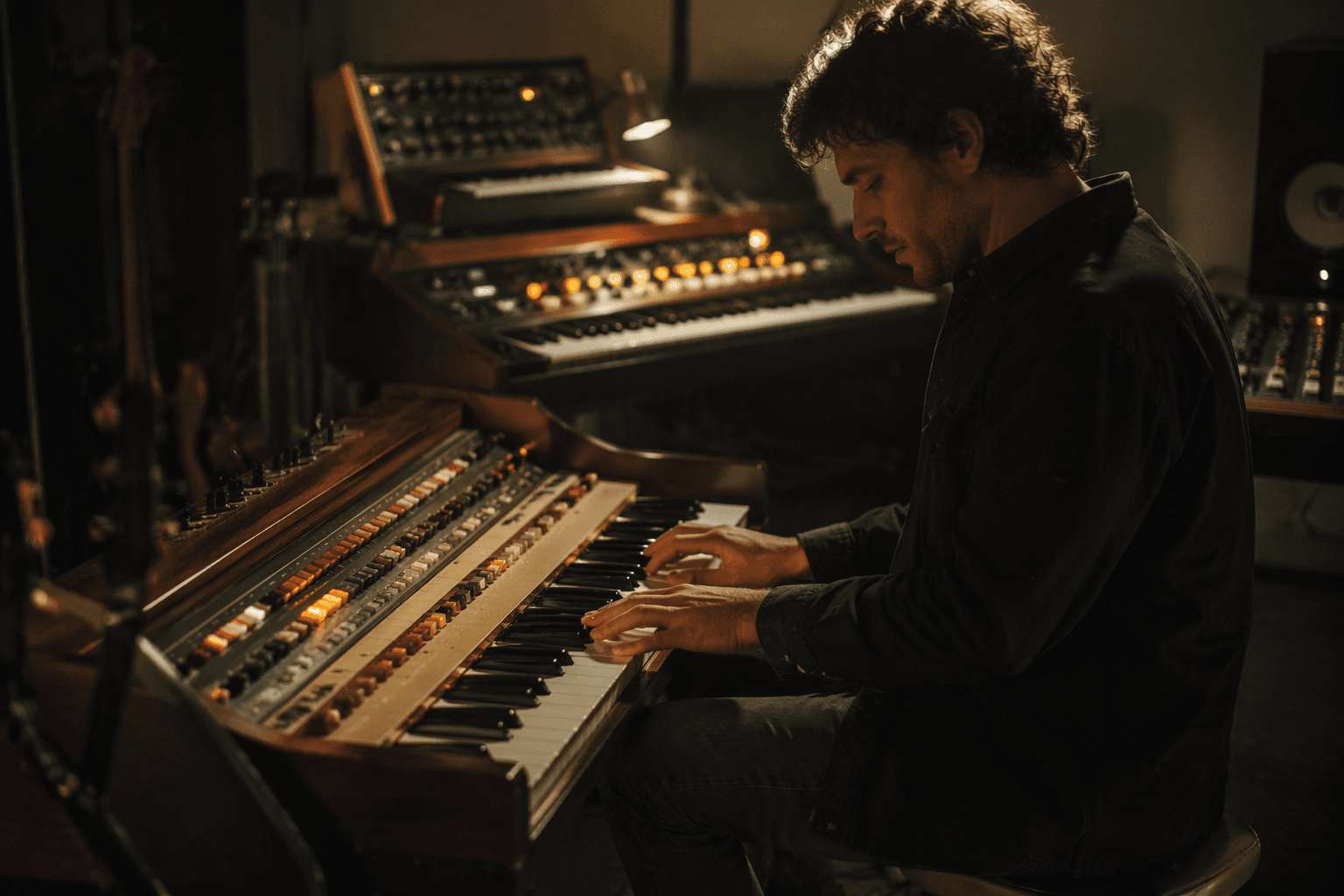
Cassette Motion brings 64 retro arpeggio presets to the Moog Muse
Cassette Motion gives the Moog Muse 64 arp presets built on detune, noise, and warmth, chasing 70s and 80s motion more than strict imitation.

The Moog Muse keeps finding new ways to dress itself in vintage clothes, and Cassette Motion is the latest to push that idea into ARP territory. Anton Anru’s 64 arpeggio presets lean on detuning, subtle noise, and analog warmth, turning Moog’s eight-voice, bi-timbral polysynth into a machine for retro motion rather than static nostalgia.
That matters because the Muse is not a museum piece. Moog released it in July 2024 after more than five years of development, and the company has positioned it as its fourth polysynth, built around velocity, aftertouch, mod wheel, and macro performance controls. Cassette Motion takes those features seriously. The presets are not just labeled for mood, they are meant to move under the hands, with velocity-sensitive response, mod-wheel variation, aftertouch that can add distortion, detune, or resonance, and a macro control that can bring in overtones or modulation.

The sound list tells the story of where Anru is aiming. These patches range across dark, noisy, lo-fi, warm, deep, soft, retro, vintage, melancholic, atmospheric, detuned, FM, distorted, metallic, evolving, and sweeping textures. That is a broad palette, but it still points back to one old obsession: arpeggiated synth music with a living pulse. In that sense, the pack reads less like a one-to-one ARP emulator and more like a translation of the ARP idea into modern Moog language, where motion and character count as much as exact circuit history.
The ARP reference is not incidental. ARP Instruments, founded by Alan R. Pearlman in 1969 and shut down in 1981, defined a huge part of the 1970s synth imagination, and the ARP 2600, introduced in 1971, remains one of the era’s most recognizable machines. With roughly 3,000 units produced, it became shorthand for semi-modular authority and the kind of expressive front-panel architecture that still shapes how players think about classic hardware. Cassette Motion taps into that same emotional field, even if it does so through a Moog rather than an ARP badge.
Moog has already shown that Muse owners respond to this kind of lineage play. In early 2026, the company released a free Memorymoog preset collection for Muse that recreated all 100 factory patches, and that made the new synth feel like a continuation of its own past. Cassette Motion takes a different route. It does not promise exact reconstruction; it sells a playable vintage vibe, and for players chasing old-school character on new hardware, that may be the more useful inheritance. Anton Anru, who says he has released more than 200 preset banks across Moog, Arturia, Korg, Novation, Behringer, Dreadbox, Elektron, Make Noise, and others, has turned the Muse into another stage for that ongoing act of translation.
This article was produced by Prism’s automated news system from verified source data, official records, and press releases, then run through automated quality and moderation checks before publishing. The system is built and supervised by the people who set the standards it runs under. Read our full AI policy.
Did this article answer your question?