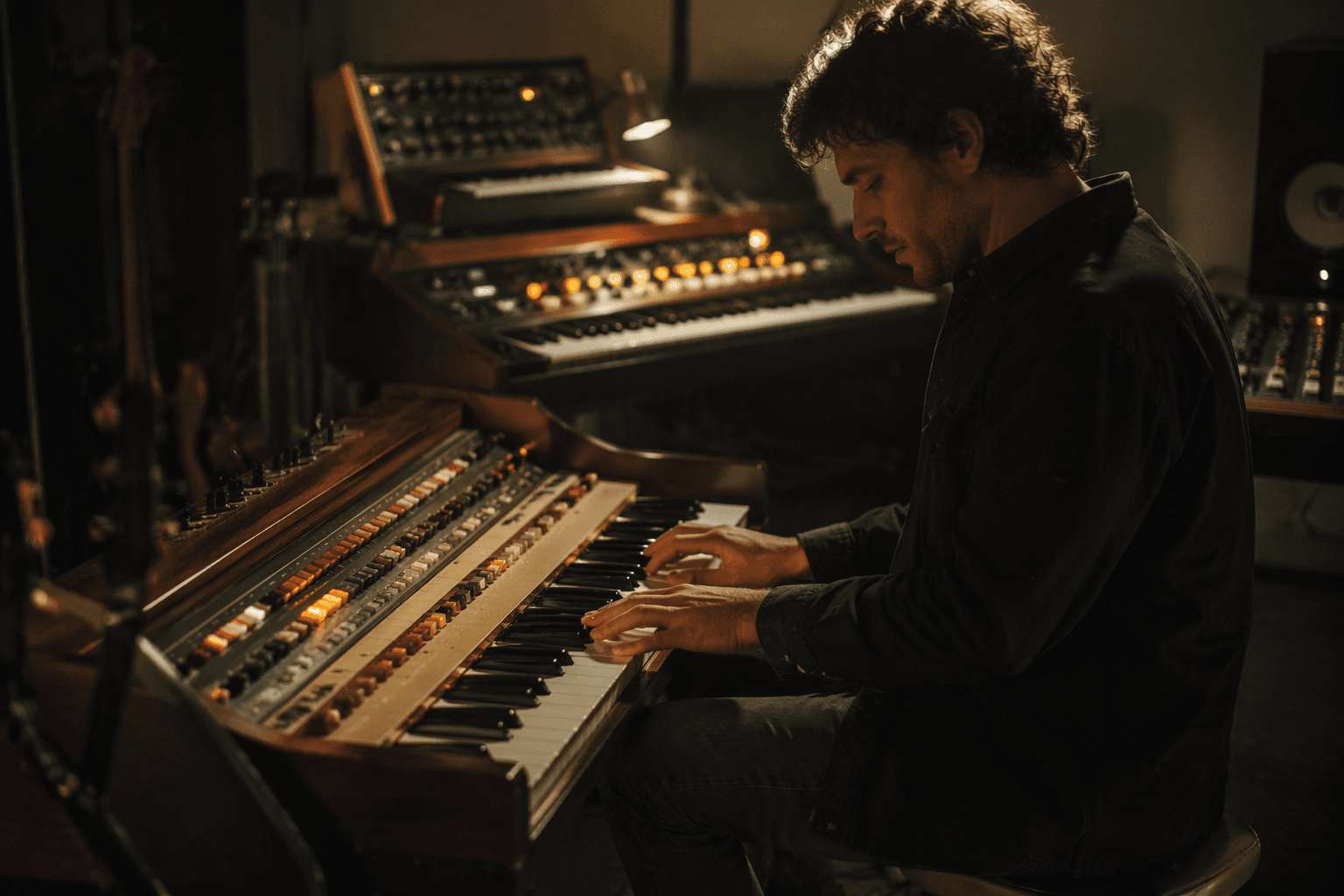
Jump Source duo turns rare Moog gear into creative identity
Jump Source treats a strange little Moog as a working voice, not a trophy. Their Montreal story shows why character and limitation still beat rarity.

A rare Moog earns its place when it changes the music
Jump Source begin with the kind of instrument that makes collectors lean in, but their real argument is simpler: a rare Moog matters most when it becomes part of a working sound, not a display case. Patrick Holland and Francis Latreille built that idea into their Montreal studio identity, and even the project name points to it, drawn from a distinctive Moog synth that looks unlike the rest of the company’s line-up.
That oddball machine is the perfect symbol for what Jump Source do best. They are not chasing polish for its own sake or treating vintage gear as untouchable museum hardware. They are drawn to instruments with a fingerprint, pieces that push back a little and ask the player to make choices, especially when the choices happen in a real studio under real constraints.
Why the Moog still carries so much weight
To understand why this story lands so hard with vintage synth fans, you have to go back to Bob Moog. He introduced the first commercial Moog synthesizer in 1964, and the ladder filter that followed became one of the most influential and imitated circuit designs in electronic music. That legacy did not stay abstract for long. The Minimoog arrived in 1970 and helped define portable analog synth design, turning a once sprawling modular dream into something a player could actually carry into a session.
That history still shapes how collectors talk. Early Moog modular systems have become holy objects, and the company’s later instruments remain touchstones because they do something so many modern tools try to imitate: they give the player an immediate, recognizable voice. Jump Source tap into that lineage without turning it into a shrine. They treat Moog history as a living toolkit, not a nostalgia exhibit.
The Bob Moog Foundation’s timeline work helps keep that lineage visible, tracing Bob Moog’s early development path and the synthesizers that changed the field. For a community that cares deeply about provenance, that matters. But Jump Source’s point is that provenance only becomes meaningful when the machine still has somewhere to go musically.
Patrick Holland, Francis Latreille, and the Montreal partnership
The duo’s own origin story reinforces that idea. MUTEK Montréal dates the Jump Source friendship and project back to 2016, which gives the collaboration real depth rather than the feel of a one-off studio pairing. Francis Latreille records as Priori, has been described by Resident Advisor as a crucial voice in underground techno, and also runs the NAFF label. Patrick Holland brings a different set of instincts, and the chemistry between them is what lets the gear feel like part of a conversation instead of a costume.
Their debut album, Fold, was announced in February 2026 and released on April 30, 2026 via NAFF Recordings. The record arrives with an eclectic cast of collaborators, including billy woods, POiSON GiRL FRiEND, Loukeman, Helena Deland, and Ross Meen, which says a lot about how wide the duo’s frame is. This is not a project locked inside synth fetishism. It is a club-aware, collaborative world where hardware serves songs, tracks, and shared instincts.
That wider network matters because Jump Source are already operating in scenes where character counts. They have worked with Martyn Bootyspoon, Frankie Teardrop, and Tiga, names that place them squarely inside modern electronic music’s conversation between experimentation and floor pressure. Rare gear makes sense here not because it is expensive or obscure, but because it can give a track a contour that software presets rarely supply.
The studio lesson hidden inside the gear talk
One of the most useful parts of the Jump Source story is how plainly it rejects the fantasy of perfect conditions. Patrick Holland talks about the value of jamming rather than only studying tutorials, and that detail cuts right to the heart of how many vintage instruments actually earn trust. A synth that surprises you in a jam often becomes more useful than one you have merely memorized on paper.
Francis Latreille’s memory of a closet-sized apartment studio makes the same point from another angle. He packed synths into a tiny room and used clothes as sound treatment, which is about as far from a luxury showroom as you can get. Yet that cramped setup is exactly where the lesson lives: gear does not need a cathedral to matter. It needs a player willing to work with the room, the limitations, and the quirks.
That is the part collectors sometimes miss when they chase rarity alone. A rare Moog that sits in storage is a badge. A rare Moog that can bend a bassline, thicken a lead, or suggest a rhythm in a dense club track becomes identity. Jump Source understand that a little imperfection can be the thing that makes an instrument memorable.
Choosing hardware for character, not just status
The practical takeaway for anyone building a synth room is not to avoid coveted gear, but to be honest about why you want it. Look for instruments that add character, offer usable limitations, and fit the way you actually make music. The best vintage pieces often do three things at once:
- they have a distinct sonic fingerprint
- they invite hands-on decisions instead of endless menu diving
- they work in the space and workflow you already have
That framework fits Jump Source perfectly. Their reference points are rare, but their philosophy is grounded. The Montreal studio, the closet-sized apartment, the guest list on Fold, and the long friendship behind the project all point to the same conclusion: the right synth is the one that changes what you make, not the one that photographs best.
In the end, Jump Source make the rare Moog feel most valuable when it is allowed to behave like a collaborator. That is the real vintage-synth lesson here, and it loops all the way back to that unusual machine that gave the project its name. The gear matters most when it stops being a trophy and starts becoming part of the music.
This article was produced by Prism’s automated news system from verified source data, official records, and press releases, then run through automated quality and moderation checks before publishing. The system is built and supervised by the people who set the standards it runs under. Read our full AI policy.
Did this article answer your question?