OB-Xd 3.22 adds aftertouch control to Oberheim OB-X emulation
OB-Xd 3.22 brings aftertouch to standard keyboards, letting OB-X brass and pads breathe without rare MPE hardware.
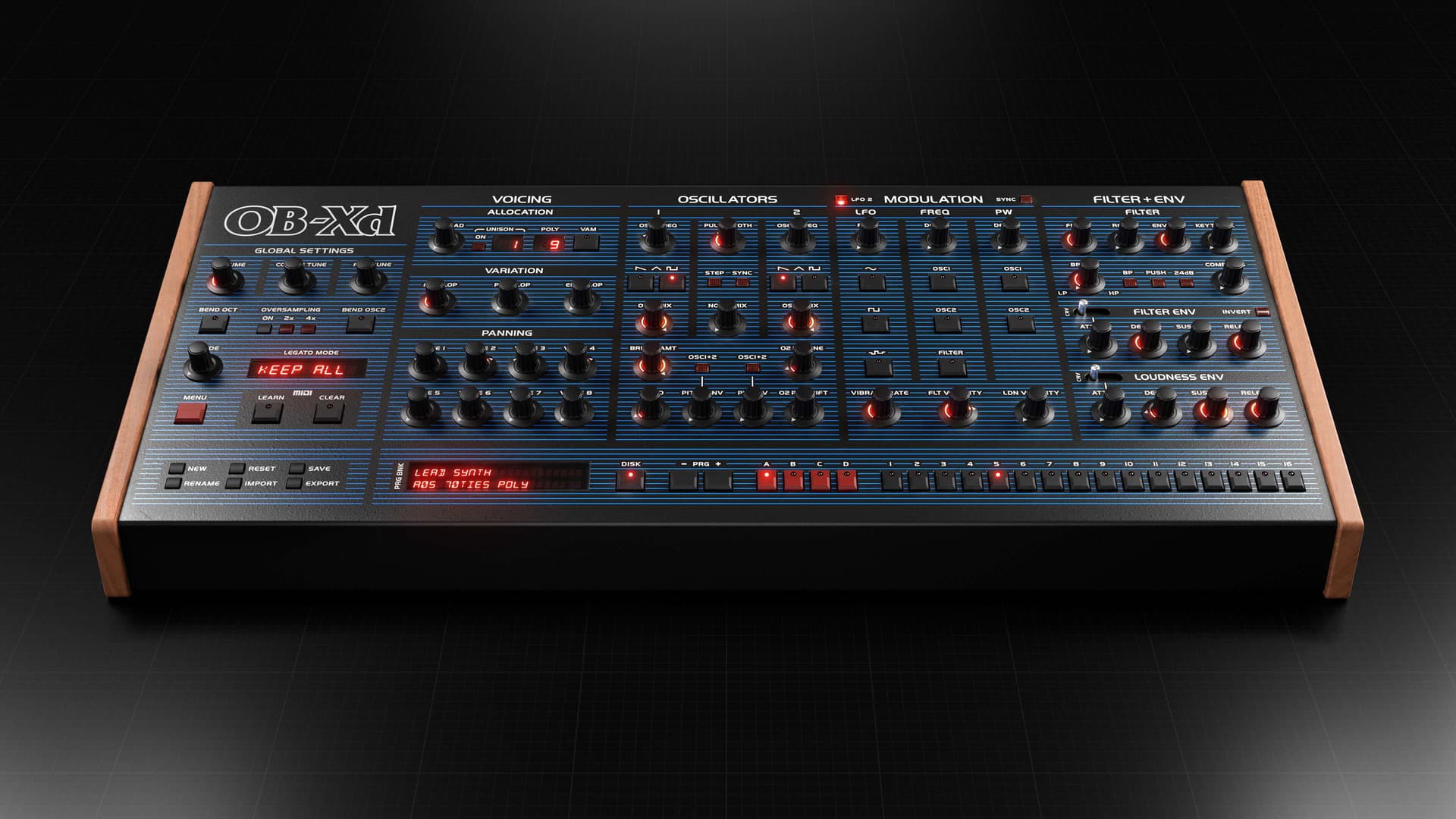
OB-Xd 3.22 makes discoDSP’s Oberheim OB-X emulation feel less like a preset rack and more like an instrument under the fingers. The new build adds aftertouch support for ordinary keyboards, so players with channel pressure or polyphonic aftertouch can push OB-Xd beyond static vintage tones and into more responsive performance territory.
The pressure routing is broad enough to matter on real patches. Aftertouch can now be mapped to cutoff, pulse width, PW offset on Osc2, cross modulation, Osc2 detune, pitch, pan, and amp, with an invertable response that lets harder pressure either increase or reduce the assigned parameter. discoDSP’s version history says the feature is MPE-aware, with the Aftertouch menu appearing only when MPE is off, so the new control path does not step on full MPE setups. It also distinguishes between source types: mono channel pressure fans out to all voices, while polyphonic aftertouch drives each voice separately.

That distinction is the heart of the update for players who do not own rare controllers. Poly AT mode gives per-finger pressure without an MPE handshake, and discoDSP specifically points to ROLI Lightpad in Multi Channel mode as a way to use that behavior. The update also adds visual LED feedback for routed destinations, which should make it easier to see what pressure is doing while shaping OB-style brass stabs, wide pads, or sync-heavy leads.
The rest of 3.22 is smaller but still practical. discoDSP fixed Windows HiDPI knob rendering and popup menu scaling, the kind of housekeeping that matters every time a plugin opens on a modern display. OB-Xd already ran on macOS, Windows, Linux, and iOS, so those usability fixes help keep a widely used free synth feeling current across a broad setup, not just in one studio lane.
discoDSP marked OB-Xd 3.22 alongside Bliss 1.14, and the broader release also included full MPE for the Bliss sampler, automatic loop cue extraction, tracker module import, and sample editor improvements. For OB-Xd itself, the bigger shift is simpler: the emulation now reacts more like a played instrument than a frozen homage. That does not replace the tactile drama of a real Oberheim OB-X, but it closes some of the gap every time pressure starts moving the sound instead of just holding it in place.
This article was produced by Prism’s automated news system from verified source data, official records, and press releases, then run through automated quality and moderation checks before publishing. The system is built and supervised by the people who set the standards it runs under. Read our full AI policy.
Did this article answer your question?