Roland Jupiter line shaped practical, premium analog polyphony
Roland’s Jupiter line turned analog polyphony into a stage-ready instrument, with memory, splits, and hands-on control that players could actually use live.
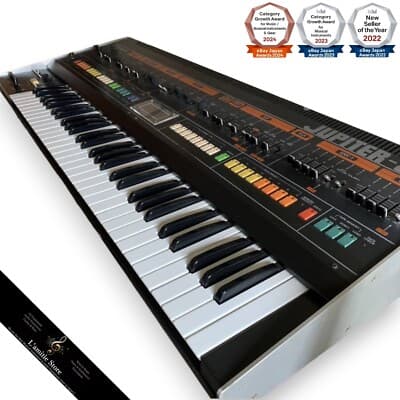
The Roland Jupiter line is where analog polyphony stopped feeling like a laboratory triumph and started behaving like a player’s instrument. From the four-voice Jupiter-4 to the eight-voice Jupiter-8, Roland kept adding the practical features that let keyboardists build complete parts, store them, recall them, and take them onstage without losing the immediacy that made analog synths fun in the first place.
The Jupiter-4 made polyphony feel usable
The Jupiter-4 arrived in 1978 and stayed in production until 1981, but its real importance is bigger than that date range. It was Roland’s first self-contained polyphonic synthesizer, and Roland described its digitally controlled analog architecture as “compuphonic,” a sign that the company was already trying to solve one of polyphony’s biggest headaches: making a multi-voice analog instrument behave predictably enough for real music-making.
That mattered because the Jupiter-4 was not just about being able to play four notes at once. It offered programmable memory, voice-assignment modes, an arpeggiator, and polyphonic portamento, all of which gave players a workable path from a single line or chord stab to something arranged and repeatable. At a U.S. price of $2,895, it was also positioned below heavyweight rivals like the Yamaha CS-80, Korg PS-3300, Sequential Circuits Prophet-5, and Oberheim OB-X, which helped make premium polyphony feel a little less distant.
Why the Jupiter-4 still reads as a player’s synth
Roland’s own framing of the Jupiter-4 is telling: a four-voice instrument with a warm, solid, meaty sound and an arpeggiator that made it immediately useful. That combination gave it a clear role in the hands of musicians who wanted something they could shape quickly rather than admire from across the studio. Nick Rhodes was among the players who embraced it, and the instrument’s appeal was never only about prestige or rarity.
The Jupiter-4 also pointed toward a new kind of workflow. It was no longer enough for a synth to sound good on a single pass; it had to remember sounds, switch voices intelligently, and support performance techniques that made arrangements feel alive. That shift is what turns the Jupiter-4 from a historical curiosity into the bridge between classic analog design and the practical demands of live keyboard work.
The Jupiter-8 turned the concept into a flagship
The Jupiter-8, introduced in early 1981, pushed the family into full flagship territory and became Roland’s top keyboard for the first half of the 1980s. It expanded the formula to eight voices and two oscillators per voice, while adding cross modulation, oscillator sync, and pulse width modulation, which opened the sound far beyond simple brass pads and string stacks. Roland’s technical specs also list split, dual, and whole key modes, patch memory, and arpeggio functions, all of which made the instrument feel engineered for actual performances, not just programming sessions.
That design choice changed the instrument’s job. Split and dual modes let one keyboard cover two roles at once, while whole key mode kept the full surface available when a single sound needed to dominate. With 64 memory locations, the Jupiter-8 made it possible to prepare sounds in advance and move through a set with far less friction, a major leap for players who needed consistency night after night.
Hands-on control was the point, not decoration
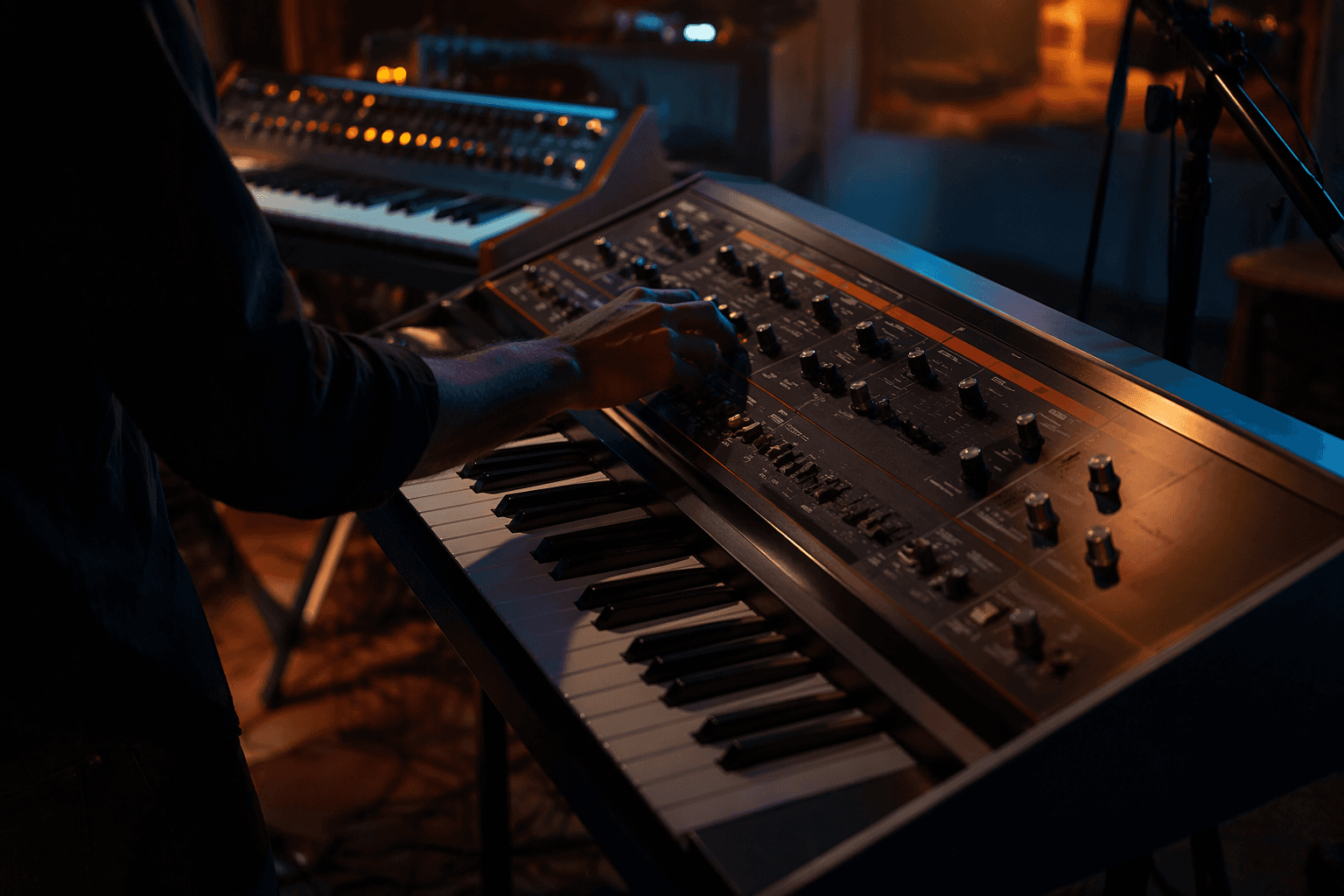
The Jupiter line’s real advance was not just voice count. It was the way Roland kept the front panel immediate while packing in more performance tools, so the player could shape sound without losing time to menus or awkward programming steps. The Jupiter-8’s assigner mode, patch memory, arpeggio functions, and split capability all reinforce the same idea: this was a keyboard designed to be touched, switched, layered, and trusted in motion.
That stage-friendly mindset is part of why the Jupiter name still carries so much weight. Roland’s own description of the Jupiter-8 as an eight-voice, two-oscillator synthesizer with a warm sound and a wide sound-creation palette fits the way musicians remember it: big enough to cover serious harmonic territory, but clear enough to stay playable. Roughly 3,300 Jupiter-8 units were made, which adds to the mythology, but the mythology rests on practical design first.
Duran Duran gave the line a visible life onstage
The Jupiter story became even more visible through Duran Duran. Roland says the Jupiter-4 supplied the juddering intro to the band’s 1982 hit “Rio,” while the Jupiter-8 rode with them on stadium tours as the band scaled up from pop success to arena-sized spectacle. That is the clearest proof of what the Jupiter series changed: these were not studio-only machines, but working instruments that could anchor a set in front of thousands of people.
Nick Rhodes has also summed up the appeal in plain language, calling the Jupiter-8 “the warmest-sounding, best-designed synth” he knows. That line lands because it captures both sides of the Jupiter identity, the sound and the layout. If a synth feels intuitive under the fingers and still delivers a massive tone, it stops being a luxury object and becomes part of the arrangement itself.
The legacy kept moving after the flagship era
The Jupiter family did not end with the Jupiter-8. Roland carried the same lineage forward with the MKS-80 Super Jupiter, produced from 1984 to 1987 and descended from the Jupiter-8 and Jupiter-6. That continuation matters because it shows the Jupiter idea was bigger than one famous keyboard: it was a design language built around premium analog polyphony that could actually be used.
That is the lasting lesson of the Jupiter line. Roland solved the practical problems of polyphony one feature at a time, with memory, splits, voice assignment, and stage-ready workflow, and in doing so made the analog polysynth feel less like a studio luxury and more like the center of a player’s rig.
This article was produced by Prism’s automated news system from verified source data, official records, and press releases, then run through automated quality and moderation checks before publishing. The system is built and supervised by the people who set the standards it runs under. Read our full AI policy.
Did this article answer your question?