Goonhammer’s April 2026 40K power rankings track shifting tournament metagame
Goonhammer's rankings are back, and April's edition is built to tell players what still works after March reshuffled the field.
The signal matters more than the table
Goonhammer has brought back its 40K power rankings, and the April 2026 edition lands as a premium meta-analysis by Innes Wilson and Lowest of Men. Published on May 6, 2026, it is framed as a monthly read on April’s tournament scene and the fallout from March, which makes its real purpose clear: turn a pile of event results into something a player can actually use.
That is why these rankings matter beyond the headline. They are not there just to crown a faction and move on. They sit above individual tournament writeups and try to answer the question every competitive player asks after a busy month of events: what is actually safe to bring, buy, or build around right now?
What this series is really measuring
The public listing does not show the full ranking table, but the framing tells you enough about the job it is doing. Goonhammer treats the power rankings as a synthesis tool, pulling together tournament outcomes, list performance, and faction movement into a relative order of who is rising, who is holding, and who is slipping. In a game where a few weeks of results can change how entire factions are perceived, that kind of snapshot is more than content filler.
The useful part is the consequence. A monthly rankings piece tells you whether last month’s hot army still has legs once the field adjusts, or whether a faction’s strong weekend was just a flash in the pan. For players planning a GT season, that is the difference between chasing a headline and making a list that can survive repeated rounds into real opposition.
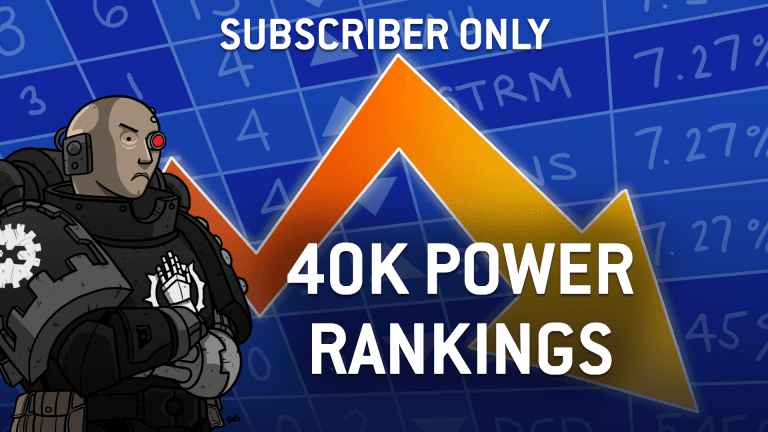
Goonhammer’s own positioning makes that intent obvious. The article is labeled as subscribers-only premium content, which tells you the site sees enough value in the interpretation to reserve the full ordering for members. The public-facing version still serves a purpose, though: it signals that the meta has shifted enough to justify a fresh pass across the whole faction landscape.
Why April needed a fresh read
The biggest story here is not a single number on a hidden table. It is that April was important enough, and March was messy enough, to force a reset in how the field is being discussed. When a rankings article explicitly says it is covering April and the fallout from March, that means the previous month’s competitive results created enough ripple to change the way lists are being judged.
That matters in table terms. If a faction can keep showing up across multiple events, into multiple missions, and still convert results after the field has had time to adapt, it earns a different kind of trust than a faction that spikes once and disappears. The rankings are built to capture that broader reality, which is exactly why competitive players follow them when deciding whether an army is a safe bet or a risky project.

The monthly cadence also suggests a living metagame rather than a settled one. Goonhammer would not keep returning to the format if the scene were static. The fact that April gets its own dedicated pass shows that the game’s competitive balance, list trends, and faction fortunes are moving quickly enough to require regular re-evaluation.
A recurring tool, not a one-off verdict
The archive matters here too. Goonhammer’s public tags show a January 2026 Warhammer 40k Power Rankings article that was published on February 16, 2026. That earlier installment confirms the series is not a one-time reaction piece, but part of a continuing monthly rhythm that gives readers a way to track changes over time.
That continuity is one of the rankings’ biggest strengths. A single tier list can become stale fast, especially in 40K where mission pressure, rules changes, and new releases can make last month’s assumptions look soft almost overnight. A recurring premium rankings format does something more useful: it lets players see whether a faction’s position is improving because the list is genuinely resilient, or fading because the wider field has figured it out.
For anyone trying to stay ahead of the curve, that distinction is everything. A faction that keeps its footing across months is a better candidate for practice, collection planning, and event prep than one that simply had a loud weekend. Goonhammer’s April edition is built to show that difference, even if the full table stays behind the patron wall.
What players should take from it
The practical takeaway from this kind of article is simple: treat it as a map of stability, not just strength. A rankings pass like this is most valuable when you are deciding where to invest time and plastic, because it points toward the factions that have turned tournament results into repeatable performance.
- If you are choosing an army for events, look for the factions that can hold up after the field adapts.
- If you are buying models, favor the lists that keep appearing in monthly meta conversations rather than one-off spikes.
- If you are refining a current army, use the rankings to judge whether your faction is still a safe bet or needs a rebuild.
That is the real value of Goonhammer’s April 2026 40K power rankings. They turn one month of competitive churn into a readable state of the meta, and they do it at exactly the moment players need that clarity most, after March has already changed the shape of the table.
This article was produced by Prism’s automated news system from verified source data, official records, and press releases, then run through automated quality and moderation checks before publishing. The system is built and supervised by the people who set the standards it runs under. Read our full AI policy.
Did this article answer your question?