New Player Tournament Guide: Checklists for List Building and Event Day
Your first GT is 30 days away; here's the exact prep pipeline TOs and veteran players wish every first-timer had read before round one.
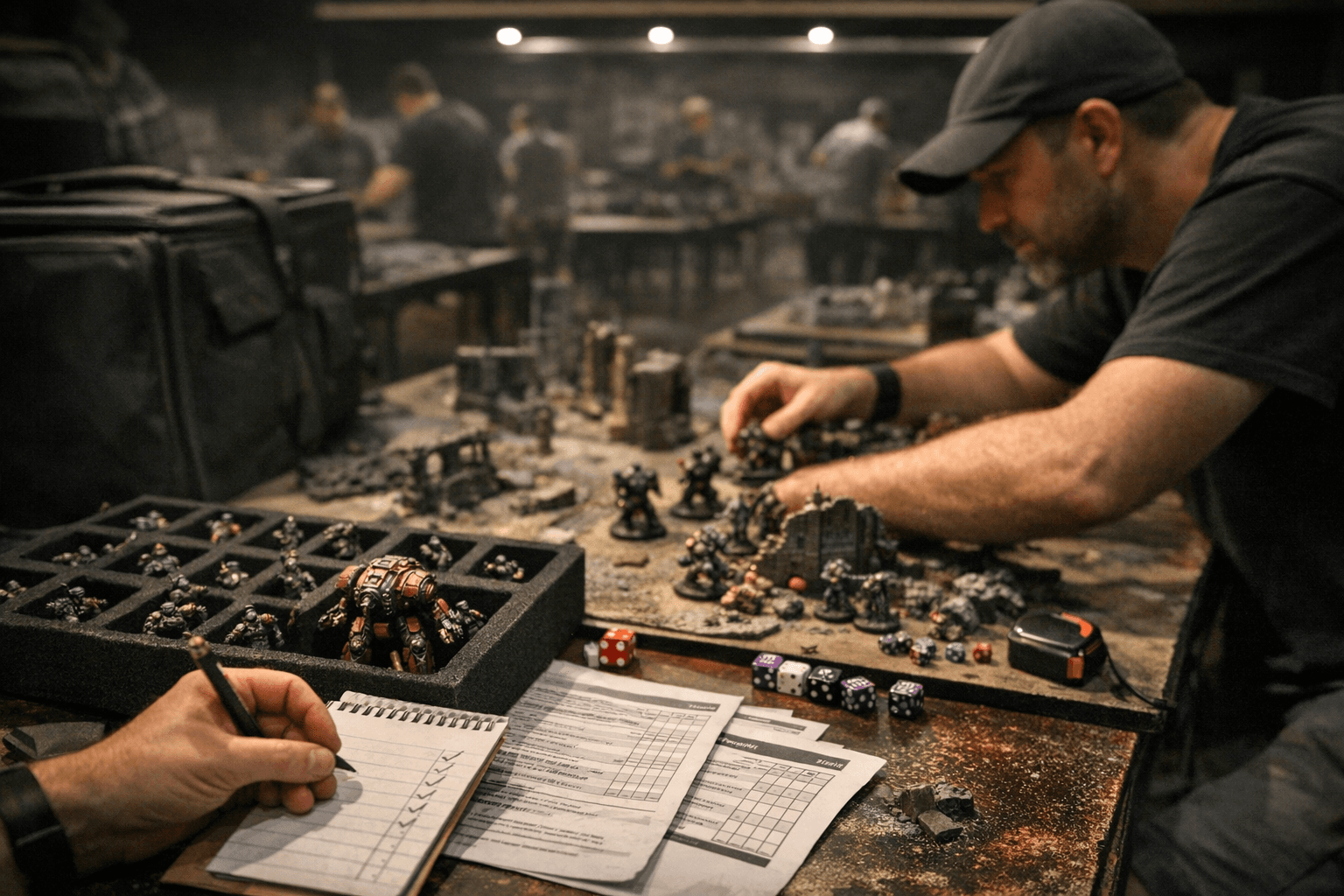
Thirty days out from your first 2000-point Grand Tournament, and the panic usually hits at the same moment: the list feels half-done, half the models still need basing, and you're not sure what the TO even wants from you on the day. The good news is that the gap between "painted box" and "tournament table" is a logistics problem, not a talent problem. What follows is the exact pipeline to close it, anchored in what TOs and experienced players consistently wish first-timers knew before they showed up for round one.
Step 1: Get the Event Pack Two Weeks Out
Everything starts here. Two weeks before the event, download and read the TO's event pack in full. Build your list to conform with its banned and allowed items, mission constraints, and scoring variants. This single habit eliminates the most common first-timer disaster: showing up with a beautifully painted army running a unit that was quietly FAQ'd out of competitive play, or a detachment configuration the event doesn't allow. Late reworks under time pressure are demoralising and usually make lists worse. Getting the pack early converts a potential crisis into a calm revision.
Format your final list clearly: points cost, detachment name, key keywords, and a wargear note for every character. Your opponent and the TO both need to verify your list quickly at the start of each round. A messy army builder export with no wargear annotations costs everyone time and opens you to disputes you could have avoided.
Step 2: Build Resilient, Not Clever
Here is the contrarian tip most new players resist: cut the tech piece. If your list has one unit that requires three stacked strat triggers, a specific deployment configuration, and memory of a two-page special rule to function correctly, cut it. Replace it with something simpler. Simpler, resilient lists consistently outperform complex lists run poorly under time pressure, and at a GT you will be under time pressure in every single round. The perfect mathematical play you spent forty minutes theorising over at home collapses when you're on turn two with twenty minutes on the clock and your opponent is asking what keyword your unit actually has.
The practical version of this: include at least one contingency unit, something you can swap in mentally for a different mission type rather than a single-point dependency that collapses the moment it gets killed early. Not every GT mission rewards the same alpha-strike setup, and a list with flexibility survives the draw better than a list with a perfect ceiling.
Step 3: Hit the Hobby Minimums
Aim for a fully painted army to at least a 50% standard for local GTs, and higher for major events. Unpainted models won't make you lose a game, but they will slow down adjudication, create ambiguity about which unit is which, and signal to your opponent and the TO that you haven't fully committed to the experience. Neat basing, unit coherency, and clear templates and markers genuinely speed up rounds and reduce disputes.
Two practical habits that veteran players swear by:
- Label your units and wargear. Small sticky notes, commander cards, or a laminated army board showing what each unit carries saves time during list checks and eliminates the most common source of mid-game disagreements.
- Bring a short written summary of your tricky rules interactions, for your own reference. If your detachment has a sequence that requires a specific order of operations, write it out on a card. Knowing it in your head is good; having it written down when you're nervous is better.
Step 4: Practice Reps with a Clock
Dedicate practice games specifically to any new or complex detachment you're running. One or two small practice games per week, each structured as a targeted drill, will do more for your results than a dozen casual games with no focus. Address specific weaknesses: fog-of-war decisions, target priority errors, and deployment choices are the three areas where new tournament players most consistently give away points.
Run pace-of-play drills. Set a timer and practice completing a full game turn within a self-imposed limit. Learning to make fast, good-enough decisions is a genuine competitive skill at GTs, and it's one you can only develop through practice, not theory.
Step 5: Pack for Event Day
Print your list and keep a PDF on your phone. TOs will often ask for a digital copy; your opponent may want to check wargear at the start of the round. Beyond the list itself:
- Dice, multiple measuring tapes, templates, pencils
- Glue, spare tape, and a small repair kit for broken models (transporting an army is violent)
- Movement trays if you use them
- Terrain notes if your army has special terrain interactions
- Snacks, a packed lunch, and small cash for TO fees or any store purchases on the day
The repair kit in particular is something most first-timers forget until they open their case at round one and find a Knight missing a leg.
On the Table: Pace of Play and Etiquette
Be punctual for pairings and sit ready at your table ten minutes before round start. This is one of the most visible signals of competence and respect at any GT; TOs notice who is consistently slow to the table.
Prioritise fast, clear communication with your opponent throughout the game. Ask for rulings early, not mid-sequence. If a rules dispute arises, call the TO politely and immediately. Never escalate a dispute in frustration: events weight sportsmanship scores as part of their awards, and a reputation for difficult table behaviour follows players across circuits far faster than a poor win rate does.
Post-Event: The Iteration Loop
Take notes after each round, not just after the event. What worked, what collapsed, which turns you gave away points on without realising it. After the event, convert those notes into the agenda for your next two practice weeks. Target the actual weaknesses the games revealed, whether that's deployment sequencing, mission scoring habits, or time management on complex turns.
This is the practice pipeline that separates players who plateau after their first few events from those who improve consistently. The GT is the test; the weeks after it are where the real coaching happens.
Printable Checklist
- Download and read the event pack in full
- Confirm list is legal under event rules and mission pack
- Format list with points, detachment, keywords, and wargear notes
Two weeks out
- Finish basing and any outstanding painting to the 50% standard minimum
- Label units and wargear (sticky notes, army board, or commander cards)
- Write your tricky rules summary card
- Run at least two timed practice games
One week out
- Print army list; save PDF to phone
- Pack dice, multiple tapes, templates, pencils, glue, repair kit, movement trays
- Pack snacks, lunch, and small cash
- Set an alarm that gets you to the venue ten minutes before round one pairings
Day before
- Sit ready ten minutes before each round
- Communicate clearly and call the TO early on any disputes
- Take brief notes after each game
On the day
- Review notes and identify two or three specific weaknesses
- Convert next practice sessions into targeted drills on those exact areas
Post-event
The players who come back from their first GT with a better record at their second are rarely the ones with the most expensive army or the most theorycrafted list. They're the ones who showed up prepared, played on time, and knew exactly what they needed to fix before the next event.
This article was produced by Prism’s automated news system from verified source data, official records, and press releases, then run through automated quality and moderation checks before publishing. The system is built and supervised by the people who set the standards it runs under. Read our full AI policy.
Did this article answer your question?