Warhammer 40,000 explained, beginner guide to the Dark Millennium
Warhammer 40,000 is part tabletop war game, part lore machine, part painting project. Here’s how the Dark Millennium fits together and where a newcomer can start.
Warhammer 40,000 is bigger than the game people picture
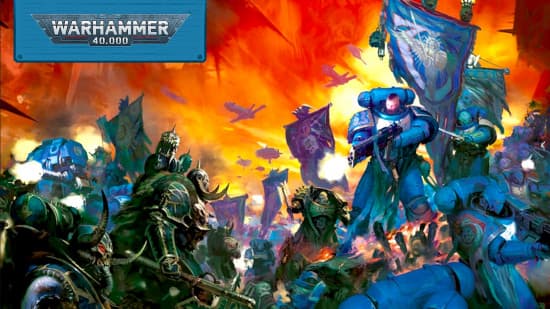
Warhammer 40,000 is the catch-all banner for a tabletop war game, a sci-fi setting, and a hands-on hobby built around assembling and painting miniatures. That is the first thing to understand if you are coming in from memes, novels, video games, or animation, because 40k is not just one activity with a complicated rulebook attached. It is a whole ecosystem, and Games Workshop officially frames it around armies of Citadel miniatures fighting in the 41st Millennium.
That breadth is exactly why the hobby pulls people in from different directions. Some arrive for the battlefield tactics, some for the grimdark lore, some for the modeling and paint side, and some never roll a die at all. The universe can be enjoyed on its own terms, which is a big reason it continues to work as an entry point for outsiders who know the name but not the hobby.
The four parts of the hobby
The simplest way to understand Warhammer 40,000 is to break it into four connected parts: the tabletop game, building and painting miniatures, the setting and lore, and the wider family of games and stories set in the same universe. The tabletop game is the most visible piece, but it is not the only one that matters, and for many people it is not even the first one they touch. A newcomer might start with a novel, a video game, or a box of models and discover the rest later.
Games Workshop’s beginner materials are built around that reality. Introductory sets and starter sets are designed to teach the fundamentals of building, painting, lore, and play in a structured way, so the hobby does not have to feel like a giant leap. That ladder of entry is one of the franchise’s quiet strengths: you can approach 40k as a casual reader, a builder, a painter, or a player and still end up in the same universe.
What the tabletop actually is
At its core, Warhammer 40,000 is a tabletop war game in which players command armies of Citadel miniatures and fight over objectives in the far future. The official rules framing keeps storytelling at the center, which matters because 40k is not only about efficiency or winning on a spreadsheet. Each battle is meant to feel like a slice of a larger conflict in the Dark Millennium, with dice, unit movement, and scenario play working together to create a narrative.
If you have only seen the game from a distance, picture a battlefield covered in painted miniatures, terrain, and measurement tools. Players move units, resolve shooting and combat, and try to control the board in a way that fits the army they chose and the story they want to tell. That combination of tactics and narrative is part of why the game has remained recognizable through multiple editions rather than drifting into a completely different system.
How the hobby side works
Painting is not an optional afterthought in Warhammer 40,000. Games Workshop describes miniature painting as one of the most satisfying parts of the hobby, and that claim is not just marketing fluff, because the whole visual identity of 40k depends on it. Painted armies turn the setting from abstract lore into something physical, and even a small force on the table can feel distinct when the models are built and colored in your own style.
The company has been painting miniatures for four decades, and that experience shows in how central the hobby is to the Warhammer experience. Building and painting can be as important as playing, especially for people who like creative work, collection building, or display pieces. In practice, many 40k fans spend just as much time clipping, gluing, priming, and layering paint as they do playing games.
The setting: the Dark Millennium
The world of Warhammer 40,000 is often called the Dark Millennium, and it is a setting defined by endurance under pressure. Humanity’s Imperium clings to power across the galaxy, centered on Terra, while facing constant threats from xenos, heretics, and the horrors of the Warp. It is a universe where nothing is safe for long, and every faction survives by force, belief, or sheer stubbornness.
The major names are part of the reason the setting clicks so quickly. Orks bring brutal chaos and sheer momentum, the T’au Empire represents expansion and alien idealism, Tyranids are a consumption nightmare on a galactic scale, and Genestealer Cults show how infiltration can rot a world from the inside. Eldar and Drukhari sit on opposite sides of a broken ancient legacy, Necrons wake from impossible slumber, and Chaos looms as the constant corruption in the Warp. You do not need to master every faction immediately, but knowing that these powers exist explains why 40k feels so huge.
From Rogue Trader to the 10th edition
Warhammer 40,000 first appeared in 1987 as Rogue Trader, and that origin matters because it shows how long the setting has been evolving. It began as a way to sell sci-fi miniatures, but it grew into something much larger, with a setting, a player base, and a publishing ecosystem that could sustain itself for decades. That history is part of the appeal: 40k is old enough to have deep roots, yet current enough to keep changing.
The game has also been repeatedly revised rather than frozen in time. Games Workshop released the 10th edition in June 2023 as a complete revision, which underlines how the rules are refreshed while the broader identity stays intact. For newcomers, that means the hobby has structure and continuity, but it also keeps moving forward in a way that can bring in new players without requiring everyone to learn from scratch.
The wider 40k machine
Warhammer 40,000 now reaches far beyond the tabletop. Black Library, Games Workshop’s publishing arm, produces novels, anthologies, and audio dramas that expand the setting and give readers another way in. That matters because many fans meet 40k through fiction first, then move into the miniatures, or they stay entirely on the reading side and never touch the tabletop at all.
The franchise’s reach keeps growing because Games Workshop treats it as a major part of the business, not a side line. In its 2024 annual report, the company described itself as the largest and most successful tabletop fantasy and futuristic battle-games company in the world, and it estimated core revenue of not less than £560 million for the 52 weeks ending 1 June 2025, with licensing revenue of about £50 million. The exclusive rights deal with Amazon for film and television set in the Warhammer 40,000 universe shows how far the brand has moved into transmedia storytelling.
Where to begin if you are new
If you are trying to understand Warhammer 40,000 for the first time, the easiest approach is to start with the lane that already interests you. If you like tactics, begin with the tabletop game and one of the starter sets. If you like making things, start with a small box of miniatures and the paint range. If you are here for stories, Black Library gives you a deep shelf of fiction to work through, and if you came from a video game or animation, the lore will give those worlds context fast.
That flexibility is the real answer to why 40k lasts. It is a war game, but it is also a setting, a craft, a reading habit, and an ongoing cultural property with room for new fans at every level. The Dark Millennium endures because it does not ask you to enter through one door only, and that is exactly why it keeps pulling people in.
This article was produced by Prism’s automated news system from verified source data, official records, and press releases, then run through automated quality and moderation checks before publishing. The system is built and supervised by the people who set the standards it runs under. Read our full AI policy.
Did this article answer your question?