Chuck Engstrom Guides Montgomery County Woodturners From Tree to Bowl
Chuck Engstrom's two-bowl demo for Montgomery County Woodturners maps the full journey from fresh log to finished piece, exposing every decision point where green-wood projects succeed or fail.

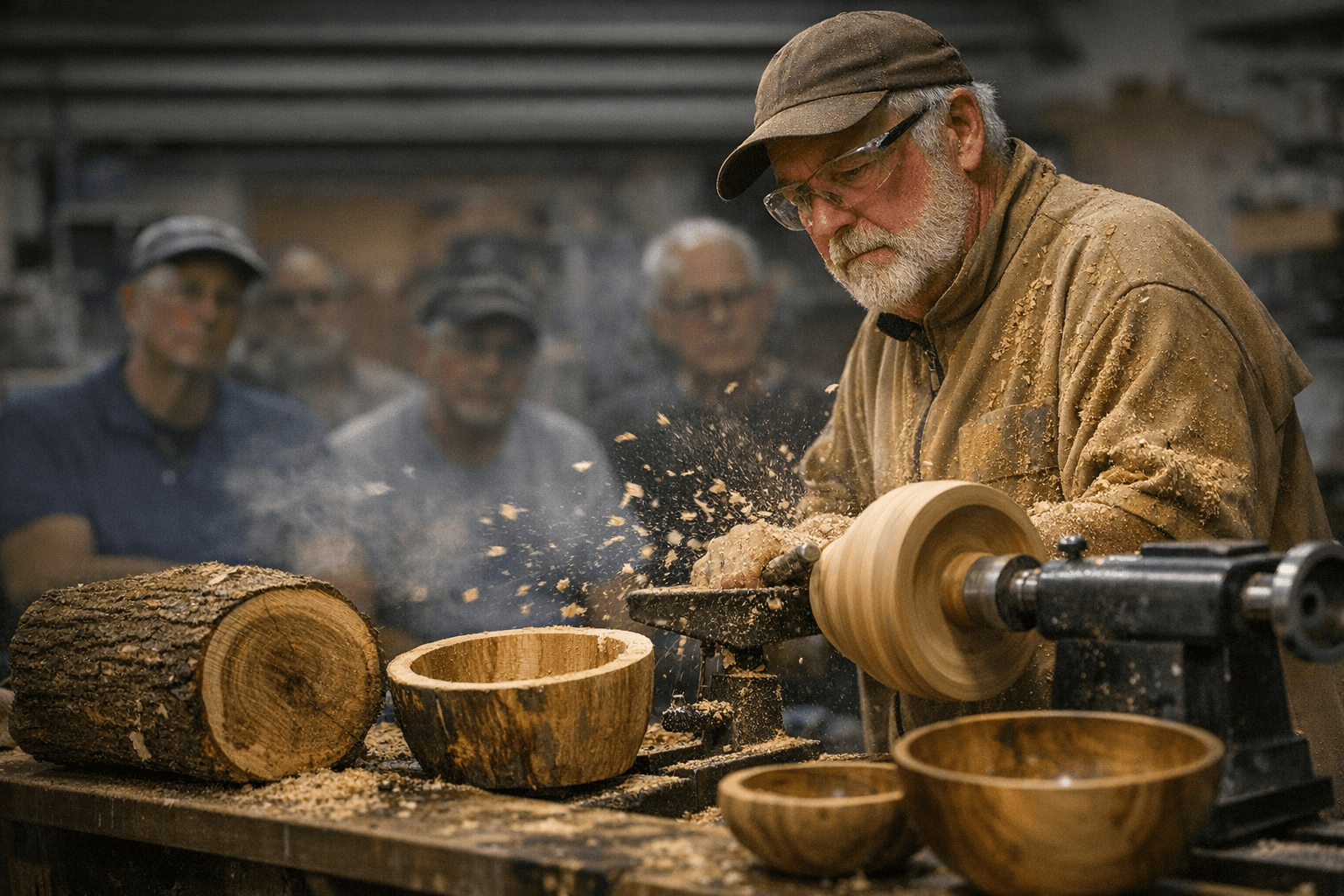
Few skills in woodturning carry as much practical weight as understanding what a piece of wet wood will do after it leaves the lathe. Chuck Engstrom's April demonstration for Montgomery County Woodturners (MCW) attacks that question head-on, walking through the complete arc from selecting a blank at the log all the way to a finished, usable bowl. The program, titled "Tree to Bowl: Two bowl demos in one," is the featured event at MCW's April 9, 2026 hybrid meeting at the Woodworkers Club, 11910 Parklawn Drive, Unit L, Rockville, MD.
Starting at the Log
Before a bowl takes shape on the lathe, it starts with decisions made at the wood pile. Engstrom's demo opens with blank selection directly from the log, a stage where most turning projects are won or lost before the first cut. The critical early move is removing the pith, the soft, unstable center of the log that almost guarantees cracking if left inside the blank. Orienting the blank to exclude the pith is a foundational step that affects everything downstream: how the bowl moves as it dries, how the grain presents in the finished piece, and how reliably the walls hold their shape.
Orientation also determines where face grain and end grain will run through the bowl, which matters both aesthetically and structurally. Face-grain and end-grain blanks behave differently during drying, so Engstrom's guidance on selecting and positioning the blank from the log gives turners a clear decision framework before any cutting begins.
Roughing the Green Blank
With the blank selected and mounted, the roughing stage sets the tolerances for everything that follows. Green wood cuts cleanly and with considerably less dust than dried stock, but it demands specific wall-thickness targets to dry without failure. The standard approach for rough-turned bowls is to leave walls at roughly 10 percent of the blank's diameter, giving the wood enough mass to move slowly during drying while remaining thin enough to reach equilibrium without generating destructive internal stress.
Engstrom's session will address mounting methods at this stage, including alternative holding strategies that matter both for safety and for controlling the blank once it begins to shift shape during the first passes. Green wood blanks are often irregular and can hide tension that releases unpredictably at the lathe, so a secure, well-considered mount is not optional: it is the foundation of safe, controlled turning on wet stock.
Two Paths, One Demo
The heart of the "Tree to Bowl" format is the direct comparison of two blanks at different stages. The first is a freshly roughed green blank, turned to target wall thickness and set aside for slow drying. The second is a blank that has already completed that drying process, and it shows exactly what to expect: ovalization, warp, and dimensional change that routinely surprises turners who haven't watched it happen firsthand.
This side-by-side comparison is one of the most instructive tools Engstrom could offer. Rather than describing what happens in theory, the demo lets members see the actual geometry shift from a round, freshly turned blank to the elliptical, slightly warped form that comes off the drying shelf weeks later. That warped blank then returns to the lathe for a second turning pass that brings it to final shape and wall thickness, completing the full cycle.
Controlling the Dry
Cracking during drying is the most common failure point for turners working with green wood, and Engstrom's demo addresses it directly. Slow drying is the primary strategy: keeping the rough-turned blank away from heat sources and often sealing the end grain with a wax emulsion to slow moisture loss at the most vulnerable areas. The goal is even moisture release across the entire blank so no single zone dries and contracts faster than its neighbors.
Wall thickness plays a central role here. Too thick, and the differential between the drying surface and the still-wet interior generates stress that the wood resolves by cracking. Too thin, and the blank may warp so dramatically it becomes difficult to remount for the second turning. Engstrom's guidance on hitting the right thickness target at the roughing stage is one of the most directly replicable takeaways from the demo: reach that benchmark, seal the end grain, and let time do the work.
Safe Tool Presentation on Wet Wood
Wet wood requires a different approach to tool presentation than dried stock, and Engstrom makes frequent tool sharpening a recurring practical admonition throughout the session. Sharp tools are essential on green wood because a dull edge tends to catch and tear rather than shear cleanly, which increases the risk of a dig-in on an already irregular, tension-loaded blank. Keeping the grinder accessible and sharpening before the tool starts to struggle, rather than after, directly improves both surface finish and safety at the lathe.
The practical implication: on wet wood, the difference between a freshly honed edge and a slightly dull one is immediately visible in the surface and audible in the cut. Sharpening frequently is not just technique preference; it is a safety discipline specific to turning green material.
Hybrid Format: In-Person and on Zoom
The April 9 meeting runs as a full hybrid event, with Engstrom's live demo at the Woodworkers Club broadcast simultaneously over Zoom by MCW's AV team. This format extends the practical value of a hands-on demonstration to members who cannot make it to Rockville in person, which matters especially for a technique-heavy session where watching tool presentation and listening to the sound of a cut carries real instructional weight.
The Woodworkers Club at 11910 Parklawn Drive, Unit L serves as MCW's in-person home, and the AV team's Zoom broadcast reflects how regional woodturning clubs are maintaining participation and preserving institutional knowledge across a geographically spread membership.
Inside the April Newsletter
The April issue of MCW's monthly bulletin carries considerably more than the meeting announcement. The newsletter includes a President's Perspective, Editor's Corner, recent meeting minutes, a Bring-Back challenge, Show & Tell summaries, skills-enhancement topics, and Treasurer's reports, along with links to photo galleries and member resources.
Editorial content is calibrated across skill levels: back-to-basics segments serve members newer to the lathe, while panel critiques and class listings address intermediate and advanced turners working to sharpen specific techniques. That range reflects MCW's approach to club programming; the same monthly issue that previews Engstrom's green-wood demo also gives newer members foundational context for what they are about to watch.
A fresh log, a roughing gouge, and Engstrom's framework form a realistic starting point for any turner ready to move beyond kiln-dried blanks and into the longer, more rewarding arc of working wood sourced and dried on their own terms.
This article was produced by Prism’s automated news system from verified source data, official records, and press releases, then run through automated quality and moderation checks before publishing. The system is built and supervised by the people who set the standards it runs under. Read our full AI policy.
Did this article answer your question?