Highland Woodturners Learn Lamp Making, Thread Cutting and Wiring Techniques
Alec Mutch’s lamp demo packed three takeaways: safer wiring, cleaner thread cutting, and controlled hollowing that turns a project into a usable shop piece.
Lamp making starts with function, not just shape
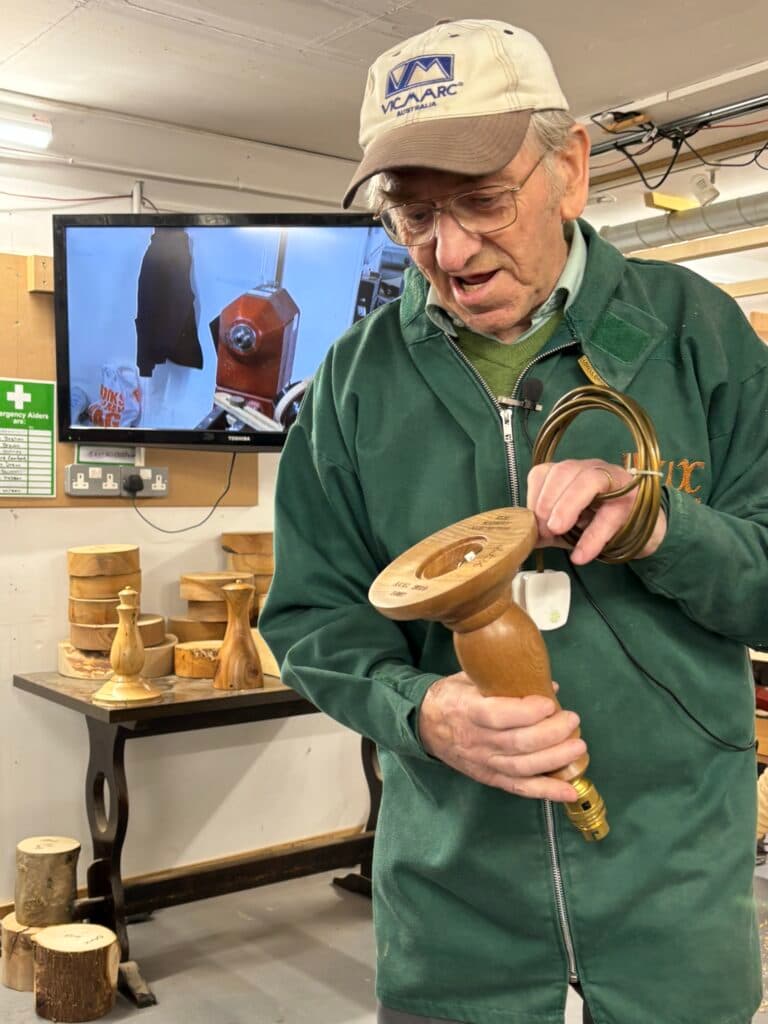
Highland Woodturners’ April 16 meeting was the kind that leaves you with more than a polished object. Alec Mutch’s table lamp demonstration showed how a turning becomes genuinely useful only when the wood, the fittings, and the wiring all work together. The session mixed lathe work with cable fixing and wiring, and that combination gave the night its real value: not a showpiece, but a lamp you could confidently put on a table and switch on.
Alec spent comparatively little time on ornament and much more on sequence. That mattered, because lamp making is one of those projects where the order of operations decides whether the parts align cleanly or fight each other all the way to the finish. The club report makes clear that the practical side of the job was the point, from how the components fit together to how the lamp is made safe as a finished object.
The shape begins where the parts meet
The first lesson was that lamp turning is really about interfaces. Alec showed how a slight hollow lets the parts sit square, a small detail that prevents the whole build from wobbling or leaning once the fittings are assembled. That kind of cut is easy to overlook when you are focused on the outer profile, but it is exactly the sort of quiet accuracy that separates a merely decorative piece from one that behaves properly in use.
For turners used to bowls or spindles, the lamp body asks for a different mindset. You are not just shaping a form; you are preparing a housing for hardware, thread, cable, and the electrical parts that make the piece function. The club’s write-up treated that as an essential part of the craft rather than an afterthought, which is why the demo landed as a true shop lesson rather than a casual show-and-tell.
Thread cutting: the part that makes the lamp fit together
If there was one section that members could take straight back to the lathe, it was thread cutting. Alec used a Robert Sorby male thread-cutting tool, then showed how to use a tap to form the female thread, with sacrificial blocks protecting the entrance as the thread was started. That detail alone is gold for anyone who has ever tried to force a fit that should have been precise from the start.
The point was not just to make threads, but to make them meet cleanly and repeatedly. A lamp base or column that relies on threads needs accurate mating surfaces, and that starts before the cutter touches the wood. The slight hollow Alec demonstrated helps the parts sit square, and the thread itself then does the work of holding the assembly true. In other words, the fit is built in twice: first by the geometry, then by the thread.
The evening’s value here was in the sequence. Threading is often taught as a clever trick, but in practice it is a chain of small decisions: preparing the face, protecting the entry, cutting steadily, and checking that the male and female sections are truly compatible. That is the kind of technical craft that rewards patience far more than speed.
Hollowing: small bites, clean flutes, steady control
Once the threaded parts were prepared, the center had to be hollowed, and this was where the demo shifted from fitting to controlled removal. Alec used a specialist hollow-centering bit and an auger, then stressed the discipline that makes hollowing safe and accurate: work only a few centimeters at a time and clear the flute often. That is exactly the sort of advice a club member can carry back to the bench and use the next day.
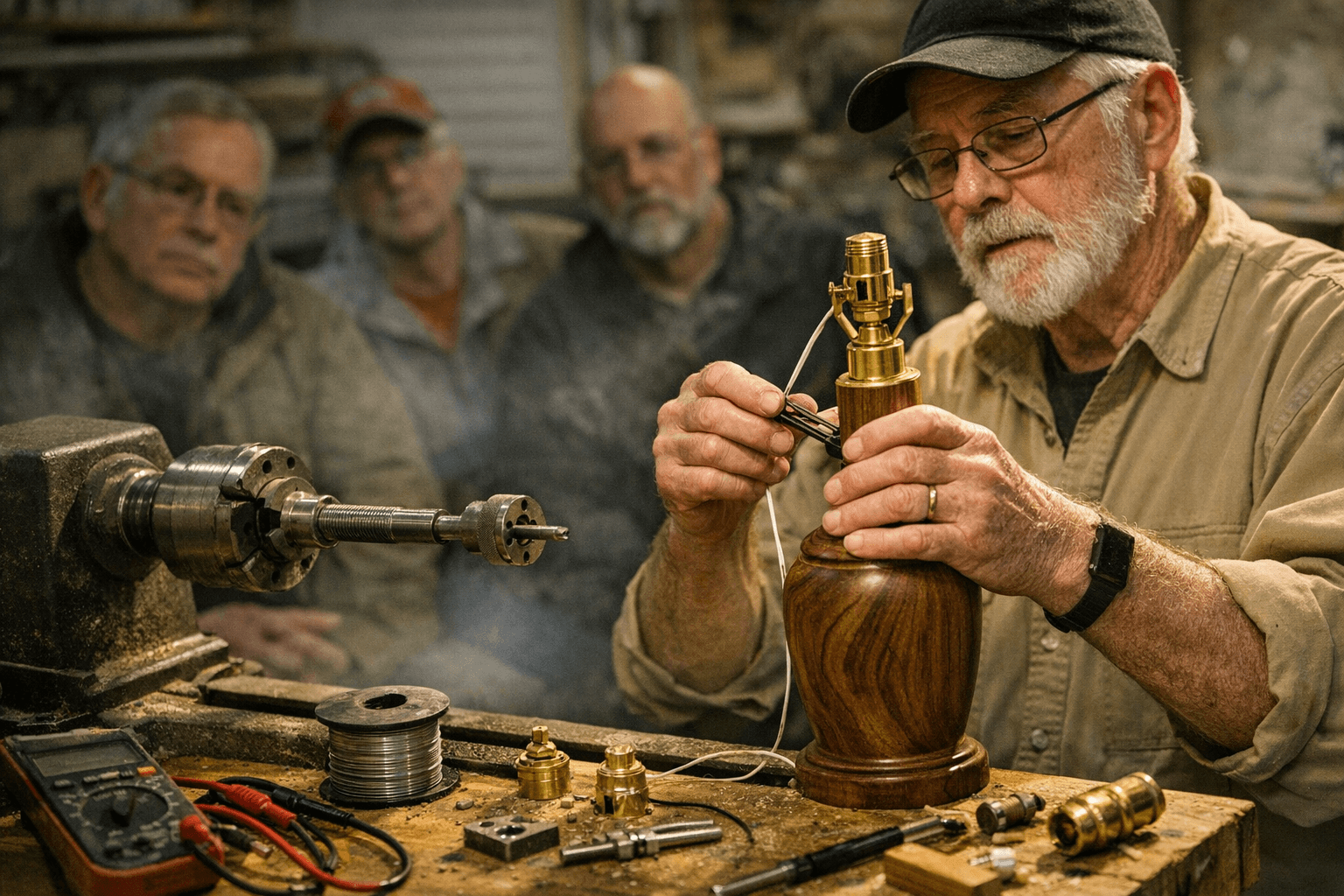
The report’s caption details reinforce the same lesson. Notes about the hole borer, the tip used to center the piece, and the way removing the tip allows the auger to pass through the center all underline how much of hollowing depends on tool setup before the cut even starts. When the tool is properly centered, the hollow stays where it belongs. When it is not, the whole operation becomes a fight against drift, chatter, and avoidable waste.
For a lot of turners, hollowing is where confidence gets tested. Alec’s approach turned it into a measured process rather than a leap of faith. That is the kind of bench-level value members remember: not just what the finished lamp looked like, but how to keep the cut controlled enough to get there.
Wiring and cable fixing: the safety side that makes the project real
What made the presentation unusually useful was the way it treated the electrical side as part of the craft. The lamp was not complete until the cable was fixed and the wiring arranged so the piece could be used safely. That is a significant reminder for anyone who tends to think of woodturning as a purely mechanical art. A lamp is a turning that has to pass into the world as a working electrical object, and that raises the bar.
That emphasis lines up with wider safety guidance. Electrical standards and approved codes of practice need to be selected for the specific application, and powered equipment should be checked so plugs are wired correctly, fuses are properly rated, and cables are secured by someone competent to do so. For a woodturner, that means the final stage of the project is not a shortcut around the lathe work. It is part of the same disciplined process.
The club’s framing was especially smart because it kept the wiring from feeling like a separate, intimidating subject. Instead, it was presented as one more practical skill attached to the turning. That approach is likely to stick with members far longer than a generic safety lecture would.
Why this night mattered to Highland Woodturners
The lamp session also fits the club’s broader habit of turning meeting reports into a living record of useful skills. Highland Woodturners says it exists to promote the art and craft of woodturning in the Scottish Highlands, operates as Scottish Charity SC053651, and limits membership to 60 because that is the maximum it can safely fit into its rooms. That scale helps explain why nights like this matter so much: when the room is small and the bench space is finite, every demonstration has to earn its place.
The club’s history gives the evening even more context. Highland Woodturners was conceived in 2005, formally started in the summer of 2006, and was granted affiliation to the Association of Woodturners of Great Britain on 10 April 2006. Alec Mutch is no stranger to technical teaching either. In August 2023 he gave a solo presentation on long-hole boring and threading in wood, which makes this lamp demo feel less like a one-off and more like part of a continuing interest in precision work.
The schedule around the meeting shows the same practical rhythm. Meetings begin at 6.45pm, the April 16 session was listed as “Alec Mutch on table lamp making,” and an extra April 23 session was set aside for mushroom making for the open day. That combination says a lot about the club’s priorities: one night on a technical project with wiring and threads, another on a crowd-friendly open day piece that can be made on a club lathe. It is a working calendar, not a ceremonial one.
What members took home from the lamp night was not just the idea of making a lamp. It was a clearer sense of how to cut the thread, how to hollow without losing control, and how to treat wiring and cable fixing as part of the turning rather than an awkward add-on. That is the sort of instruction that changes what happens at the lathe on the very next session.
This article was produced by Prism’s automated news system from verified source data, official records, and press releases, then run through automated quality and moderation checks before publishing. The system is built and supervised by the people who set the standards it runs under. Read our full AI policy.
Did this article answer your question?