Small-Space Woodturning Guide Covers Compact Lathes, Storage, and Dust Control
A midi lathe with a folding stand, magnetic tool rails, and a shop vac fitted with a microfilter can turn a basement corner into a fully functional turning space.
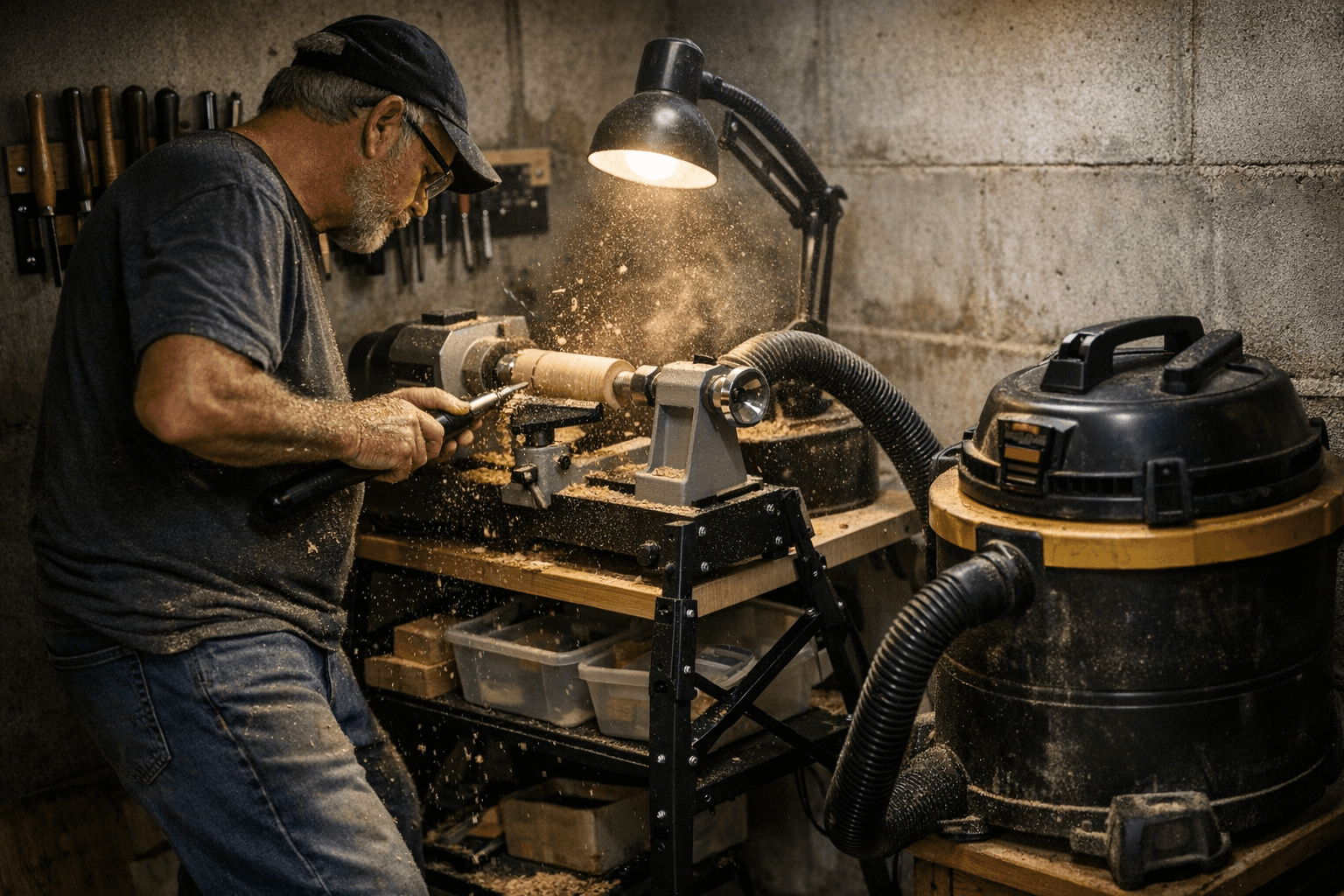
Floor space has always been woodturning's unofficial entry fee. The lathe, the stand, the shavings, the blanks stacked in the corner — it adds up fast, and for anyone working in a garage shared with a car, a basement room, or a rented workshop bay, the math rarely works out. The good news is that with deliberate equipment choices and some wall-mounted ingenuity, a compact footprint can support real turning: bowls, plates, pens, spindles, and utility pieces that would look at home in any gallery or craft show.
Picking the Right Lathe
The lathe is the first and most consequential decision in a small shop. A full-size floor lathe is essentially off the table when square footage is limited, but a midi lathe with a 12" to 16" swing covers the vast majority of everyday turning projects without dominating the room. That swing range handles small bowls, plates, and decorative vessels comfortably, and with a bed extension most midi machines will take on longer spindle work too. The tradeoffs are real: reduced bed length means fewer furniture-scale spindles, and a 12" swing won't accommodate a wide platter blank the way a 20" machine would. But for pens, lidded boxes, small bowls, and utility pieces, those are compromises most hobbyists will rarely notice in practice.
The stand matters as much as the machine itself. A benchtop lathe mounted on a fold-up or rolling stand gives back floor space the moment turning is done. Rolling the lathe to the wall, or folding the stand flat against it, transforms the turning area into general shop space in under a minute. That flexibility is particularly valuable in shared workshops where multiple people need access to the same zone at different times.
Dust Control in a Tight Space
Turning generates two distinct dust problems: the chunky shavings that pile up around the lathe, and the fine airborne particles produced during sanding that are genuinely hazardous to breathe over time. A small-footprint shop can't always accommodate a full-scale dust collector with dedicated ductwork, but a shop vacuum fitted with a fine-particulate microfilter addresses the sanding phase effectively and takes up almost no room. The key word is microfilter: standard shop vac filters pass fine wood dust right back into the air, so upgrading to a rated fine-dust filter is a non-negotiable step for safe lathe sanding operations.
For chip management, a bench-mounted dust collection port positioned near the headstock captures a useful percentage of shavings before they hit the floor. It won't eliminate cleanup entirely, but it concentrates the mess, which is the realistic goal in a small shop. Closing off the turning area as much as possible, whether through a curtain, a folding panel, or simply keeping adjacent surfaces cleared, helps contain chips to a defined zone and makes post-session cleanup significantly faster.
Tool Storage: Off the Bench, On the Wall
A cluttered bench is a slow bench. In a compact turning setup, every tool left flat on the work surface is a hazard and a time sink. Pegboard panels mounted directly behind or beside the lathe put gouges, parting tools, skews, and scrapers within arm's reach while keeping the turning area clear. Magnetic tool rails are an equally effective option and particularly well-suited to chisels and smaller turning tools; the tools seat securely, release with a single motion, and the rails themselves take up almost no wall depth.
The organizing principle in both systems is the same: keep the tools you reach for most often at eye level and within a single step of the lathe. That might mean a magnetic strip for the four or five gouges used on every turning session, a pegboard hook for the chuck key, and a dedicated shallow shelf for calipers and parting tools. Modular storage makes it easy to adjust that layout as your tool collection grows without tearing out a fixed cabinet.
Blank Storage: Think Vertical
Turning blanks present a different storage problem than tools. They're heavy, irregular in shape, and tend to accumulate quickly once you start sourcing from local tree services or buying in variety packs. In a small shop, floor piles are the enemy: they restrict movement around the lathe, create tripping hazards, and make it nearly impossible to find the blank you actually want.
Vertical racks address short blanks cleanly. A simple wall-mounted bin or divided rack stores bowl blanks on end, keeps them visible, and takes up a fraction of the floor area a horizontal stack would require. For pen blanks and other slim stock, a narrow vertical bin mounted near the lathe keeps longer pieces organized without spreading across the bench. Neither solution requires much investment; both make a measurable difference in how quickly a turning session gets started.
Ergonomics and Lighting
Small-shop ergonomics often get overlooked in favor of equipment discussions, but they directly affect both the quality of the work and the safety of the session. Task lighting mounted directly over the lathe, aimed at the tool-rest zone, eliminates the shadows that make it difficult to read the profile of a developing bowl or catch a catch before it happens. A dedicated light over the lathe is more effective than overhead shop lighting alone, and it scales well to any shop size.
One underused trick for checking form during bowl and vessel turning is a mirror positioned behind or beside the lathe. Checking the outside profile of a piece while turning the inside is much easier when you can see the back without stopping and walking around the machine. It's a small-shop ergonomics adjustment that translates directly into better-looking work.
A Lower Bar to Entry
Perhaps the most significant implication of compact turning setups is what they mean for who gets to turn. City dwellers, apartment woodworkers, and anyone who can't dedicate a full garage to the craft can now approach the hobby with realistic expectations and a workable plan. Clubs and educational programs can apply the same principles to build drop-in beginner stations in community centers, school makerspaces, or shared studios, where permanent dedicated shop space simply isn't available.
Getting a turning station to fit within a small footprint doesn't require sacrifice so much as intention. The right midi lathe, a folding stand, a shop vac with a proper microfilter, a magnetic tool rail, and a pair of vertical blank racks represent a modest total investment that delivers a safe, repeatable, and genuinely productive turning environment, whatever the square footage.
This article was produced by Prism’s automated news system from verified source data, official records, and press releases, then run through automated quality and moderation checks before publishing. The system is built and supervised by the people who set the standards it runs under. Read our full AI policy.
Did this article answer your question?