Woodturner Combines Lathe Skills and Flatwork to Craft Wormhole Coffee Table
French woodturner Olivier Gomis spent 140+ hours combining lathe work, laminated flatwork, and LED lighting to build a wormhole coffee table that no CNC could replicate.
Most woodturners pick a lane: you're either at the lathe shaping bowls and vessels, or you're at the bench doing flatwork. Olivier Gomis, a French woodturner with 24 years of experience, refused that divide and built something that proves the two disciplines are stronger together. His wormhole coffee table has been circulating in the woodworking world as one of the most ambitious hybrid projects in recent memory, and studying how he did it reveals a masterclass in sequencing, joinery, and knowing exactly when to reach for the gouge versus the hand plane.
The Concept: Physics as a Design Brief
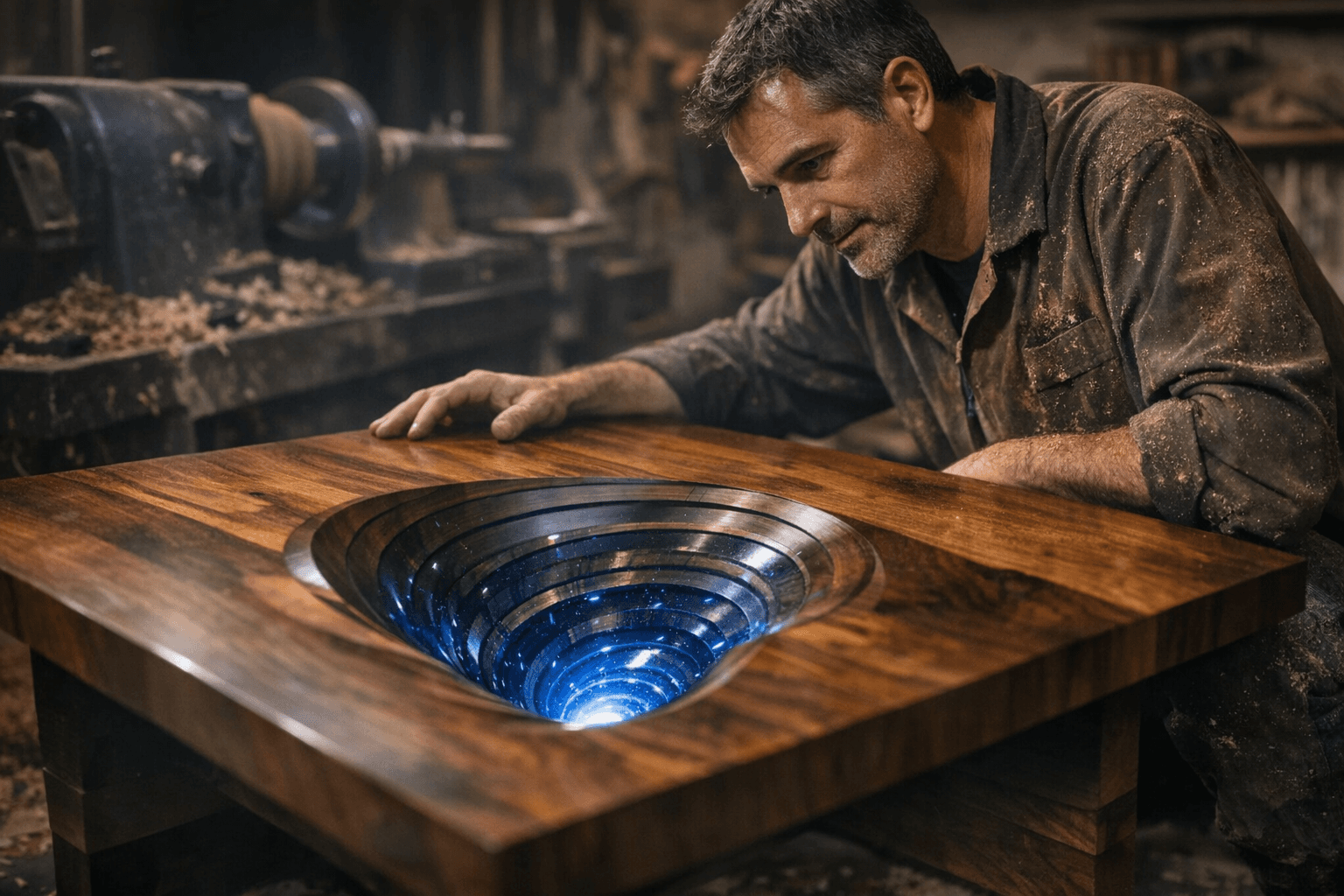
In astrophysics, a wormhole is a hypothetical object that connects two distinct sheets or regions of space-time, manifesting itself as a black hole on one side and a white hole on the other. Gomis took that abstract idea and made it the literal geometry of a coffee table. The shape is almost like a wooden plank that has been bent so that the two ends are on top of each other and then joined together by a double cone. What sounds simple as a sentence is extraordinarily difficult to execute in solid wood, and Gomis chose to do it entirely by hand. The complicated shape and curvature of the wormhole isn't easy to create, but Gomis managed to carve one without the aid of a CNC or 3D printer.
Species and Material Selection
The table is made of walnut and sycamore maple. These aren't arbitrary choices. Walnut's deep brown and the pale cream of sycamore maple create a high-contrast grid once laminated together, which is exactly the visual effect Gomis needed to evoke a spacetime diagram. He prepared the wood by cutting it into strips, using maple veneer sandwiched between pieces of walnut. This lamination strategy is the foundation of the whole build: without it, you have no grid, and without the grid, you have no wormhole.
The Flatwork Phase: Building the Blank
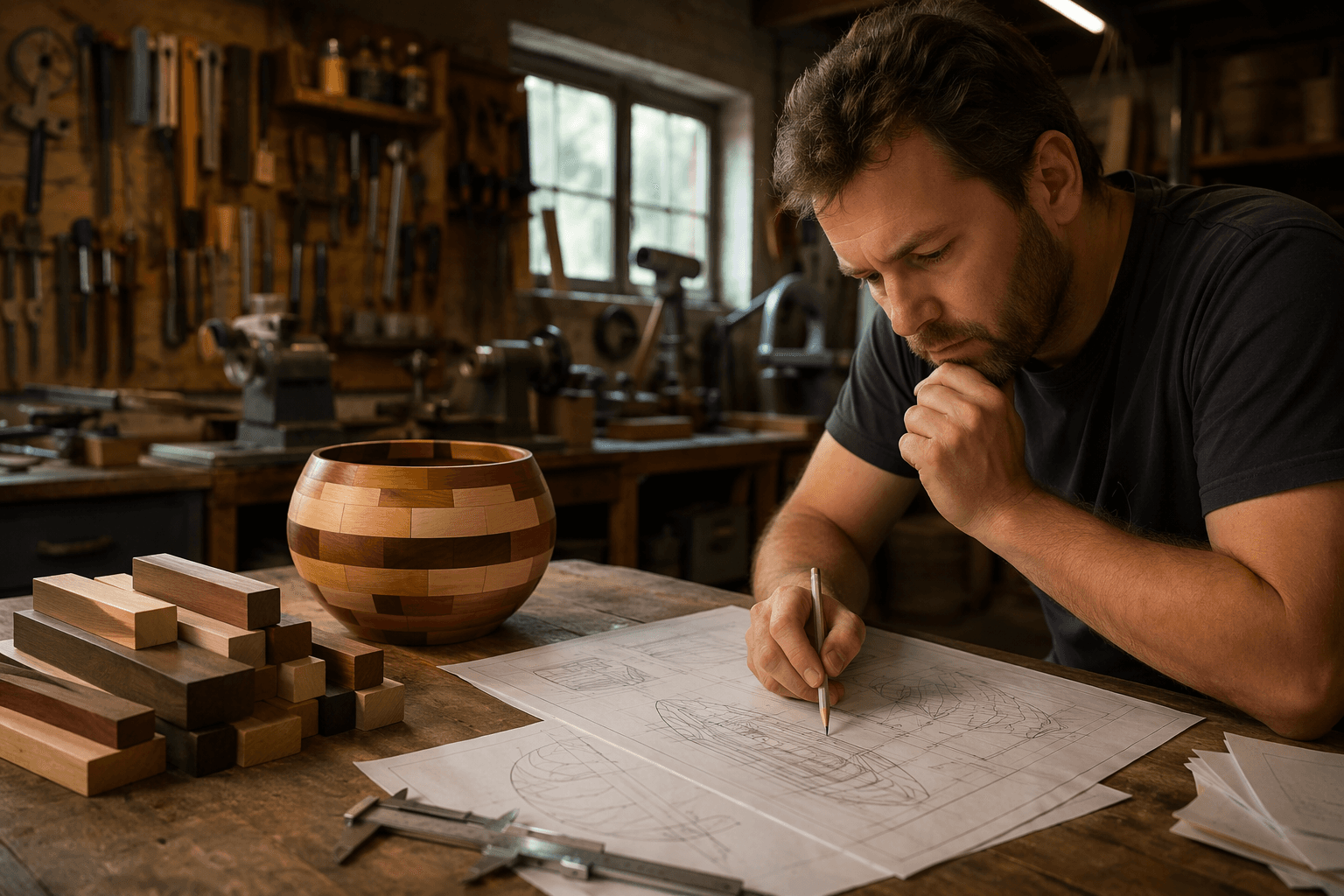
Before a single tool touched the lathe, Gomis put in serious bench time. He built the table from rough walnut planks he cut into sticks and glued into grids. Starting with walnut planks and maple veneer laminated together, he created a grid stackup to replicate the common representation of spacetime as a 2D grid, then used various arrangements of these grids to build up the central section of the wormhole.
The project kicked off with cutting walnut pieces into smaller, manageable sections, since smaller pieces are easier to work with and can be planed down more effectively. This is a discipline every turner should internalize: the quality of your lathe work is largely determined by the quality of your blank prep. Sloppy glue-ups telegraph themselves in the turned surface. Gomis's grids had to be square, flat, and true before any rotation happened.
Using various arrangements of these grids, he built up the central section of the wormhole, which looked like a low poly vase before he put it on the lathe for turning. That low-poly vase stage is the critical handoff point between flatwork and turning, and it's worth pausing on. The flatwork has to get the shape close enough that the lathe can do its job without taking forever, but not so refined that you've removed the material you'll need for the turned curves.
The Lathe Work: Turning Between Chaos
This is where the build gets genuinely dangerous by woodturning standards. The lathe work on this build is simultaneously impressive and terrifying. Turning down the central portion of the wormhole required working between two large spinning squares of walnut, which Gomis admits was "scary." Multiple custom jigs were required to keep parts flat and deal with the extreme curvature of the inside of the wormhole's opening.
If you've ever turned between centers with an out-of-round blank, you already know the pucker factor. Now imagine doing that with large flat panels of laminated walnut spinning at either end of your workpiece. The centrifugal forces are uneven, the vibration is significant, and a dig-in at the wrong moment isn't just a ruined blank — it's a safety incident. The custom jigs Gomis built to manage flatness and curvature weren't an optional refinement; they were a prerequisite for survival.
With almost the same mathematical precision as the wormhole's foundations, the strips of wood were cut and joined together, sometimes at angles to form a curved shape, and a lot of machining was involved to carve the blocky sides down to smooth curves. Suffice it to say, there was a great deal of patience involved in a process that had very little wiggle room for errors.
Assembly and Finishing
He assembled the turned rounded pieces, then assembled and finished them. The finishing stage on a piece like this is a challenge in its own right: you have end grain, long grain, and cross-grain surfaces all presenting within centimeters of each other, and they absorb finish at wildly different rates. Gomis finished the piece with natural lemon oil, a choice that keeps the walnut's natural warmth without building a heavy film that would fight with the geometry.
A removable transparent glass top is associated with the work, protecting it from all objects and enabling it to be used as a functional coffee table. That glass top is a practical necessity and a smart design decision: it protects the LED system below and gives the piece a surface you can actually use without worrying about a coffee mug disappearing into the void.
The Lighting: Extending the Illusion
At its center, a system of mirrors and LEDs, controlled by a remote, extends the lines of space-time to infinity. To really bring that sci-fi atmosphere to life, a lamp was installed in the center of the hole, giving the table an eerie appearance in the dark. The lighting isn't decorative whimsy — it completes the conceptual logic of the piece. Without it, you have an impressive turning exercise. With it, you have a convincing physical argument that a wormhole is sitting in your living room.
What This Build Teaches
With over 140 hours invested in this project, the final product is not just a piece of furniture, but a work of art that captures the imagination. That 140-hour figure is the most honest number in this entire story. It's not a weekend build or even a month of evenings. It's a sustained commitment to a single vision across every discipline in the shop.
The practical takeaways for turners thinking about hybrid projects:
- The lathe is not always the starting point — sometimes flatwork builds the blank the lathe needs
- Lamination sequencing determines your visual result; plan the grid before you cut a single strip
- Custom jigs are not a shortcut for advanced work; they're the only way through it
- Safety margins shrink fast when turning asymmetric or large out-of-round blanks; reduce speed before you think you need to
- Finish selection should match the grain complexity — a penetrating oil lets the wood breathe across varying grain directions
Skilled woodworker Olivier Gomis constructed this wormhole coffee table out of aged walnut, and the depth of the craft on display makes one thing clear: the turners pushing the boundaries of what the lathe can do are usually the ones willing to put it down and pick up a handplane first.
This article was produced by Prism’s automated news system from verified source data, official records, and press releases, then run through automated quality and moderation checks before publishing. The system is built and supervised by the people who set the standards it runs under. Read our full AI policy.
Did this article answer your question?