How to Evaluate Color, Clarity, and Treatments When Buying Gemstone Jewelry
Most gemstone buyers focus on sparkle and miss the three factors that determine whether a stone is worth its price: color depth, species-specific clarity, and undisclosed treatments.
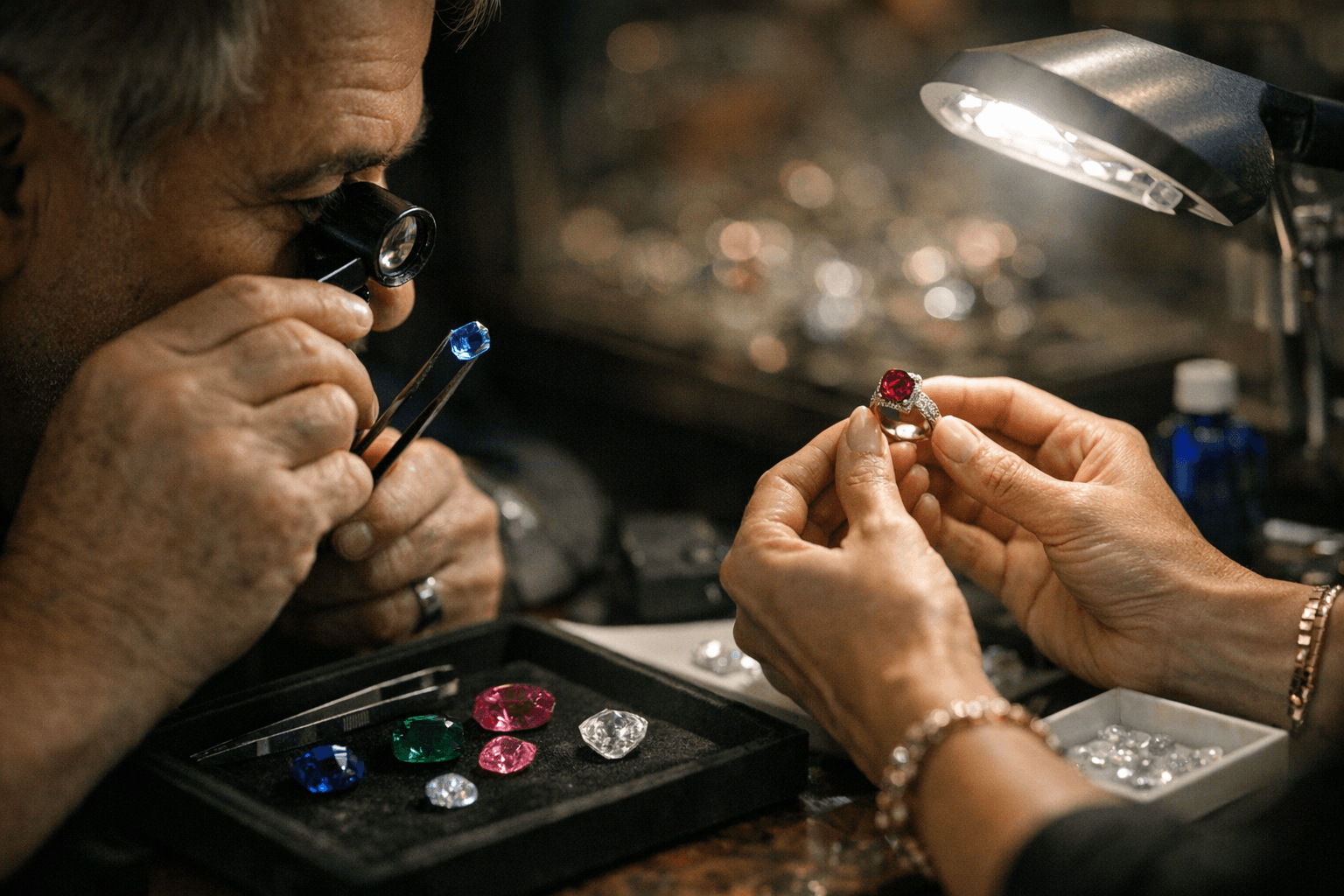
Pick up an untreated Burmese ruby and a heat-treated one side by side, and the difference in price can be staggering — yet both stones might look nearly identical to the untrained eye. That gap is where knowledge pays off, and it's why understanding color, clarity, and treatments isn't gemological pedantry; it's the most practical thing you can do before spending real money on colored stone jewelry.
Color: Hue, Tone, and Saturation Are Not the Same Thing
When gemologists talk about color, they're actually describing three distinct properties working together. Hue is the basic color family — the blue of a sapphire, the green of an emerald, the violet of tanzanite. Tone refers to how light or dark that color appears on a scale from near-colorless to near-black. Saturation describes the intensity or vividness of the color, from dull and grey to vivid and pure.
A stone can have the right hue but be so dark in tone that light can't travel through it, leaving it looking inky and lifeless. Conversely, a pale, low-saturation stone might technically be the correct color but lack the presence that makes a piece of jewelry worth wearing for decades. The sweet spot — medium to medium-dark tone with strong, even saturation and minimal grey or brown modifying the hue — is where value concentrates. When you're evaluating a stone, hold it under different light sources: daylight-equivalent lighting, incandescent light, and if possible, direct sunlight. A gem that looks vibrant only under one lighting condition is telling you something important about its color quality.
Clarity: Why the Rules Change by Species
In the diamond world, clarity grading follows a single standardized scale. Colored gemstones are more complicated, and the standard that applies to one species can be irrelevant — or even misleading — for another. Clarity matters enormously for some stones and very little for others.
Emeralds, for example, are so routinely included that the industry has its own term for their internal landscape: "jardin," French for garden. An emerald with no visible inclusions is so rare it commands a premium that can exceed a comparably sized fine diamond. Sapphires and rubies sit in the middle ground; some inclusions are tolerated, but obvious fractures or clouds that affect transparency will drag value down considerably. At the other end of the spectrum, stones like opaque turquoise or chalcedony are not evaluated for transparency at all — their value is driven by color uniformity, pattern, and surface finish instead. Before judging a stone's clarity, know which species you're looking at and what that species' natural inclination toward inclusions actually is.
Treatments: The Question Every Buyer Must Ask
The treatment of colored gemstones is the area where the most money is lost by uninformed buyers, and where disclosure from sellers is most inconsistently applied. Heat treatment of sapphires and rubies is so common that it's considered standard practice and is priced accordingly; an unheated fine sapphire with a certificate confirming that status can sell for multiples of a heat-treated equivalent. Fracture filling in emeralds is nearly universal, but the degree of filling matters, and stones that have been heavily filled with resins or oils are far more fragile and less valuable than lightly treated examples.
Other treatments — surface diffusion, irradiation, coating — are less visible and sometimes less stable, and some are considered controversial precisely because they can be difficult to detect without laboratory equipment. The single most effective thing you can do as a buyer is ask, directly and explicitly, whether the stone has been treated, and in what way. As the guidance from Gemsenvogue puts it plainly: "When purchasing from a jeweler, ask for information about the stone's origin and any treatments it may have undergone." Synthetic stones and outright fakes also circulate in the colored stone market; these are distinct from treated natural stones and require different tests to identify. Reputable sellers will welcome the question; evasion is itself a data point.
Certificates: What to Ask For and Why
A gemological certificate from an independent laboratory is the closest thing to objective proof in the colored stone market. Not all certificates are equal. Reports from recognized gemological laboratories can confirm a stone's identity (natural vs. synthetic), disclose treatments, provide an origin determination for significant stones, and give weight, measurements, and cut quality. For high-value purchases — anything where the price justifies the cost of testing — asking for a laboratory report, or asking why one isn't available, is entirely reasonable. The origin of a stone can affect its price significantly: a Colombian emerald, a Kashmiri sapphire, or a Burmese ruby with credible laboratory-confirmed origin commands a premium that has nothing to do with the stone's appearance alone.
Durability and the Long-Term Investment
Color and clarity mean little if the stone doesn't survive ownership. Different gem species sit at very different points on the Mohs hardness scale, and hardness is only one dimension of durability; toughness (resistance to fracturing) and stability (resistance to heat, chemicals, and light) also vary considerably. Tanzanite, with its deep blue-violet hue representing transformation and enlightenment in its symbolic tradition, is a relatively soft stone at around 6.5 on the Mohs scale, making it less suited to a daily-wear ring than to earrings or a pendant. Turquoise, often set in silver for its striking blue-green color, is porous and sensitive to chemicals including perfume and hand cream, which means care instructions matter as much as setting choice.
Choosing durable settings and high-quality stones to ensure the jewelry lasts is practical advice that goes beyond aesthetics. Consider the wearer's lifestyle and select pieces that can withstand daily wear if needed. A bezel setting, which wraps metal around the stone's girdle, offers more physical protection than a prong setting; this is worth discussing with the jeweler for any stone below a 7 on the Mohs scale.
Origin, Budget, and the Case for Customization
Budget is a legitimate part of the evaluation process, not an afterthought. Birthstone jewelry spans an enormous price range, and knowing what you're willing to spend before walking into a jeweler shapes every conversation you'll have. It also protects you from being upsold on factors that don't matter for your use case, or from accepting quality compromises you don't have to make.
Reputable jewelers — those with verifiable credentials, transparent sourcing practices, and willingness to answer detailed questions about their stones — are worth seeking out specifically. The provenance question is not only ethical; it's financial. Knowing where a stone comes from affects its certificate's conclusions, its treatment history, and in many cases its price trajectory.
Customization is one of the most underused options in birthstone jewelry: adding engravings, choosing specific settings, or combining multiple birthstones for a family piece or layered design produces something that no mass-market retailer can replicate at any price. For November, topaz, often blue or yellow, and citrine, with its warm yellow hue, offer complementary tones that work well together in a mixed-stone piece. For December, the trio of turquoise, zircon, and tanzanite presents a range of blue tones from the soft, earthy blue-green of turquoise to the intense blue-violet of tanzanite, giving a custom jeweler interesting material to work with.
Going Deeper
For buyers who want a structured reference beyond a single purchase, the Gemstone Buying Guide (Third Edition), published by International Jewelry Publications, covers quality evaluation, price comparison, gem identification, cutting styles, treatments, fake stones, optical effects, gem care, and geographic sources across species including jade, opal, topaz, garnet, ruby, spinel, chalcedony, and tourmaline. The 156-page paperback retails at $19.95 (ISBN 978-0-929975-51-1) and is available through DavTools in Antwerp at idavid.be, among other retailers. It is one of the few consumer-facing references that addresses synthetic stones and treatment disclosures in the same volume as aesthetic evaluation — which is exactly the combination of knowledge that turns a buyer into someone who rarely gets a bad deal.
The colored stone market rewards preparation in a way the diamond market, with its standardized grading and more transparent pricing, does not. The questions you ask before you buy are worth more than any jeweler's assurance after.
Know something we missed? Have a correction or additional information?
Submit a Tip