Playful birthstone-inspired jewelry rides Vegas luxury week trends
Pearls are shedding their formal-only reputation, with Vegas week favoring charm-heavy, mixed-stone pieces that make June birthstone jewelry feel fresh.
The new pearl mood
Pearls are getting louder, more playful, and far less precious in the old-fashioned sense. At JCK’s Luxury week in Las Vegas, the clearest signal was not a classic strand tucked into a velvet tray, but a burst of wearable pieces that mixed South Sea and akoya pearls, diamonds, carved shell, and charm-heavy styling into jewelry that feels built for real life.
Luxury itself is a telling setting for that shift. JCK positions the show as a curated, secure buying environment for elite retailers, designer brands, and manufacturers, and in 2026 it occupied The Venetian Expo in Las Vegas with invitation-only buying on May 27 and May 28 before opening to broader JCK attendees from May 29 through June 1. That structure matters because it puts high jewelry, demi-fine work, and accessible luxury on the same floor, where trends have to prove they can travel from display case to customer.
Why June birthstone jewelry is turning playful
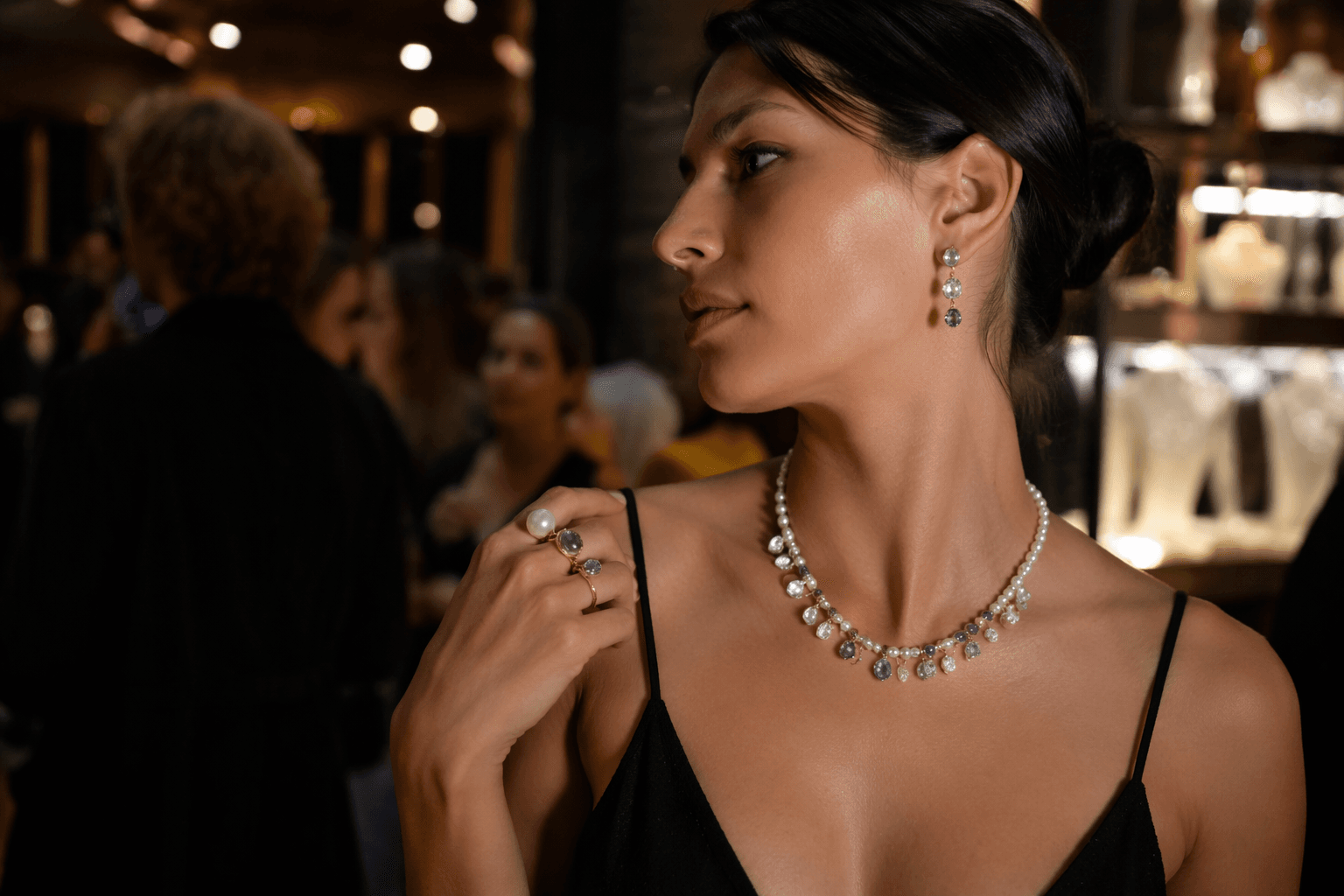
The strongest pearl pieces in the room were not trying to look ceremonial. They were mixed, layered, and deliberately easy to imagine with a shirt, a tank, or a night-out dress, which is exactly why they read as a 2026 birthstone signal rather than a formal callback. A Zypp necklace paired Australian South Sea pearls and Japanese akoya pearls with diamonds, a combination that gives the piece both heft and polish, while also loosening pearls from the old rules of symmetry and matching.
That move says a lot about how June birthstone jewelry is being rewritten. Instead of a single strand reserved for anniversaries or black-tie dressing, the new language is charm-led and personality-driven, with scale doing much of the work. Puffy letter charms add a wink of self-expression, and carved motifs turn pearl-adjacent materials into something that feels collectible without becoming stiff.
Sarin Bachmann, senior vice-president of the RX Global jewelry portfolio, said the 2026 Luxury and JCK show floors would tell “nuanced stories” about gold jewelry, sterling silver, demi-fine jewelry, and other metals and materials. That framing fit the pearl moment perfectly: the pieces were not defined by one precious material, but by the way multiple materials were brought into conversation.
Materials that do the talking
The best statement pieces on the floor were specific about what they were made of, which is one reason they felt so convincing. Maura Green’s carved mother-of-pearl and abalone charms, including a flying pig, landed in the $500 to $1,000 range, and that price band made the work feel like a smart entry point into statement jewelry rather than a precious-object-only proposition. The charm language matters here too: mother-of-pearl and abalone bring natural iridescence, but the designs keep the mood light, tactile, and easy to wear.
Fantaci’s Bodega Pool Party collection sat at a higher tier, with the core brand retailing from $1,000 to $2,800. That spread is useful because it shows how playful jewelry can still live in accessible luxury when the materials, finishing, and design story are strong enough to justify the price. In other words, the value is not in pretending to be quiet luxury, but in making novelty feel refined.
This is where the pearl trend gets sharper than a generic “statement jewelry” story. The pieces at Luxury did not rely on vague promises or overworked branding. They showed their value through recognizable materials, visible craftsmanship, and styling that makes sense outside a gala setting.
The price reality behind the sparkle
Gold hovering around $4,500 per ounce was one of the defining pressures on the show floor, and that figure helped explain why so many exhibitors leaned into mixed materials, scaled-back metal weight, and designs that could be read as accessible luxury rather than pure fine-jewelry opulence. When gold is expensive, the smartest pieces often shift emphasis from metal volume to design intelligence.
That context made the price spectrum at Luxury especially instructive. On one end, Fantaci’s $1,000 to $2,800 range and Maura Green’s $500 to $1,000 charms showed how designers are building entry points without flattening the design. On the other, Rahaminov drew crowds with six-figure natural diamonds, including a 36-carat cushion-cut diamond ring, a reminder that the floor still had plenty of appetite for high drama and serious stones.
Yoko London also appeared among the key exhibitors, reinforcing that pearls were not a side note. They were part of a larger luxury conversation in which heritage materials, modern silhouettes, and collectible charm details are all competing for attention at once.
What this means for buyers right now
For anyone shopping June birthstone jewelry, the most useful takeaway is simple: look for pearls that feel designed, not merely preserved. The strongest pieces mix sizes and origins, like Australian South Sea and Japanese akoya pearls, or add contrast through diamonds, mother-of-pearl, abalone, and bold letter charms. That combination gives the jewelry movement, and movement is what keeps pearls from reading as formal-only.
It also helps to read price through construction rather than through carat-size assumptions. A $500 charm with carved mother-of-pearl and abalone can be more fashion-forward than a heavier but static piece, while a $1,000-plus pearl design with mixed origins and diamonds can justify itself through balance, finish, and wearability. In a market where gold costs are distorting old assumptions, the most relevant pieces are the ones that make materials feel modern without hiding what they are.
JCK’s 2026 program even added a new Timepieces at Luxury and JCK area, underscoring how the event keeps broadening beyond core fine jewelry into adjacent luxury categories. That expansion mirrors the pearl story itself: the category is no longer confined to tradition. It is moving into the same space as statement dressing, collectible charms, and everyday luxury, and that is what makes it feel like a true fashion shift rather than a seasonal flourish.
This article was produced by Prism’s automated news system from verified source data, official records, and press releases, then run through automated quality and moderation checks before publishing. The system is built and supervised by the people who set the standards it runs under. Read our full AI policy.
Did this article answer your question?