2026 Chart Shows Lab-Grown Diamond Prices Plunged Then Stabilized Versus Naturals
Lab-grown diamond retail prices plunged roughly 60–70% between 2020 and 2024 and then largely settled in early 2026; 1‑carat rounds now trade around $800–$900.
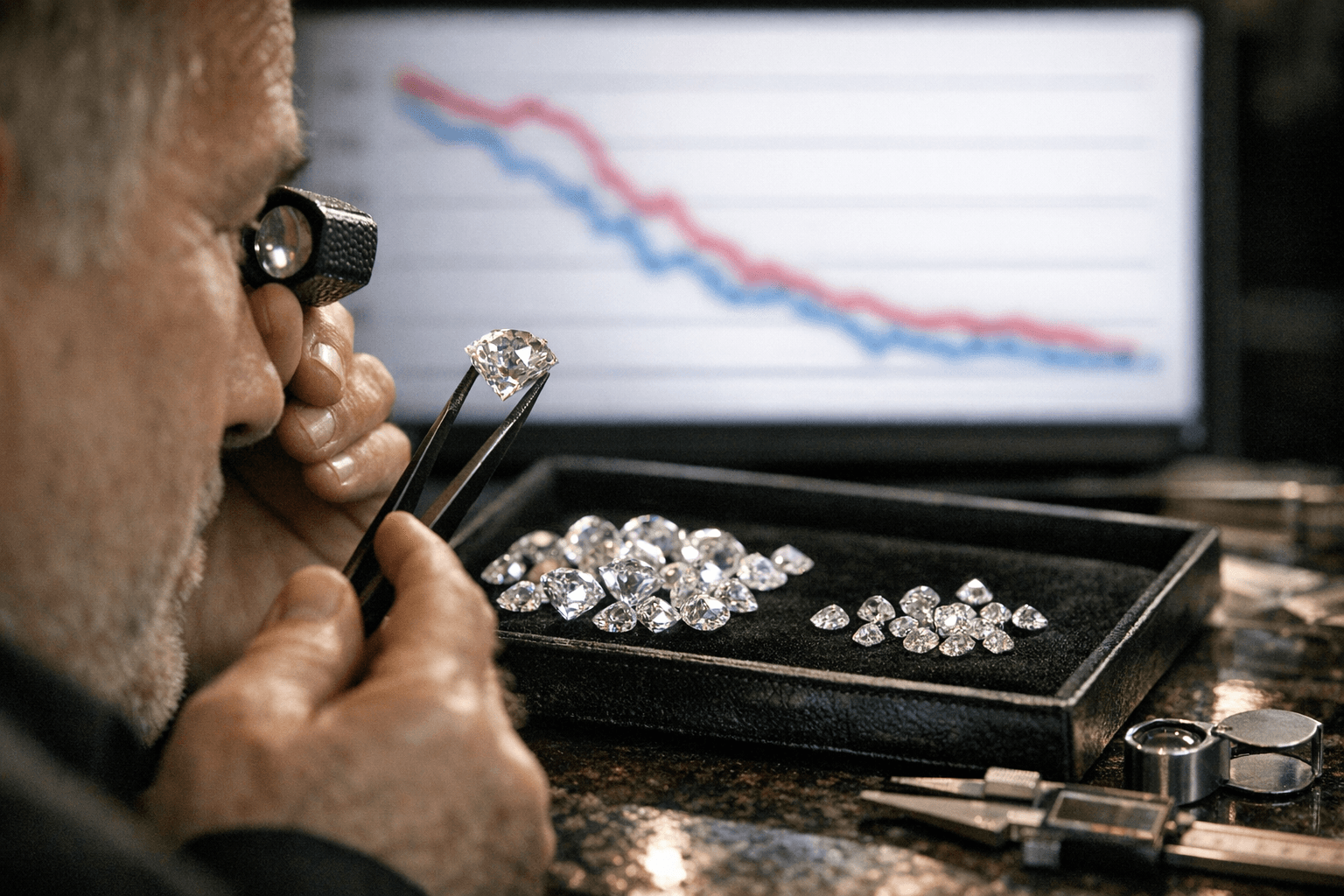
A mid‑February 2026 chart and multiple market indexes show a dramatic collapse in lab-grown retail prices between 2020 and 2024, followed by stabilization in early 2026. PriceScope’s monthly lab-grown price chart, built from “real-time data from over 400,000 lab-grown diamonds (and growing) listed on PriceScope,” documents peak-to-trough declines in certain categories of roughly 60–70%. That steep fall has left current entry-level 1‑carat round prices near $800–$900 in several retail indexes.
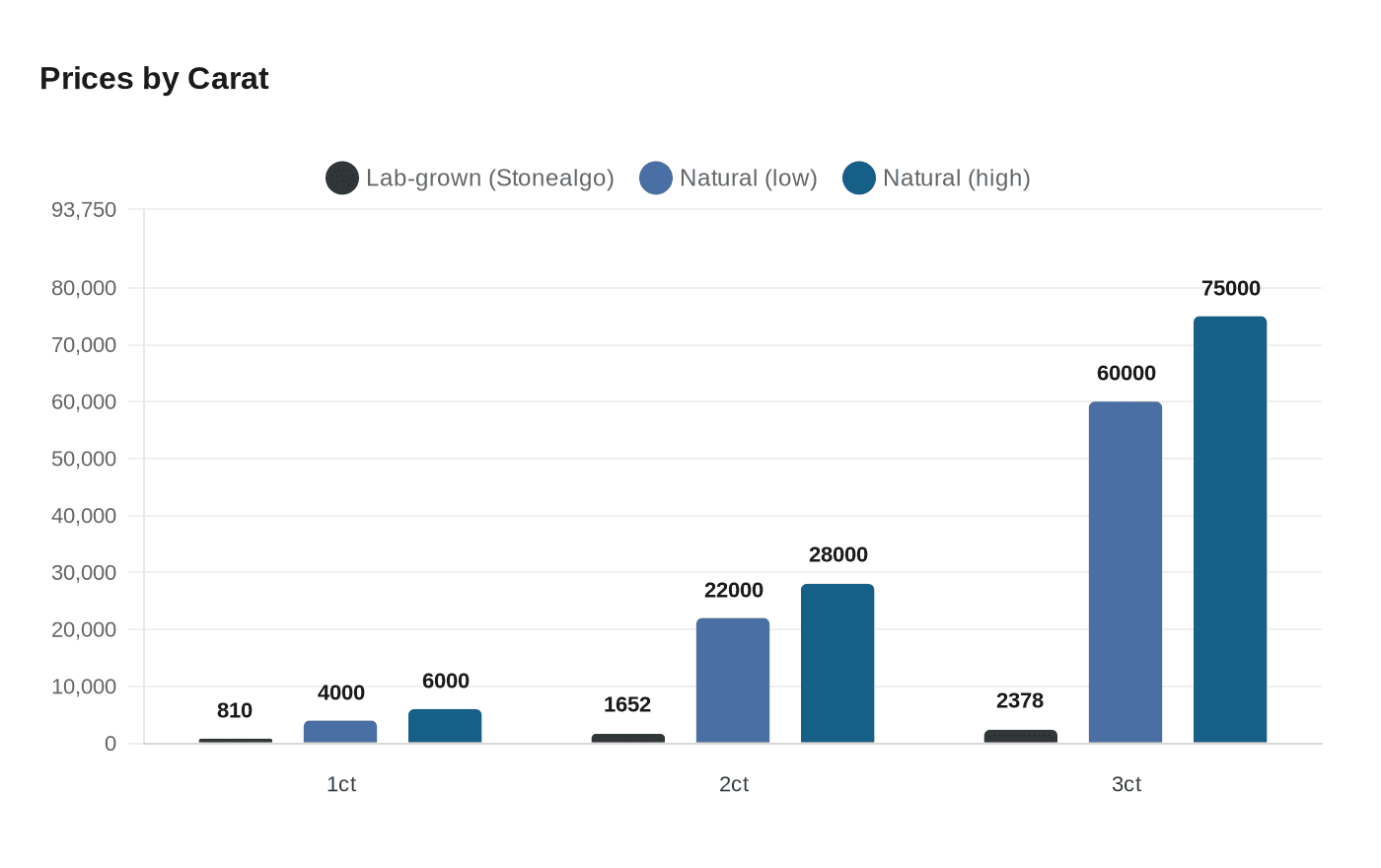
Stonealgo’s price snapshot dated 02/13/2026 puts the 1‑carat round at $810, the 2‑carat round at $1,652, and the 3‑carat round at $2,378. Those index figures align with market commentary from Thediamondprice, which summarizes the period 2020–2026 this way: “In my 15 years trading diamonds, I've never seen pricing dynamics shift as dramatically as they have from 2020-2026.” Thediamondprice gives a concrete example: a 1ct lab-grown listed at $2,800 in 2020 now trades about $900, and it asserts lab-grown stones now cost “60-85% less than natural diamonds.”
The gap between lab-grown and mined stones is visible across size bands. Thediamondprice lists 1ct lab-grown at $800–$1,500 versus natural $4,000–$6,000; 2ct lab-grown $3,500–$6,000 versus natural $22,000–$28,000; 3ct lab-grown $8,000–$12,000 versus natural $60,000–$75,000. MadisonDia’s wholesale table places mainstream natural wholesale averages at HKD 98,000 (≈ USD 12,560) in 2015 and estimates HKD 55,000 (≈ USD 7,050) for 2026, while MadisonDia reports a direct‑to‑consumer lab-grown price of HKD 2,380 (≈ USD 305) and typical retail lab-grown ranges around HKD 2,500–8,000 (≈ USD 320–1,025).
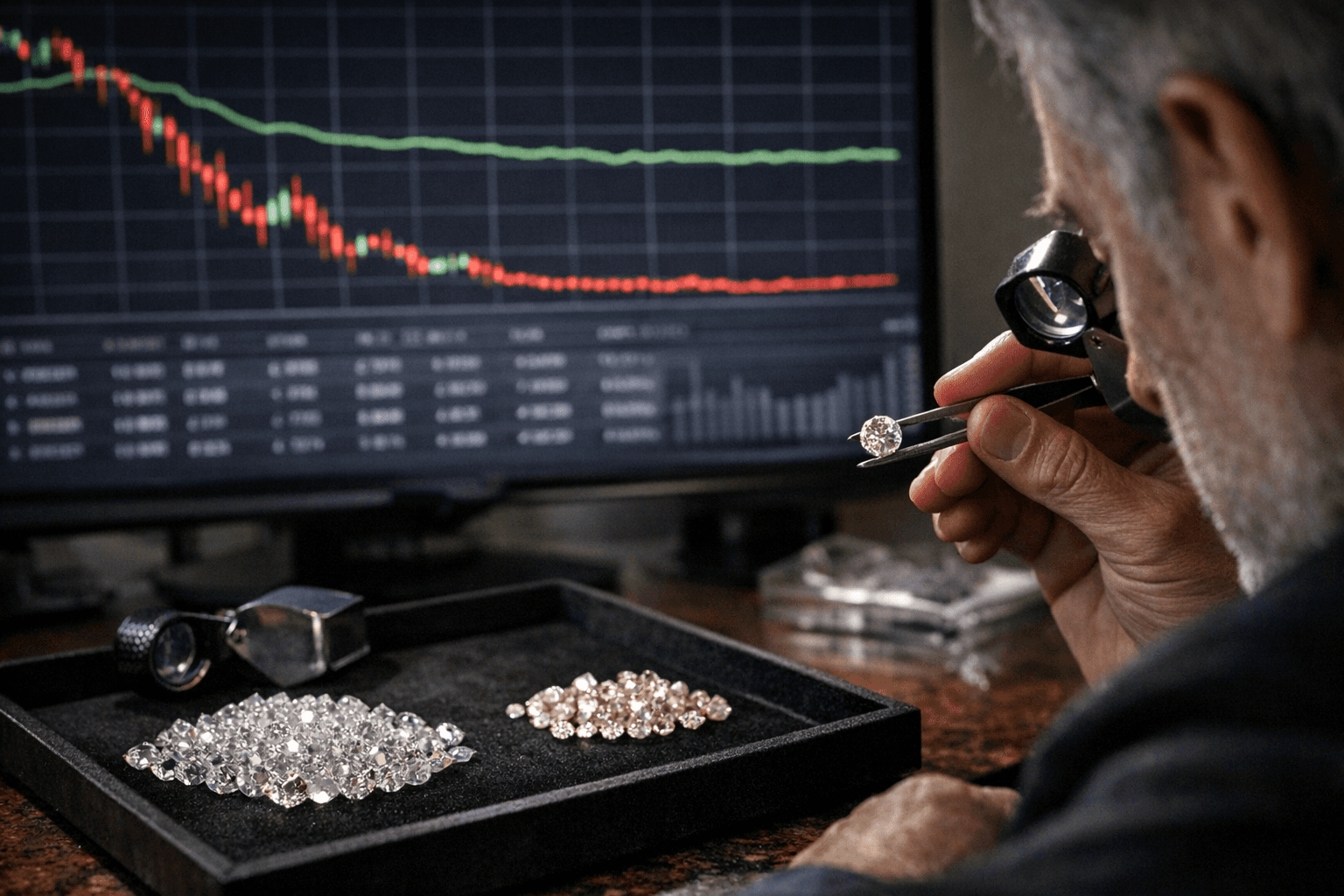
Market structure and supply shifts are central to the price move. PriceScope notes “notable price drops occurred after several large Indian natural diamond-cutting firms began growing and polishing CVD diamonds around 2023.” Stonealgo attributes falling prices to “declining costs for growing and manufacturing lab diamonds, increased competition from suppliers, and increased competition from jewelers which has resulted in lower profit margins at the retailer level.” Rapaport published AI-generated predictions, explicitly noting the content came from ChatGPT, that “Lab-grown retail prices keep falling, and ‘under $1,000 center stone’ becomes normal.”
Channel changes amplify the trend. Thediamondprice reports lab-grown capture of “35-40% market share” and that “online retailers now control 60% of diamond sales (up from 35% in 2020), driving prices down 20-30% vs traditional retail.” Market inventories are substantial in the Stonealgo snapshot: a general Inventory line reads 238K, while per-weight lines list 2ct inventory 425K, 3ct 444K and 4ct 134K; these figures appear inconsistent and warrant reconciliation before using them as a global total.
Short-term indexes show the abrupt fall has eased. PriceScope’s three-month percent-change table for 12/1/2025, 1/1/2026 and 2/1/2026 records small month-to-month moves across bands - for example the 1.0–2.0 ct band shows +6% then -1% then 0%, while the 3.0–4.0 ct band shows -9%, -9% and -10%. Stonealgo’s one-month changes on 02/13/2026 show 2ct -4.17%, 3ct -4.15% and 4ct +1.23%. Taken together, the indexes indicate that after a steep 2020–2024 decline - commonly cited in the 60–70% range - lab-grown prices largely settled into a lower baseline by early 2026, while natural diamonds have softened less dramatically and are being reframed by producers and retailers toward rarity and provenance.
This article was produced by Prism’s automated news system from verified source data, official records, and press releases, then run through automated quality and moderation checks before publishing. The system is built and supervised by the people who set the standards it runs under. Read our full AI policy.
Did this article answer your question?