Berkshires jeweler says natural diamonds sell through beauty and cut
Tim McClelland says natural diamonds sell when the eye lands on beauty first. His Wildflower rings turn cut, setting, and metal into the pitch.
Beauty sells before rarity
Tim McClelland’s case for natural diamonds is disarmingly simple: people buy what looks beautiful and interesting. The Berkshires jeweler, who runs TW McClelland & Daughters in Great Barrington, Mass., has spent decades selling engagement rings to discerning clients, and his answer to a crowded diamond market is not a slogan. It is a stone that feels intentional from the first glance.
That is why he is willing to argue with cutters who prefer to conserve material instead of chasing a particular look. McClelland’s own line of reasoning is blunt, even a little rebellious: if removing more rough produces a more beautiful result, then the loss is worth it. The pitch is not that natural diamonds are rare in the abstract. It is that the right cut makes the diamond impossible to ignore.
The ring, not just the solitaire
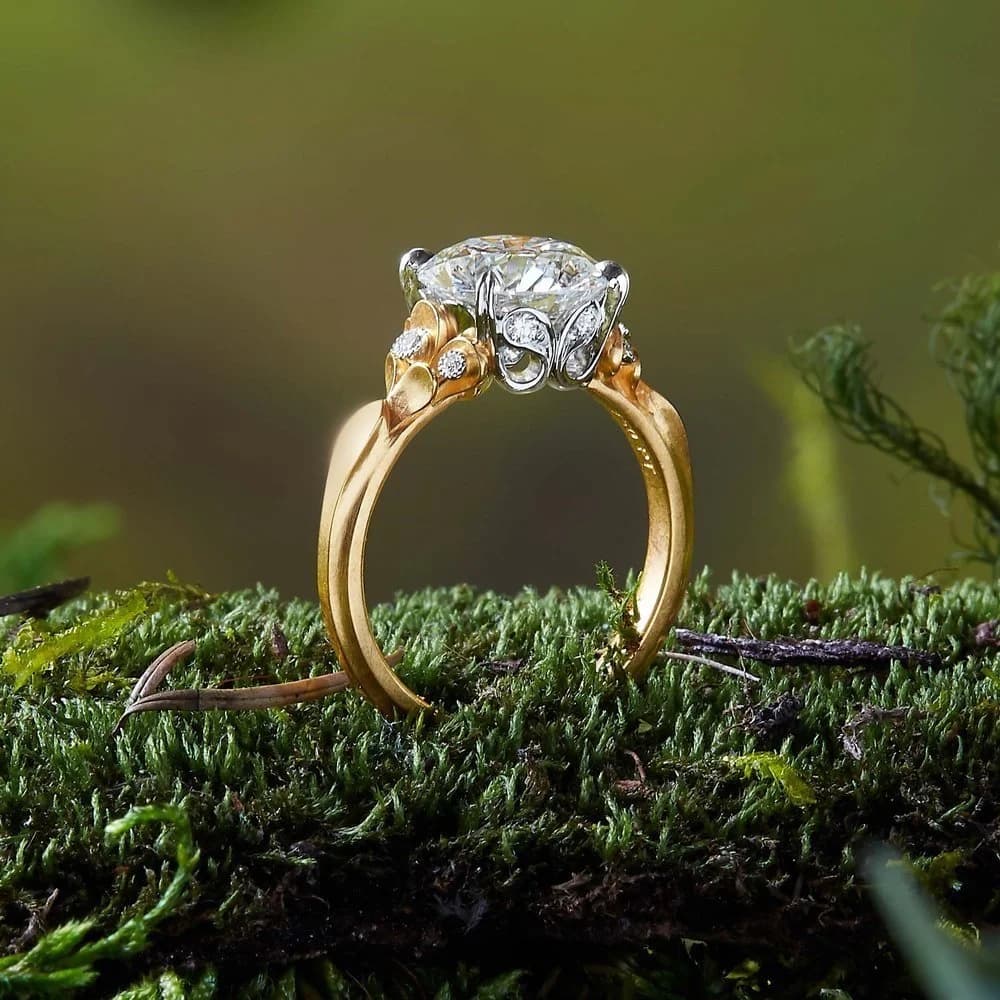
McClelland’s Wildflower collection grew out of that philosophy in the late 1990s, when he was design director at McTeigue & McClelland. He wanted an original engagement-ring style that honored both the mounting and the stone, instead of repeating the familiar solitaire template inspired by Tiffany & Co.’s six-prong setting, which helped define the modern engagement ring for more than a century.
That decision still shapes how the collection is positioned. The mountings start around $4,000 and move into the $10,000 range for more elaborate styles, placing the line firmly in fine-jewelry territory rather than mass-market bridal. Several pieces are shown with price on request, a reminder that these rings are treated more like custom-leaning objects of design than shelf-stock commodities.
What makes the strategy work is that the setting is never just a backdrop. McClelland wanted to look at the whole ring in relation to the stone, then build design around the diamond rather than around a generic prong structure. He focused especially on the shoulders of the ring, using a natural motif there to give the eye something to follow without stealing attention from the center stone.

What the shopper sees first
The collection’s captions tell the story in specific material terms. A Classic Flora ring in 18k Bloomed gold holds a 2.16-carat antique cushion-cut diamond. Another Bella Flora version pairs 18k Bloomed gold with platinum around a 1.38-carat fancy yellow diamond. A Classic Flora in platinum centers a 1.81-carat Asscher-cut diamond, while a Flora Belle ring in 18k Bloomed gold features a 1.07-carat round brilliant. Those combinations matter because each one changes how the diamond reads at a glance: antique cushion for softness, Asscher for architectural clarity, fancy yellow for color-driven distinction, round brilliant for classic flash.
McClelland also learned that design room changes with scale. He began making rings with larger stones, in the 5-to-10-carat range, because the extra size gave him more space to develop the mounting. That is a useful lesson for anyone trying to sell natural diamonds without leaning on defensive talking points: if the setting is too cramped, the design disappears; if the stone has room to breathe, the whole ring becomes easier to remember.
How natural diamonds win the conversation
McClelland’s approach offers a practical counter to category marketing that gets stuck in broad claims. Rather than asking a shopper to care first about origin, he asks them to respond to form, proportion, and craftsmanship. That matters in a market where the simplest way to create desire is still visual: a diamond with a distinctive cut, a mounting that frames it, and mixed metals that sharpen the contrast can do more selling than a lecture about industry positioning.
For readers trying to understand why certain natural diamond pieces feel worth the leap, the formula is right there in the Wildflower collection. Start with a memorable center stone. Give the setting enough design intelligence to support it. Use materials like 18k Bloomed gold and platinum to create texture and depth. And let the ring read as a finished object, not a stone mounted by habit. That is how natural diamonds keep their power on the finger: not by arguing their case, but by making the eye stop.
This article was produced by Prism’s automated news system from verified source data, official records, and press releases, then run through automated quality and moderation checks before publishing. The system is built and supervised by the people who set the standards it runs under. Read our full AI policy.
Did this article answer your question?