Boucheron’s archival diamonds trace Marie Louise Mackay’s American influence
Marie Louise Mackay’s commissions gave Boucheron a transatlantic glamour, from a 159-carat Kashmir sapphire in 1878 to a diamond dog-collar that still defines Belle Époque prestige.

American patronage at the center of Boucheron’s rise
Marie Louise Mackay is one of those rare society clients who did more than wear jewelry well. She helped shape the language of it. Long before “global client strategy” became luxury’s favorite phrase, Boucheron was already answering to an American patron whose taste traveled across the Atlantic and, in turn, helped refine the house’s Belle Époque identity.
Boucheron’s story begins in 1858, when Frédéric Boucheron founded the maison and opened its first boutique in the Galerie de Valois at the Palais-Royal in Paris. That setting mattered. It placed the jeweler at the heart of Parisian luxury, but the commissions that truly broadened its reach were increasingly American, and Mackay was among the most influential of those clients. Her name appears again and again in the archive, a sign not of a single one-off order but of a sustained relationship that helped cement Boucheron’s prestige.
The sapphire commission that announced a new kind of clientele
The clearest proof of that influence is the necklace Boucheron created in 1878 for Marie-Louise MacKay, set with a 159-carat Kashmir sapphire. The maison’s own history describes it as the first time Boucheron made such a necklace, and it ties the gem directly to the American woman for whom it was specially designed.
That detail is more than a footnote. A Kashmir sapphire of that scale is not merely a center stone, it is a declaration of taste, status, and technical confidence. Set in the late 19th century, such a jewel would have relied on the jeweler’s ability to cradle a monumental stone while allowing its velvety color to remain the star, a balance that separates fine mounting from mere display. In Boucheron’s hands, the commission signaled that the house could speak fluently to the ambitions of wealthy American women who were reshaping European luxury from the outside in.
Why the 1899 dog-collar still reads as modern luxury
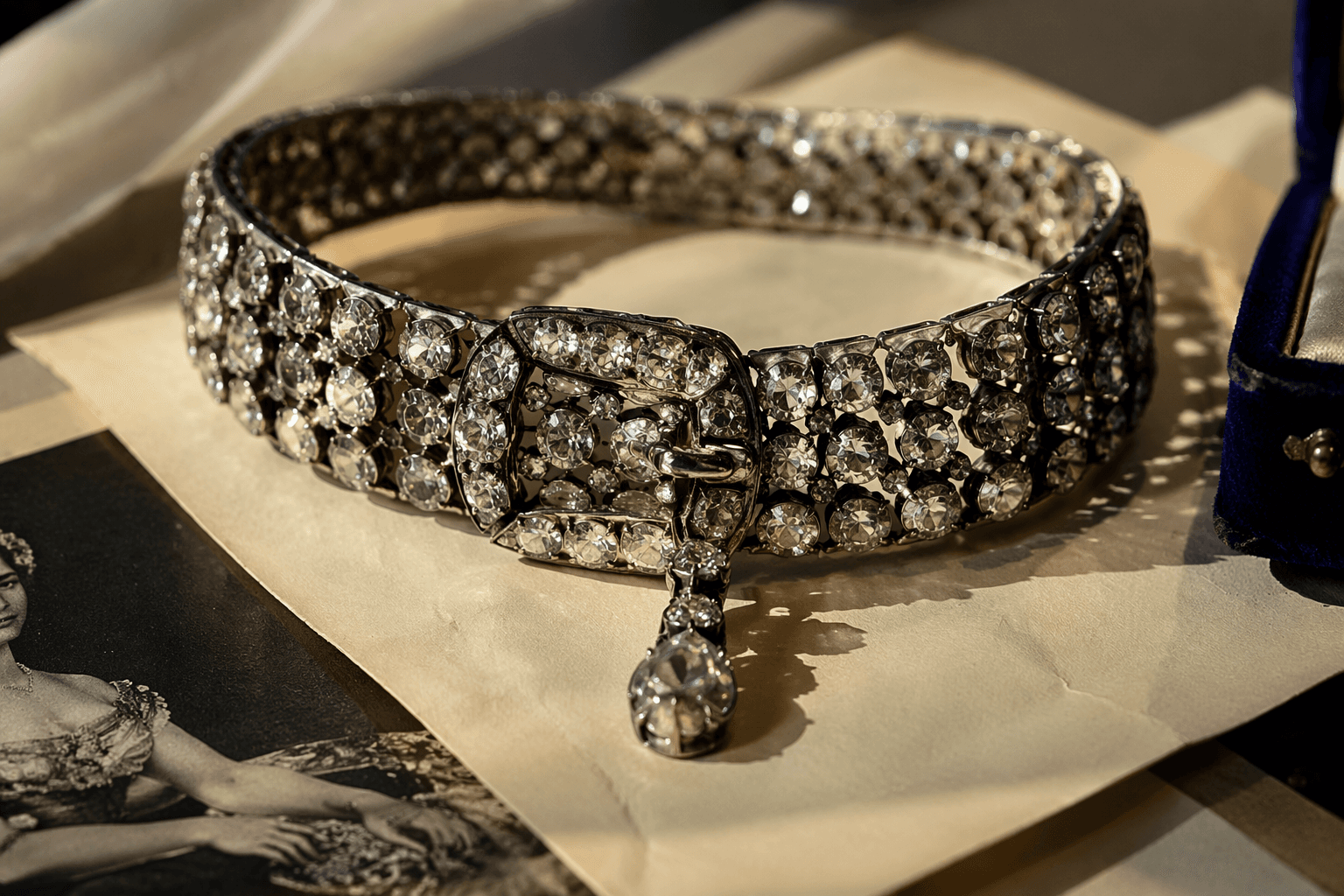
If the sapphire necklace announced Mackay’s power, the 1899 dog-collar necklace distilled it into Belle Époque form. Documented in the commission book with 621 diamonds totaling 237 carats, it was built for impact: a collar-like sweep at the neck, with a plastron effect that broadened the silhouette and turned the décolletage into a stage for light.
That kind of construction is central to understanding why Boucheron’s archival jewels still feel relevant. The piece is not about isolated stones alone, but about orchestration, how diamonds are arranged to create volume, rhythm, and movement around the body. In the Belle Époque era, this was the difference between ornament and authority. The necklace’s scale and structure placed Mackay within a visual language of power that remains legible today, when collectors still gravitate toward jewels that read clearly from across a room and reward close inspection up close.
An archive shaped by absence
What makes Mackay’s jewels especially compelling is how much of them no longer survives. WWD notes that most of her pieces have disappeared, which means the archive carries an unusual burden. The surviving documents are not just records, they are the jewels’ afterlife, preserving proportions, carat counts, and design intent long after the physical objects have been lost.
That absence raises the value of the material that does remain. Mackay appears no less than 102 times in Boucheron’s order books over 25 years, a remarkable frequency that suggests a client relationship deep enough to influence the house’s output. For modern readers, this is the crucial lesson: luxury is not only built through ateliers and workshops, but through repeat commissions, discerning clients, and the back-and-forth that happens when a house learns how a particular woman wants to be seen.
A transatlantic story, not just a Parisian one
Mackay’s biography explains why her role mattered. Marie Louise Hungerford Mackay was born in Brooklyn in 1843, moved with her family to Downieville, California, at age ten, and later became tied to the Western silver-mining and San Francisco elite through her family and her marriage to mining magnate John William Mackay. She was not simply an American visitor to Paris; she belonged to a new class of transatlantic wealth whose social power could cross borders as readily as its jewelry orders.
That cross-Atlantic movement is what gave Boucheron a broader audience. The house’s early American commissions helped position it not only as a Paris jeweler, but as a maker for women whose tastes were shaped by social ascent, inherited ambition, and the desire to translate money into elegance. In that sense, Mackay was part client, part patron, part cultural bridge.
From archive to exhibition, and back into the present
Boucheron’s archive has not remained locked away. A Comite Colbert exhibition in New York featured the 1899 Belle Époque necklace from its archives, placing the jewel within a broader showcase of French luxury houses for an American audience. That was a smart curatorial move, because the necklace does more than represent craftsmanship. It demonstrates how design and patronage moved in both directions between Paris and the United States.
Robb Report also noted that Boucheron pulled the 1899 Belle Époque necklace commissioned by American Marie-Louise Mackay from its archives, reinforcing the sense that the piece is not merely historical inventory. It is evidence. In a market where provenance and story increasingly matter alongside carat weight and brand cachet, the Mackay jewels offer exactly the kind of material today’s luxury storytelling seeks: a named client, a documented commission, a recognizable silhouette, and a design language that still reads as aspirational.
The legacy that survives on paper, and in memory
Marie Louise Mackay’s final resting place adds a quiet coda to a dazzling life. Find a Grave records her entombment at Green-Wood Cemetery in Brooklyn on September 13, 1928, a fitting return to the borough where she was born. The arc from Brooklyn to Paris and back again captures the essence of her influence: local origins, global reach, and a taste powerful enough to travel through one of the great jewelry houses of the 19th century.
For Boucheron, Mackay’s importance lies not just in what she bought, but in what her commissions taught the maison about American wealth, American self-fashioning, and the visual force of high jewelry. The surviving archive, especially the sapphire necklace, the diamond dog-collar, and the repeated order-book entries, shows a house learning to speak with clients who wanted more than decoration. They wanted presence, and Boucheron helped give it form.
This article was produced by Prism’s automated news system from verified source data, official records, and press releases, then run through automated quality and moderation checks before publishing. The system is built and supervised by the people who set the standards it runs under. Read our full AI policy.
Did this article answer your question?