China's lab-grown diamonds find new use cooling AI chips
China’s lab-grown stones are being pulled into chip cooling just as jewelry prices are already under pressure, raising a new question for supply.
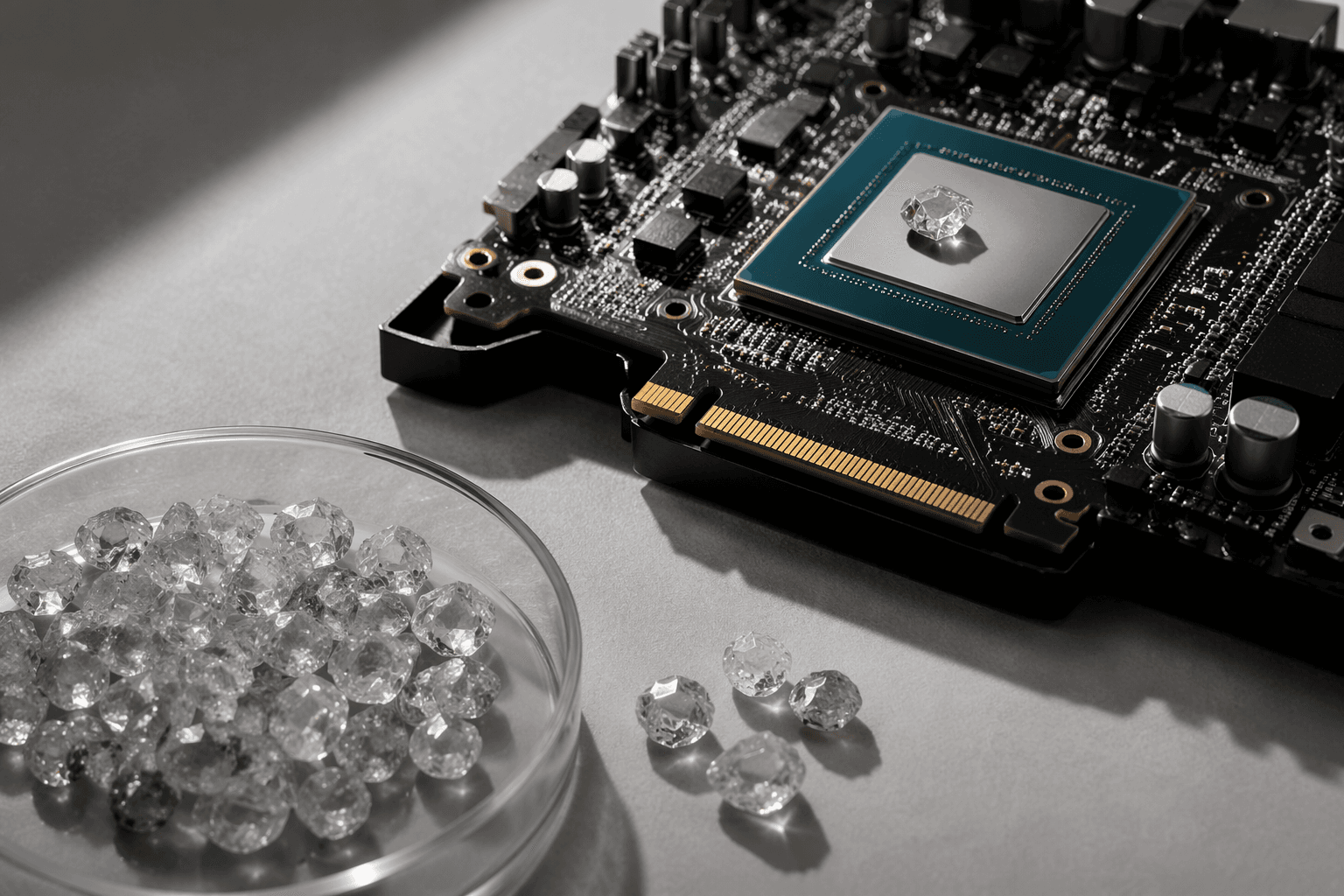
Heat, not sparkle, is giving China’s lab-grown diamonds a second life. Producers are seeing the stones taken up as chip-cooling heat spreaders for advanced semiconductors and AI hardware, a use case built on diamond’s unusually high thermal conductivity and its ability to insulate electrically.
That technical appeal is not theoretical. A 2024 paper in Cell Reports Physical Science said diamond-based heat spreaders can carry heat away from semiconductor devices and reduce reliance on energy-intensive cooling. A 2024 to 2025 Springer study revisited polycrystalline diamond heat spreaders for GaN HEMTs and package-level thermal management, underscoring why diamond remains so attractive as chips get hotter and more tightly stacked. Chinese researchers have also pushed harder into thermal management as AI data centers run into cooling limits, with a diamond-copper material reported in April to improve cooling efficiency by up to 80 percent.
The industrial pull matters because China’s lab-grown diamond supply is concentrated and large. Henan province has become the center of gravity, with Zhecheng county described as producing about 6 billion carats of diamond single crystal, 15 billion carats of diamond micro-powder and more than 10 million carats of lab-grown gems each year. Henan government reporting also says SF Diamond’s factory in the province has annual CVD capacity of about 700,000 carats, making it the country’s largest producer using that method. If chip-cooling demand keeps building, it could give factories another outlet beyond jewelry, where margins have already been squeezed.

That is the market contradiction investors and retailers will watch most closely. Lab-grown diamonds have already changed the jewelry trade, with more than half of engagement rings now made with them, and a separate market slide in natural stones has been fueled by tariffs, wars and the rise of lab-grown supply. For retailers, a growing industrial channel could stabilize some producers by absorbing output; for buyers, it could reinforce the idea that lab-grown diamonds are no longer only a cheaper bridal alternative but a material with real engineering value. The unanswered question is scale: whether cooling chips becomes a durable demand stream large enough to matter to jewelry availability, pricing and resale perceptions, or whether it remains a niche beside the far larger gem market.
This article was produced by Prism’s automated news system from verified source data, official records, and press releases, then run through automated quality and moderation checks before publishing. The system is built and supervised by the people who set the standards it runs under. Read our full AI policy.
Did this article answer your question?