Christie's Jewels Online Features Tiffany 10.02-Carat Emerald-Cut Diamond
A 10.02-carat Tiffany emerald-cut diamond, Type IIa and Internally Flawless, led Christie's first jewelry auction of 2026 with a $700,000 high estimate.
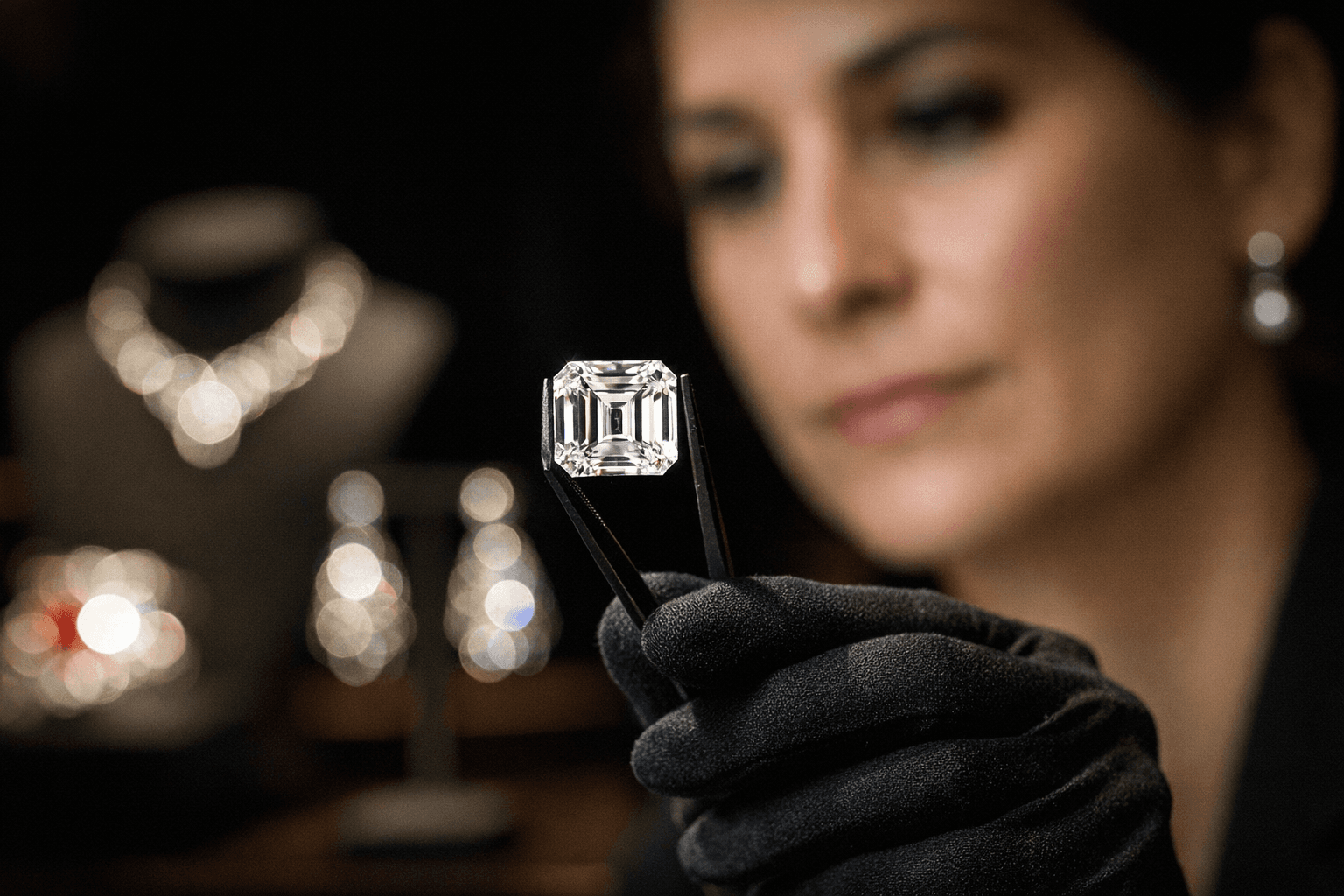
A platinum ring signed Tiffany & Co. and set with a 10.02-carat emerald-cut diamond opened bidding at Christie's Jewels Online this month with an estimate of $500,000 to $700,000 — and with it, the auction house launched what it called its first jewelry sale of 2026. The stone itself is a gemologist's benchmark: Type IIa classification, D color, Internally Flawless clarity. In the grading hierarchy, there is almost nothing higher to aspire to.
The Marquee Stone
To understand why this particular Tiffany ring commands the top position in a 156-lot sale, it helps to understand what Type IIa actually means. These diamonds contain virtually no nitrogen impurities, placing them in the rarest chemical category of all naturally occurring diamonds. Paired with D color — the absolute absence of any detectable body color — and an Internally Flawless clarity grade, the 10.02-carat stone represents a convergence of rarity that occurs only a handful of times in any auction season. The emerald cut, with its broad flat table and stepped facets, is an unforgiving choice: it conceals nothing, which is precisely why it so effectively showcases a diamond of this optical purity. Set in platinum and bearing the Tiffany & Co. signature, the ring arrives with the added weight of one of the most recognized names in American jewelry history. Christie's estimated it at $500,000 to $700,000.
The Sale Format and How to See It
Christie's Jewels Online ran as a fully online auction from March 9 through March 19, 2026, with bidding conducted via christies.com and the Christie's apps. For those who prefer to assess a stone in person before committing — and with diamonds at this level, the instinct is sound — Christie's made the pieces available for viewing at its Rockefeller Center galleries in New York from March 16 through March 18. Three days of in-person access within a ten-day online window is a format that reflects how the secondary market for fine jewelry has evolved: digital convenience for the broad pool of bidders, physical access for those placing the serious bids.
Other Exceptional Diamonds
Beyond the Tiffany ring, the diamond content of this sale is notably dense. A second ring anchors the upper tier of the catalogue: a round brilliant-cut, 10.03-carat diamond graded D color and VS1 clarity, also Type IIa, set on a band featuring approximately 98 additional round diamonds. Where the Tiffany stone makes its argument through the severity of the emerald cut, this piece takes the opposite position — the center stone is encircled by an almost theatrical abundance of accent diamonds.
The rivière necklace among the top lots is a study in accumulated weight: 73 emerald-cut diamonds totaling 86.58 carats, with color ranging from G to I and clarity spanning Internally Flawless to VS2. A rivière is an inherently democratic form — no pendant, no interruption, just stone following stone in an unbroken line — and at 86.58 carats total, this example sits in a category that rarely appears outside major evening sales.
A pair of stud earrings in the Rapaport top-lot grouping features round brilliant-cut diamonds of 5.01 carats each; one is graded D, VS2 and the other E, VS1. A separate pair of earrings, described as featuring square emerald-cut diamonds, presents two principal stones: a 6.04-carat, I-color, VVS2 stone and a 6.01-carat, I-color, VS1. The color grade here drops into the near-colorless range, which tends to translate into a warmer, more antique-adjacent visual character — a different appeal from the icy precision of the Tiffany stone, but not a lesser one.
The pair of Type IIa round brilliant-cut diamond studs detailed separately in trade reporting carries weights of 5.13 carats and 5.04 carats, both D color and VVS2 clarity, with an estimate of $300,000 to $500,000. For context, a matched pair of Type IIa, D-color round brilliants above five carats apiece represents the kind of symmetry that diamond dealers spend years assembling.
A diamond bracelet rounds out the notable stone pieces: 30 square emerald-cut diamonds ranging from 1.01 to 1.06 carats each, D to F in color, VVS1 to VS2 in clarity. The uniformity of scale — each stone kept within a five-point range — signals the deliberate, time-intensive curation that distinguishes serious jeweled bracelets from decorative ones.
Colored Stones and Signed Houses
Not every important lot in Jewels Online arrived as a diamond. A Kashmir Sapphire and Diamond Ring, estimated at $120,000 to $180,000, represents one of the most coveted geographic designations in the colored-stone market. Kashmir sapphires — known for their velvety, slightly hazy blue caused by fine silk inclusions — have commanded premiums per carat that regularly surpass their finest Ceylon or Burma counterparts at auction, and their appearance in an online-format sale rather than a dedicated evening auction speaks to the broadening appetite for top-quality colored stones outside the traditional evening-sale format.
The Hemmerle multi-gem tassel earrings, estimated at $30,000 to $50,000, represent a different kind of significance. Hemmerle, the Munich-based house known for unexpected material combinations and a rigorously anti-flashy aesthetic, occupies a collector position that major maisons rarely achieve. A pair of Hemmerle tassel earrings at the lower end of this sale's price range is, in a certain collector circle, arguably the most interesting purchase in the room.
The broader signed-jewel roster in the sale encompasses Cartier, David Webb, Seaman Schepps, Tiffany & Co., and Van Cleef & Arpels — a lineup that covers the full spectrum from American modernist exuberance (Webb's sculptural gold work, Schepps's signature shell and coral motifs) to Parisian precision and New York refinement.
Provenance: Elizabeth Taylor and Yvonne Kalman
Two named collections add the dimension of personal history that transforms objects into narrative. From the Collection of Elizabeth Taylor, Christie's offered a diamond and gold evening bag estimated at $10,000 to $15,000 and a matching ruby and diamond beaded necklace and earrings estimated at $15,000 to $20,000. Taylor's relationship with jewelry was famously unsentimental in the best sense: she wore her stones, she knew their weight, and pieces that passed through her ownership carry a biographical specificity that no gemological certificate can replicate.
Property from the Collection of Yvonne Kalman also features in the sale, though specific lot details were not disclosed in pre-sale materials.
Christie's and the Online Auction Format
Christie's, founded in 1766 and now operating with a physical presence in 46 countries, has positioned online-only sales not as a secondary tier but as a parallel channel for serious works. Jewels Online sits within a catalogue that the house says spans more than 80 art and luxury categories, at price points ranging from $500 to over $100 million. The decision to lead the year's first jewelry auction with a nine-figure-aspiring Tiffany diamond in an online format rather than a white-glove evening sale reflects a broader shift: the buyers capable of spending $700,000 on a ring are increasingly comfortable doing so without a paddle in hand.
The three-day viewing window at Rockefeller Center remained the physical anchor of the sale — and for a D, Internally Flawless Type IIa stone of more than ten carats, the opportunity to observe it under different light conditions before the final bid closed was not a courtesy. It was, for the serious buyer, a necessity.
This article was produced by Prism’s automated news system from verified source data, official records, and press releases, then run through automated quality and moderation checks before publishing. The system is built and supervised by the people who set the standards it runs under. Read our full AI policy.
Did this article answer your question?