Colored Stones Surge at Auction as Demand for Large White Diamonds Softens
Christie's reports clients of 15–20 years are abandoning white diamonds for colored stones as paraiba tourmalines hit record prices and spinels reach new highs.
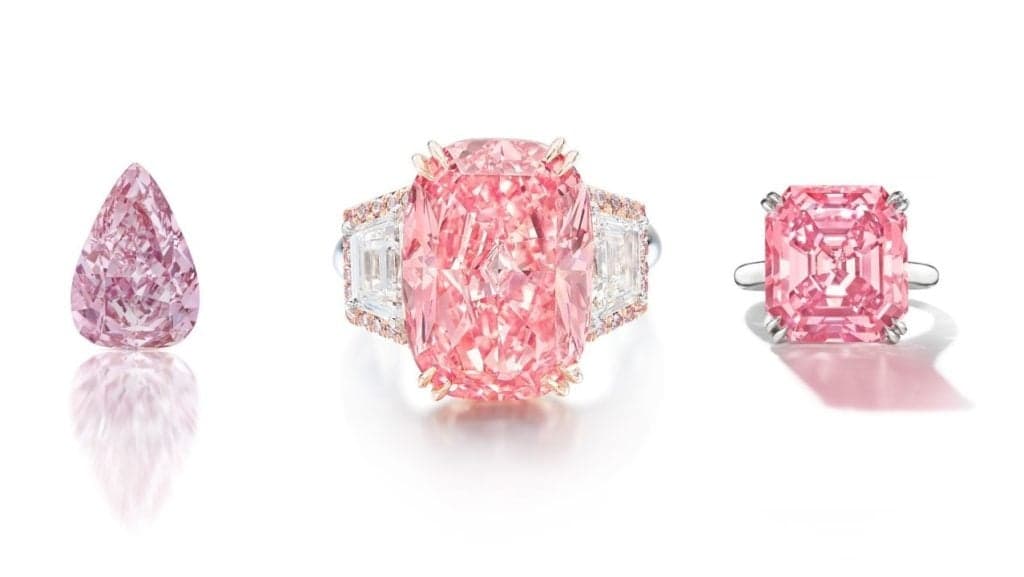
Clients who spent 15 to 20 years buying diamonds at Christie's are now colored-stone clients. That single observation from Christie's global jewelry leadership captures the breadth of a shift reshaping the top end of the auction market: high-end buyers and collectors are allocating more of their capital to rare colored stones and natural pearls, while demand for large white diamonds has measurably softened.
The reasons are structural as much as aesthetic. "We have traditional clients from Israel that are bread-and-butter diamond dealers who have moved away from diamonds because it's simply too difficult to make the margins and the prices have decreased so drastically," Christie's leadership told JCK. "So colored stones is now where they're investing their money."
Part of the explanation sits upstream, in the production decisions mining companies made during and immediately after the pandemic. Demand for precious stones skyrocketed in 2020 and 2021, and diamond producers increased output to match. But as Rapaport analysis notes, those same producers "kept the production floodgates open in 2022 when they should have curtailed diamond output." When borders reopened and consumers redirected their spending toward travel, diamond demand softened into a glut. Colored-stone supply, by contrast, could not be similarly scaled: deposits are rarer in nature, and more than half of colored gems cannot be traced to a formal mine at all. That fragmented, largely informal supply chain, further disrupted by pandemic-era border closures, helped push gemstone prices higher even as diamond prices fell.
The stones benefiting most from this realignment extend well beyond the traditional triumvirate of sapphires, rubies, and emeralds. Christie's leadership identified paraiba tourmalines as making record prices, spinels as increasingly desirable, and Ceylon sapphire as sitting at an all-time high. "Rarity speaks volumes," Christie's said, "and colored stones have kind of caught fire over the last five years. It's not just concentrated in those one or two types of stone, but it's also spread to other semiprecious stones."

Fashion is amplifying what markets are already signaling. The current vogue for retro jewelry, particularly pieces from the 1950s, 1970s, and 1980s, favors bold wearable designs in yellow gold from houses like Bulgari and Van Cleef. That aesthetic depends on color. Christie's put it plainly: "It's that big, bold wearable jewelry, which often has more colored stones than big diamonds."
The momentum has drawn a wave of new participants from the diamond trade. RapNet, the world's largest diamond-trading platform, recently launched a colored-gemstone edition in partnership with the American Gem Trade Association. But the influx carries a warning: many of these new buyers are evaluating gemstones using lab reports rather than in-person assessment. Rapaport flagged the consequence directly, noting that this approach "is driving prices up for gems that a seasoned colored-stone specialist might have assigned a lower value." Colored-stone valuation depends on subtleties of saturation, tone, and origin that a certificate cannot fully capture, and buyers trained on the more standardized metrics of the diamond world are navigating unfamiliar territory.
Christie's framed the psychology with characteristic precision: "People want what other people can't have, and that is going to be true forever." With more than 80 percent of diamonds sourced from institutional suppliers capable of scaling production, and barely half of colored gems traceable to a formal mine, the scarcity argument for colored stones is not merely sentimental. It is structural — and the auction room is pricing it accordingly.
This article was produced by Prism’s automated news system from verified source data, official records, and press releases, then run through automated quality and moderation checks before publishing. The system is built and supervised by the people who set the standards it runs under. Read our full AI policy.
Did this article answer your question?