De Beers showcases 63-carat Botswana diamond amid lab-grown anxiety
A Botswana-born 63-carat rough took center stage at JCK as De Beers pushed traceability and natural-diamond heritage against lab-grown pressure.

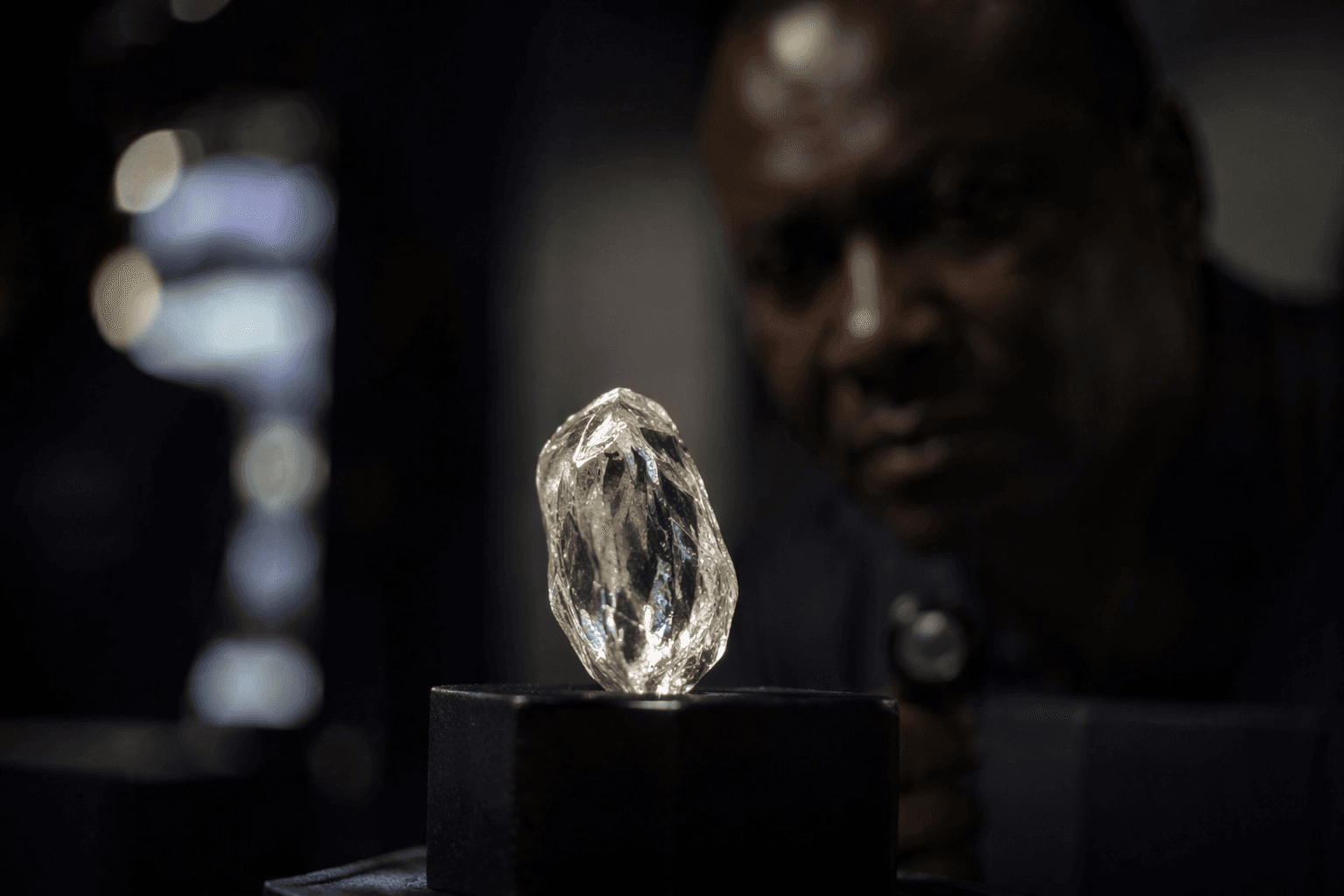
The sharpest symbol on the JCK floor was not a finished jewel but a rough stone: a 63-carat natural diamond from Botswana, held up as proof that provenance still has commercial force even as lab-grown competition squeezes the market below. London Jewelers president Candy Udell presented the stone during JCK Las Vegas at the Venetian Expo, where the natural-diamond business was being cast as a crossroads with consequences, not a comfortable legacy trade.
The diamond is part of De Beers’ Origin program and is set to return to Botswana, its country of origin, before Grandview Klein Diamonds cuts it in Botswana into a 20.26-carat D-flawless old-mine cushion. That target is more than a technical finish. The 20.26-carat weight was chosen to mark London Jewelers’ 100th anniversary, tying one retailer’s centennial to De Beers’ larger effort to sell natural diamonds through traceability, documentation and a clearly labeled origin story.
JCK’s own framing captured the tension that hung over the show, which ran May 29 to June 1, 2026, with selected events opening May 28. The natural-diamond business was not presented as a neat fork in the road. Analyst Russell Shor called it a “spaghetti junction,” a vivid way of describing a market where lab-grown stones are cheaper, mainstream demand is uneven, and the luxury tier is still searching for a cleaner narrative advantage.
That is where De Beers and Botswana kept pressing their case. The company used JCK to promote downstream marketing around natural diamonds, with traceability at the center of the pitch. Botswana’s presence at the show reinforced the same message: the country is not just a source of rough, but part of the ethical and developmental argument for natural diamonds. In Grandview Klein’s case, the program is defined by sourcing from De Beers Group mines in Botswana, Namibia or South Africa, with polished stones required to weigh 30 points or more.
The show floor suggested the business is not simply losing demand to lab-grown stones. It is splitting in two. Larger natural diamonds, premium shapes and stones with a documented path from mine to market still carried momentum, while the middle of the market looked more vulnerable. For De Beers and Botswana, that is the bet: that heritage, rarity and provenance can still command attention if the industry can prove every step of the journey.
This article was produced by Prism’s automated news system from verified source data, official records, and press releases, then run through automated quality and moderation checks before publishing. The system is built and supervised by the people who set the standards it runs under. Read our full AI policy.
Did this article answer your question?