Fancy Colored Diamonds: How They Are Graded, Priced, and Bought
Before you spend a single dollar on a fancy colored diamond, know this: a stone's color can matter more than its clarity, and a half-carat pink can outprice a flawless colorless diamond many times over.
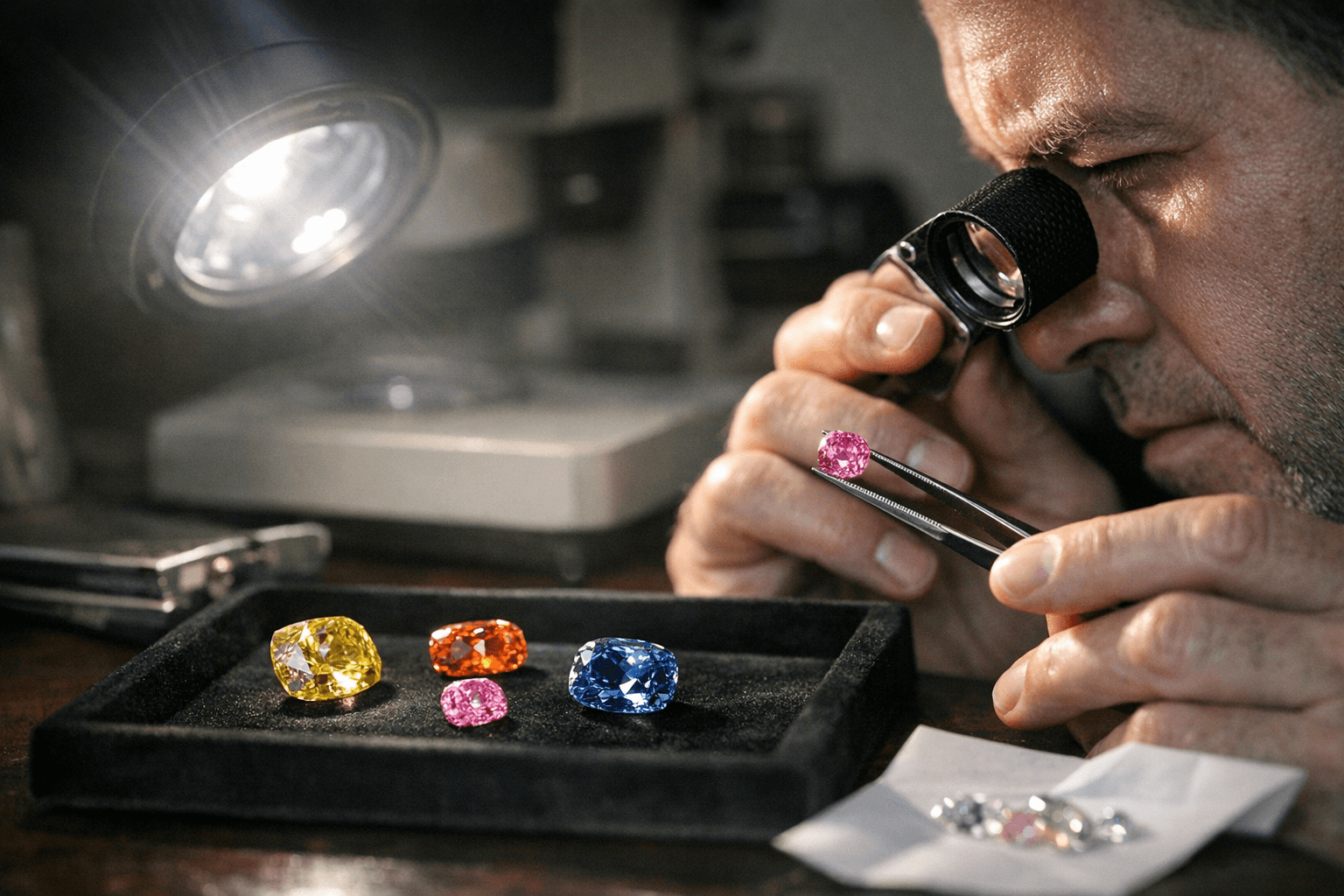
The moment a Fancy Vivid Pink crosses a Christie's auction block, something shifts in how the room understands value. The 10.38-carat Marie-Thérèse Pink fetched nearly $14 million at Christie's New York. At Sotheby's Geneva, the Mediterranean Blue, a 10.03-carat fancy vivid blue diamond, sold for $21.4 million, translating to $2.1 million per carat. These are not outliers. They are the logical endpoint of a grading system built on an entirely different philosophy from the one governing colorless stones.
Fancy colored diamonds are evaluated and priced differently from colorless diamonds, with emphasis placed on hue, tone, and saturation rather than on the absence of color. Understanding that distinction is the first thing any serious buyer needs to internalize.
How Fancy Color Diamonds Are Formed
The origin story of a fancy colored diamond begins roughly 90 to 120 miles below the Earth's surface, where extreme heat and pressure create the conditions for diamond formation. What separates these stones from their colorless counterparts is what happens during that process at a molecular level.
Nearly 30 base colors can create over 200 unique color combinations. Each one has a specific cause. The color of blue diamonds is caused by the trace element boron, which, during formation, displaces carbon atoms and absorbs red, orange, and yellow light. Nitrogen, on the other hand, absorbs blue light and produces yellow tones. In some cases, natural radiation alters the crystal structure of the stone entirely, resulting in green diamonds. Pink diamonds are perhaps the most scientifically mysterious of all: pink diamonds remain a scientific mystery, as the exact cause of their color is still unknown to gemologists. Unlike other colored diamonds, they contain no trace elements but have a different crystal structure.
Once rough diamonds reach a cutter's bench, one additional complexity emerges: the color in a rough diamond might not be evenly distributed throughout. How a cutter orients the stone before the first facet is made can determine whether the finished gem displays a rich, even hue or a muddy, uneven one.
How Grading Differs From Colorless Diamonds
For colorless diamonds, the GIA's D-to-Z scale rewards the absence of color. A D-grade stone is prized precisely because it contains no detectable tint. Most diamonds used in jewelry range from colorless to light yellow and are graded on a scale from D (colorless) to Z (light yellow). Those with less color, or closer to colorless, are generally more valuable. Diamonds with deeper shades of yellow (more color than Z) are graded differently and given a fancy-color grade. For these colored diamonds, a more vibrant color typically means higher value.
The grading of fancy colored diamonds, then, is an inversion of that logic. GIA describes color in terms of hue, tone, and saturation: hue refers to the diamond's characteristic color, tone refers to the color's relative lightness or darkness, and saturation refers to the color's depth or strength.
The Intensity Scale: What the Labels Actually Mean
This is where the real money lives. On GIA Colored Diamond Grading Reports, colored diamonds are graded in order of increasing color strength: Faint, Very Light, Light, Fancy Light, and Fancy, up to Fancy Intense, Fancy Vivid, Fancy Dark, and Fancy Deep. Fancy Intense and Fancy Vivid generally command higher prices.
A fancy grade, such as Fancy Light or Fancy Intense, represents the combined effect of tone and saturation on the color of a diamond. These grades correspond to regions of tone and saturation in color space. The system is also hue-dependent, meaning the grade thresholds shift depending on which color is being evaluated. Yellow being by far the least rare of all colors, a greater depth of this color is required for a stone to get a "Fancy" grade. In contrast, a "Fancy" grade is given to paler pink or blue stones because they are rarer.
Using highly controlled viewing conditions and color comparators, a fancy color grader selects one of 27 hues, then describes tone and saturation with terms such as "Fancy Light," "Fancy Intense," and "Fancy Vivid." The practical consequence of this precision is stark: the intensity of the color determines the grade, with rankings from least to most saturated as follows: faint, very light, light, fancy light, fancy, fancy intense, fancy vivid, fancy dark, and fancy deep. Moving one grade up the scale can double or triple a stone's value per carat.
The Role of Cut in Color
Cut is less about sparkle here than it is about color saturation. The radiant cutting style helps intensify a fancy colored diamond's color. This is not accidental. Many yellow diamonds appear in cushion and radiant cuts, since those shapes intensify color. GIA has documented this phenomenon precisely: cutters discovered that certain mixed styles like the radiant can intensify yellow color in diamonds toward the lower end of the D-to-Z scale, and that when carefully fashioned as radiant cuts, many yellow-tinted stones can become fancy yellows when viewed face up. The implication for buyers is significant: the same rough material, cut differently, can land in an entirely different grade and price tier.
Clarity: The Acceptable Tradeoff
In colorless diamond buying, clarity is treated with near-reverence. In fancy colored diamonds, it yields to color. According to GIA, color is the dominant value factor: even diamonds with numerous inclusions that result in a low clarity grade are prized by connoisseurs if they display attractive face-up color. Inclusions that threaten the gem's durability are a different matter entirely and can lower value significantly.
Because color is the main attraction, buyers can often accept slightly lower clarity, such as SI1 or SI2, as long as the inclusions don't break the surface or sit in obvious places. This is a meaningful financial lever for buyers who want genuine color without auction-level budgets.
Rarity and Which Colors Command the Highest Prices
These tinted diamonds make up just 0.01 percent of all natural diamonds mined, appearing in shades of pink, blue, yellow, green, and even red. Within that already rarefied category, some colors are rarer still.
According to GIA, the rarest and most valuable colors are saturated pinks, blues, and greens. The most prized hues are red, pinks, blues, and greens. Compared to fancy yellows and browns, diamonds with a noticeable hint of any other hue are considerably more rare. Red diamonds occupy a category unto themselves: according to GIA, there are only four publicly known pure Fancy Red diamonds, without any modifying colors, in existence in the world.
Yellow and brown diamonds constitute more than half of the colored diamond market. Though still rare compared to colorless diamonds, their relatively lower price point and striking appearance have made yellow diamonds the most sought-after colored diamonds among consumers. The price gap between a Fancy Light yellow and a Fancy Vivid pink is not a difference in degree; it is a difference in kind.
What Fancy Colored Diamonds Actually Cost
The pricing range is vast and, for first-time buyers, genuinely disorienting. Yellow diamonds are the entry point for most buyers who want color without an auction-level budget. For natural stones, smaller Fancy Light yellow diamonds around 0.5 carat can start roughly in the low four figures, while stronger Fancy or Fancy Intense one-carat stones often move into the mid four to low five figures, depending on cut and clarity.
Pinks and blues are in an entirely different stratosphere. Pink and blue diamonds are among the most coveted gems in the world. Natural Fancy pinks at around 0.5 carat can already sit in the mid to high four figures, with one-carat Fancy Intense or Fancy Vivid stones often reaching into the five or even six figures. Blues are generally rarer still; even Fancy Light blue diamonds can command very high per-carat prices.
At the auction level, a 5-carat Fancy Vivid Pink sold for $10.2 million at Sotheby's in March 2025, 27% above its 2024 estimate. The long-term investment case is supported by data from the Fancy Color Research Foundation: since 2005, pink diamonds have increased in value by nearly 394 percent, blue diamonds by more than 240 percent, and yellow diamonds by nearly 50 percent, with overall prices rising at a compound annual growth rate of 5.7 percent.
Part of that scarcity story has a specific geographic chapter. The closure of Australia's Argyle Mine in 2020, which produced 90% of the world's pink diamonds, cemented their status as ultra-rare assets. Supply has not recovered, and collectors know it.
How to Buy: The Certification Imperative
Fancy diamonds are graded according to a complex system, and only the most specialized and highly trained gemstone graders can accomplish that task. The fancy diamonds' price can vary widely across different colors, which makes their purchase a particularly challenging process.
GIA-graded stones command 20 to 30 percent higher prices, even in downturns, which reflects the market's recognition that grading by the world's foremost gemological authority is not a formality but a financial safeguard. GIA issues two types of colored diamond reports: the GIA Colored Diamond Grading Report contains comprehensive 4Cs information, while the GIA Colored Diamond Identification and Origin Report is limited to color grade, origin of the color (natural or treated), carat weight, clarity, and a plotted diagram of clarity characteristics.
For any stone you are considering, verify that the information on its report matches exactly what is archived in the GIA report database. This is not bureaucratic caution; it is the difference between owning what you think you own and discovering, years later, that you do not. Work through a reputable jeweler who can submit the stone for you if a GIA report does not already accompany it.
One additional caution: diamonds can be treated to alter their color, and treatments range from primitive to very high-tech. A legitimate natural fancy color diamond commands its premium precisely because no laboratory intervention created its hue. The GIA report will note whether the color origin is natural or treated, and that single designation can mean the difference of hundreds of thousands of dollars on a significant stone.
The appeal of a fancy colored diamond is, at its core, irreducible: it is one of the few objects in the luxury world where a single millimeter of cutting precision, a geological accident from billions of years ago, and the opinion of a trained grader can collectively determine a price in the millions. That is not irrational. It is rarity made tangible, held in the palm of your hand.
This article was produced by Prism’s automated news system from verified source data, official records, and press releases, then run through automated quality and moderation checks before publishing. The system is built and supervised by the people who set the standards it runs under. Read our full AI policy.
Did this article answer your question?