FTC Updates Jewelry Guides to Require Clearer Lab-Grown Diamond Disclosures
The FTC updated its Jewelry Guides to require retailers to make unambiguous, conspicuous lab-grown diamond disclosures at point of sale and in marketing.
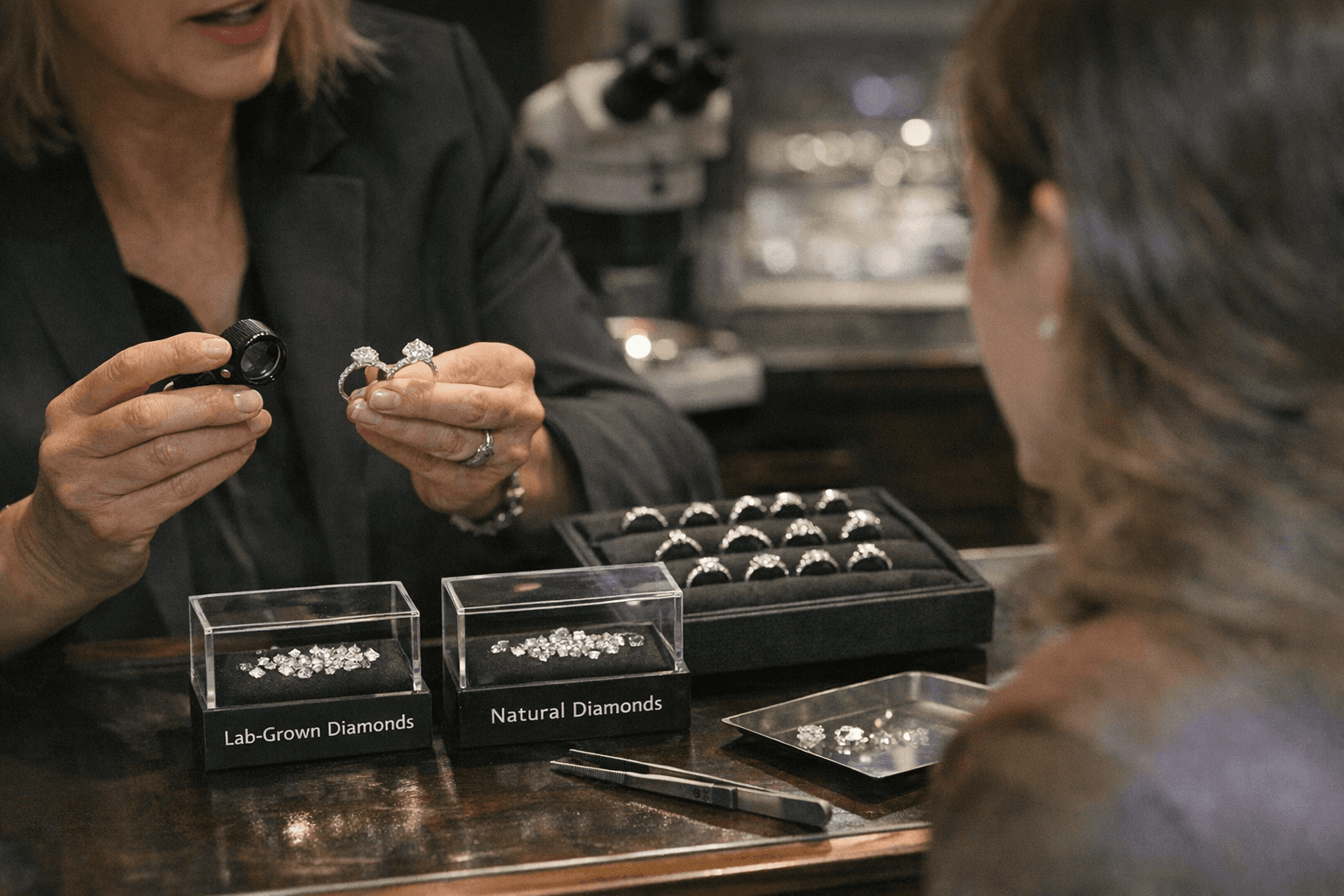
The Federal Trade Commission revised its Jewelry Guides this week, tightening the language around how retailers must identify and disclose lab-grown diamonds to consumers at every point of contact, from in-store signage to digital marketing copy.
The updated Guides, which took effect March 19, center on a single, non-negotiable principle: disclosure must be unambiguous and conspicuous. That means a small-print footnote buried in an online product description, or a casual verbal mention at the sales counter, no longer clears the bar. The FTC's revised expectations place the burden squarely on retailers to ensure that a customer cannot reasonably mistake a lab-grown diamond for a mined one.
The distinction matters more now than it did even five years ago. Lab-grown diamonds are chemically and optically identical to their mined counterparts, which makes the potential for consumer confusion genuinely high. A buyer presented with a two-carat round brilliant in a platinum four-prong solitaire has no way to determine its origin by looking at it, touching it, or even subjecting it to standard gemological testing without specialized equipment. The FTC's update acknowledges that reality and responds to it with regulatory clarity.
For the trade, the revised Guides signal that the commission is paying attention to how lab-grown inventory is being marketed, particularly as the category has expanded rapidly and price differentials between lab-grown and mined diamonds have widened significantly. Retailers who have leaned on softened language, describing a stone as "created" or "grown" without leading with the word "laboratory-grown" or "lab-grown," may now find themselves outside compliance.
The practical effect reaches across every format where jewelry is sold: e-commerce product pages, printed catalogs, social media advertisements, and the physical tags attached to pieces in a display case. Disclosure must meet the conspicuous standard in each context individually. A compliant website listing does not excuse a vague in-store presentation of the same piece.
The FTC's Jewelry Guides are not statutes, but they carry significant weight as the agency's authoritative statement of what constitutes fair and non-deceptive trade practice in the industry. Retailers who operate outside them risk FTC enforcement action. The updated Guides arrive at a moment when the lab-grown diamond category is no longer a niche; it is a structural part of the market, and the commission is treating it accordingly.
This article was produced by Prism’s automated news system from verified source data, official records, and press releases, then run through automated quality and moderation checks before publishing. The system is built and supervised by the people who set the standards it runs under. Read our full AI policy.
Did this article answer your question?