Geneva Auction: Napoleon's Waterloo Brooch and Mellon Blue Diamond Fetch Millions
Napoleon's Waterloo brooch sold for 22 times its Sotheby's estimate at Geneva's November 2025 auctions; Christie's Mellon Blue fetched $25.5 million.
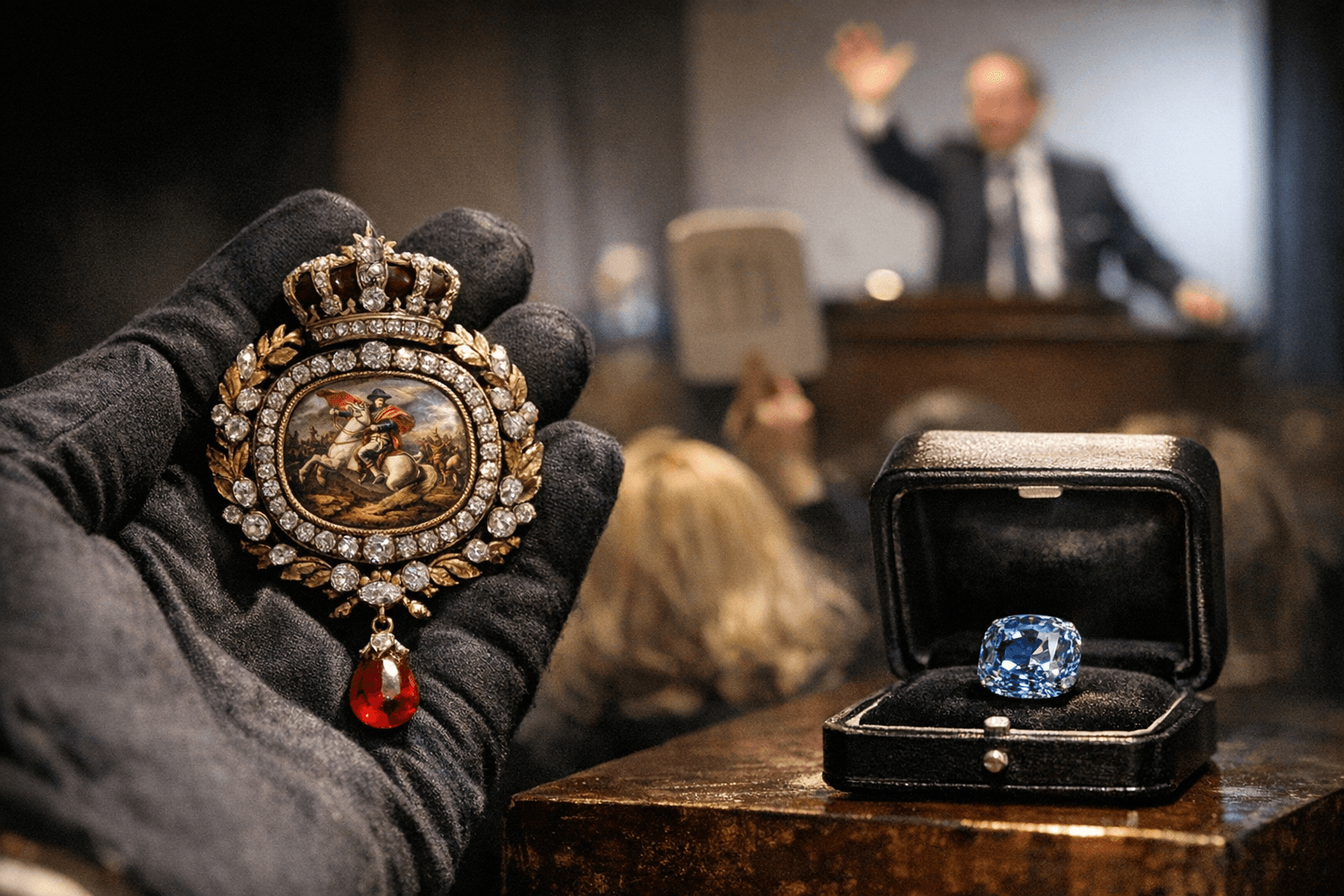
The lot was catalogued with the measured language Sotheby's reserves for its most serious offerings: "Historically Important and Highly Significant Diamond Brooch/Pendant." What those words contained was wearable mythology. A brooch-pendant centered on a 13.04-carat oval diamond, the piece had reportedly ridden in Napoleon I's carriage as his forces fled Waterloo in 1815, and Sotheby's had traced its subsequent history to the Hohenzollern collection. The house estimated it at CHF 120,000 to CHF 200,000. Geneva's November 2025 bidders answered with something else entirely.
The brooch sold for more than CHF 3.5 million, approximately $4.4 million, a figure representing roughly 22 times Sotheby's high presale estimate. That result transformed a historical curiosity into one of the defining moments of Geneva's jewelry sales season and confirmed something dealers and collectors have long maintained: provenance, timing, and story shape the fiercest bidding at the very top of the market. Rarity alone is not sufficient. A compelling stone without a compelling story cannot command the same room.
The design itself rewards close reading, and a stylist standing in any Geneva viewing room would have read it immediately. An oval diamond of 13.04 carats, mounted to function as both brooch and pendant, is an architectural decision about how a single stone occupies space on the body. The oval cut's elongated faceting maximizes brilliance through a silhouette that flatters every neckline it approaches, and the double-wear format, high on the chest as a brooch or suspended at the décolletage as a pendant, is precisely the versatility that makes one transformative piece more useful than a full matched suite. This is exactly how major red-carpet looks are constructed today: one extraordinary stone, worn at the apex of the body's visual field, doing everything without competition. The stylist's instinct and the Napoleonic courtier's instinct, it turns out, are the same.
When that stone also carries a story verifiable to 1815, the provenance becomes an amplifier. A piece that survived the retreat from Waterloo does not merely sit at a neckline. It anchors the entire narrative of an outfit. That quality, the sense that a jewel is carrying freight beyond its gemological specifications, separates auction-category jewelry from fine retail. It is also what drove the Napoleon brooch from a CHF 200,000 ceiling to a result more than seventeen times that figure.
Christie's Mellon Blue arrived at the season with different credentials and delivered a correspondingly different number. The 9.51-carat fancy vivid blue diamond sold for CHF 20.525 million, approximately $25.6 million, confirming collector appetite for historically significant colored stones at the apex of the grading scale. "Fancy vivid" is not a marketing phrase. It is the GIA's designation for the highest saturation tier in colored diamond grading, and it applies to a vanishingly small share of colored stones recovered from the earth each year. Blue diamonds owe their color to trace amounts of boron absorbed during formation, which means every fancy vivid blue represents a geological accident of the rarest possible order.
The Mellon Blue's result carries a specific visual message for the direction of jewelry styling. Deep, saturated color, held in a clean setting without distraction, worn against a neutral background, is among the most arresting combinations available to a stylist at any level of the market. Glass Almanac described the result as strong, a characterization the CHF 20.525 million figure fully supports.
The oval and the vivid blue together defined the appetite of Geneva's season, and they reflect a preference that has been building in high jewelry for several collections: singular chromatic statements over matched suites, one stone that reads from across a room over several that compete for attention. For a stylist assembling a red-carpet look, both Geneva lots offer the same directive in different keys. The Napoleon brooch's oval at the collarbone, suspended on a minimal chain, is a look in itself. The Mellon Blue's philosophy, one stone of maximum depth against a clean ground, translates to a single substantial colored stone at the ear or throat achieving what no coordinated suite of smaller stones could replicate. The houses most attentive to auction results consistently translate what the top of the market produces into the wearable vocabulary of the following season.
The season's other storylines were briefer but pointed. The Gleitze Rolex confirmed that provenance commands a premium across categories, a principle the brooch result had already established in diamonds. The Glowing Rose never made it to the hammer at all, withdrawn before bidding opened, a reminder that at this level, even a glittering lot carries no guarantee of reaching the block. Some headline lots performed unevenly against prior benchmarks, evidence that caratage and beauty are necessary but not sufficient conditions for a top result.
What the Geneva results mean if you are buying diamonds now
The November 2025 sales should recalibrate how you think about diamond value at every price point. The 22-times estimate result for Napoleon's brooch was not a function of caratage alone. It was three things working in concert: a verifiable historical narrative, an independent institutional attribution from Sotheby's, and a cut that delivers beauty in proportion to its weight. Each of those elements has an accessible equivalent.
Before you spend a dollar on a diamond, understand the oval cut's specific advantage. Its elongated facet pattern creates apparent size beyond what the same weight produces in a round brilliant. A well-proportioned oval, typically with a length-to-width ratio between 1.3 and 1.5, reads larger than a round stone of equivalent carat weight and delivers exceptional light performance. That is the same geometry that helped a hat ornament from a defeated emperor command $4.4 million in a Geneva salesroom. At accessible price points, it means more visual impact per dollar spent.
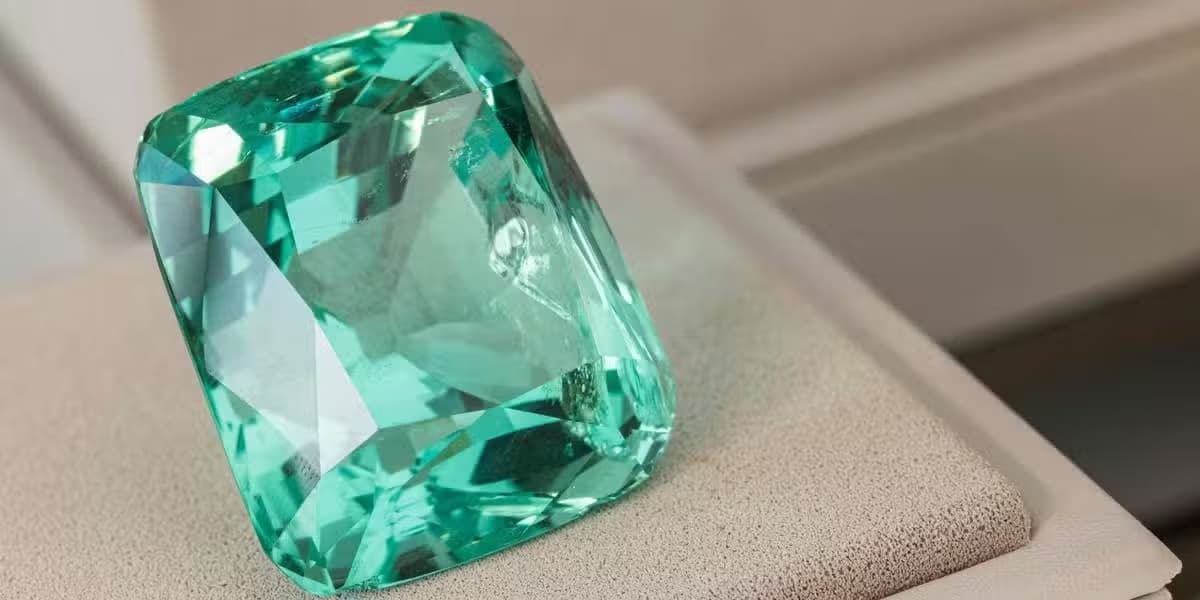
For those drawn to the chromatic confidence the Mellon Blue exemplified, understanding the GIA color grading scale before shopping matters considerably. "Fancy vivid" sits at the absolute apex, and prices scale exponentially with saturation at that tier. Near-colorless whites in the D-to-F range offer maximum brilliance without the rarity premium. Natural sapphires, certified by GIA or Gübelin, deliver saturated blue at dramatically lower price points than fancy colored diamonds, and the market for well-documented natural colored stones rewards provenance in precisely the same way the diamond market does.
Two principles from Geneva translate to every budget. Certification from a recognized independent laboratory is non-negotiable: GIA and AGS grading reports carry lot numbers verifiable directly on the issuing laboratory's website, and no seller with a legitimate stone should resist providing one. Provenance documentation, even for modestly priced estate pieces, adds measurable value at every level. A brooch with original receipts and period hallmarks, a ring with a traceable maker's attribution: these are the small proofs that separate a beautiful object from one with a story. Geneva's November 2025 season made that case across tens of millions in Swiss francs. The story is always part of the stone's weight.
This article was produced by Prism’s automated news system from verified source data, official records, and press releases, then run through automated quality and moderation checks before publishing. The system is built and supervised by the people who set the standards it runs under. Read our full AI policy.
Did this article answer your question?