Jewelry shoppers value trust and price over traceability tools
Shoppers may not ask for blockchain at the counter, but they do ask for trust, proof, and a price that feels earned.

The diamond sale still hinges on the oldest luxury instincts: trust the seller, believe the stone, and feel the price is justified. Traceability matters most when it stops sounding like a tech feature and starts answering the buyer’s quiet questions about where a diamond came from, who handled it, and why it is worth the number on the tag.
What closes the sale at the counter
The retail reality is less glamorous than the industry’s traceability pitch. Many jewelers say customers are not walking in asking for blockchain records or digital passports; they are asking whether the diamond is beautiful, whether the price makes sense, and whether the seller seems straight with them. Younger buyers do ask more often about provenance, but the broad point remains the same: honest conversation tends to do more work than a flashy tracking tool.
That is the tension running through the category. A diamond can be fully traceable and still fail to reassure if the explanation is vague. A salesperson who can translate provenance into quality assurance, consistent sourcing, and a clear price story will usually do more for trust than a buzzword-laden app ever will.
The numbers say provenance is gaining ground, but not evenly
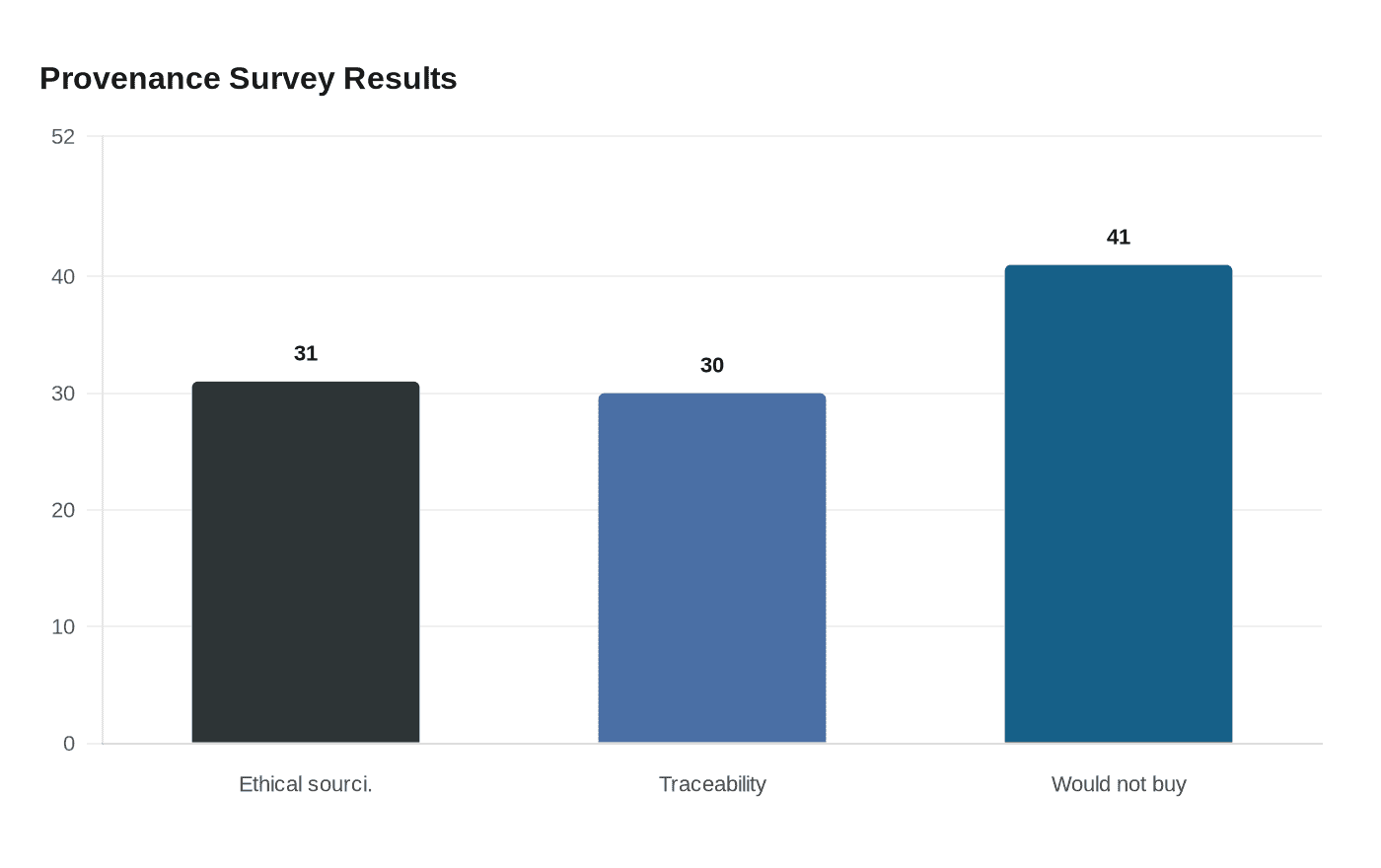
A 2025 Plumb Club survey of 2,000 U.S. consumers ages 25 to 60, all with household incomes of at least $75,000, shows the market is not indifferent. In that group, 31% said ethical sourcing was important, and 30% said origin traceability was important, up 8 percentage points from the same group’s 2023 survey. That is not universal demand, but it is a meaningful signal from an affluent audience that can afford to care.
The same survey also found that 41% of respondents were unlikely to buy a product if they could not confirm it was responsibly sourced. Almost half said they would pay “a lot more” or “a great deal more” for ethically sourced, traceable jewelry. Those are exactly the kinds of numbers that should make jewelers treat provenance as a selling tool, not a decorative extra.
Traceability tools only matter when they prove something
De Beers has tried to make traceability concrete through Tracr, the blockchain platform it launched in 2018. By 2024, De Beers said more than 3 million diamonds had been registered at source on the platform, and a later update said that figure had passed 4 million. That kind of scale matters because it suggests traceability is no longer a pilot project or a marketing experiment; it is part of how some stones are being documented through the supply chain.
De Beers also said Tracr was being used to list a single country of origin for newly registered De Beers-sourced diamonds over 0.5 carats in polished size, in line with new G7 import requirements. That is a practical shift, not just a brand statement. For a customer, a named country of origin can carry more weight than a generic promise of responsibility because it turns an abstract claim into something specific enough to verify.
Code of Origin goes one step further
There is also a more consumer-facing layer. Rapaport has reported that De Beers’ Code of Origin is etched onto diamonds of 0.3 carat and larger, allowing buyers to download a full report on the diamond’s journey and the associated social and environmental impacts. That is the kind of tool that can work in a store, because it gives the salesperson a concrete artifact to explain rather than a vague commitment to transparency.
The difference between a traceability system and a sales tool is clarity. If the buyer can see serial numbers, a documented path, and a defined country of origin, provenance starts to feel like part of the stone’s value. If the language stays broad, the promise can sound a lot like greenwashing in a nicer font.
Why the debate got louder now
Sanctions on Russian diamonds have sharpened the demand for proof of origin. When supply chains become politically sensitive, shoppers and retailers alike start asking harder questions about what can actually be verified. That has pushed provenance from an ethical talking point into a practical one.
It also matters that the trade is global in very specific ways. India remains the main cutting center for natural diamonds, while the United States remains the largest end-market for diamond jewelry. That split makes the journey from rough to polished especially important: the farther a stone travels, the more a buyer may want assurance that the story behind it is clean, coherent, and not just creatively marketed.
Industry voices are shifting from claims to evidence
The language from suppliers has changed too. Feriel Zerouki has framed the consumer shift as moving from “tell me” to “show me,” and Rajiv Mehta has said traceability is now unavoidable. Those are not just slogans; they reflect a trade that knows shoppers may not arrive asking for a certificate, but they do want a reason to believe the seller.
At the 2025 Rapaport Breakfast at JCK, jeweler Aleah Arundale said U.S. customers are never asked where a diamond is from. Rob Bates countered that a lack of questions does not mean a lack of interest, pointing to Brilliant Earth’s business model as evidence that origin can matter in the market. Together, those positions capture the heart of the issue: provenance can influence buying behavior even when it is not the first thing a customer voices aloud.
How jewelers should translate provenance into trust
The best retail pitch for traceability is not technical. It is practical, specific, and tied to the case in front of the customer.
- Name the origin clearly when it is known, instead of hiding behind broad language like “responsibly sourced.”
- Explain what the tool actually proves, whether that is a registered source, a country of origin, or a full journey report.
- Connect provenance to quality assurance, for example, a more documented chain of custody and clearer accountability.
- Use price honestly. If traceability helps justify a premium, say why the premium exists.
- Avoid turning every traceability claim into a virtue signal. A vague sustainability story is weaker than a plain, verifiable one.
The diamond counter does not need more jargon. It needs better translation. When provenance is presented as proof, not performance, it can help close the sale, support the price, and give the buyer something sturdier than a polished slogan to believe in.
This article was produced by Prism’s automated news system from verified source data, official records, and press releases, then run through automated quality and moderation checks before publishing. The system is built and supervised by the people who set the standards it runs under. Read our full AI policy.
Did this article answer your question?