May 2026 diamond price tracker shows falling lab-grown values
May’s fixed-basket tracker exposes the real spread in diamond pricing: lab-grown stones are sliding, but retailer premiums still vary wildly from one basket to the next.

What the May tracker really tells you
The most useful thing in May’s diamond tracker is not a single price, but the distance between one retailer’s list price and another’s. For a 1.00-carat round, G color, VS1 clarity, Excellent-cut natural diamond, the tracker shows $5,200 at Rare Carat and $7,400 at Whiteflash; the same spec in lab-grown form runs from $880 to $1,800, while a 2.00-carat oval, F-color, VS1 lab-grown stone spans $1,850 to $3,400. That is the market in miniature: not a clean sticker price, but a wide corridor of pricing power, brand premium, and inventory strategy.
How the fixed basket makes price transparency visible
The Carat Cut’s tracker is built to compare like with like. It samples a fixed basket of diamond specifications across major online retailers, records advertised list prices in U.S. dollars before promo codes, and leaves gaps where a retailer has no in-stock match rather than substituting a softer comparison. That matters because the same carat weight can mean very different things once cut, color, clarity, and seller markup enter the picture. In this snapshot, the natural 1-carat round carries a 42% spread, while the lab-grown 1-carat round spreads by 105%, which is exactly why a transparent benchmark is more useful than a generic price chart.
Why lab-grown pricing carries so much weight now
This tracker lands in a market where lab-grown center stones are no longer a side story. The Knot Worldwide’s 2026 Real Weddings Study found that lab-grown center stones accounted for 61% of all U.S. engagement ring purchases among couples married in 2025, up 239% since 2020, and nearly 9 in 10 proposers had a ring in hand. JCK added the detail that the study surveyed more than 10,000 U.S. couples married between January 1 and December 31, 2025, which gives the shift real scale: the dominant engagement-ring category is now the one whose price is moving fastest.
The shape of that demand is visible too. JCK reported that the move toward lab-grown stones has coincided with larger average center stones, 1.9 carats, and lower average spend, $4,600, a combination that explains why buyers keep gravitating to lab-grown when they want a bigger visual presence without crossing into natural-diamond budgets. For shoppers, that means the lab-grown market is not just cheaper, it is also the category where size and value are being renegotiated in real time.
Which specs are under the most pressure
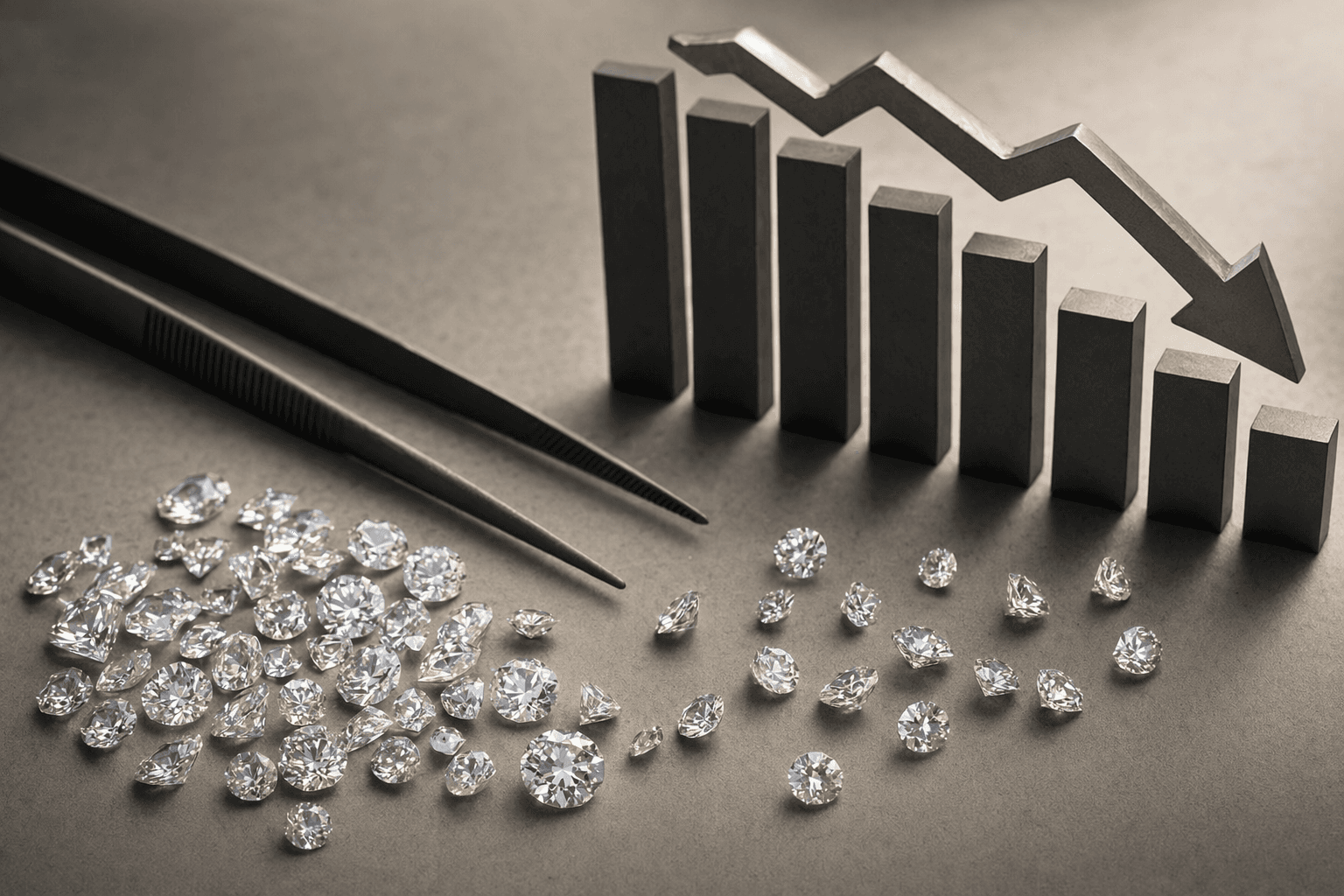
The steepest price pressure is still at the larger end of the lab-grown market. JCK reported that wholesale lab-grown diamond prices fell 14% in the first quarter of 2026, and that 3-carat round stones dropped 28%, compared with a 15% decline for 1-carat rounds. That gap matters because the larger stone once delivered the richest margins and the most visible premium; now it is the segment most exposed to price compression.
For shoppers, the implication is simple: if you are considering a lab-grown center stone, the biggest bargaining power sits in larger rounds and other statement sizes, not in the tiny diamonds that already sit close to commodity pricing. The May basket’s 2-carat oval lab-grown example reinforces that point, with a range wide enough to make retailer choice almost as important as stone quality itself.
What natural diamonds are doing in the background
The mined side of the market is under pressure too, but in a different register. De Beers said rough diamond trading conditions remained challenged throughout 2025 and early 2026 amid industry, geopolitical, and tariff uncertainty, and it revised 2026 production guidance to 21 to 26 million carats from 26 to 29 million. That is not the behavior of a market flooding the channel with excess supply; it is the behavior of a producer trimming output in response to demand strain and trade friction.
De Beers also announced in 2025 that it intended to close Lightbox, its lab-grown jewelry brand, reinforcing a strategic commitment to natural diamonds even as it says it still produces around a third of the world’s rough diamonds. The company’s own U.S. materials have long framed lab-grown growth as a real challenge to natural-diamond demand, and the current numbers show why that message still matters.
How to read the retailer spread before you buy
The tracker is especially useful because it shows how different retailers price the same visual promise. Rare Carat sits at the low end of the basket, while Blue Nile and James Allen are consistently higher; Brilliant Earth carries a clear brand premium, and Whiteflash pushes natural stones even higher with its super-ideal-cut positioning. In lab-grown, Vrai’s single-source CVD approach appears to command a premium rather than a discount, which is a reminder that origin story and merchandising can matter almost as much as the stone itself.
That is the practical takeaway for anyone comparing rings online: do not compare a branded ring against a marketplace stone and assume the difference is only marketing. Compare the exact basket, the exact shape, and the exact quality grades, then decide whether you are paying for a cut specialist, a label, or a better underlying diamond. In this market, transparency is not a slogan; it is the only way to tell whether a higher list price reflects craftsmanship or just a stronger margin.
Buy now or wait?
If you want lab-grown, the numbers still favor patience in larger sizes. Wholesale pressure remains downward, and the biggest stones are still repricing most aggressively, which means today’s “good deal” can look ordinary very quickly in a category that behaves more like fast-moving consumer tech than heirloom scarcity. If you want natural, waiting for a dramatic markdown is a weaker strategy; the better move is to shop the exact make of the stone and use the tracker to identify where one retailer’s premium is justified and where it is simply inflated.
The market has split into two different value systems: lab-grown, where size is still becoming cheaper, and natural, where rarity, supply discipline, and brand positioning still support a more resistant price structure. May’s tracker does not tell you to rush or hold back, but it does make one thing unmistakable: the smartest diamond buyer now shops with a ruler, a loupe, and a spreadsheet mentality all at once.
Know something we missed? Have a correction or additional information?
Submit a Tip